Most people who struggle with procrastination have already heard the productivity advice. They know the tricks. What they have not been given is an honest account of what is actually happening when they delay, and why the same strategies keep failing. Procrastination is not a time-management problem. The research has shifted on this, and so has our understanding of what it takes to actually move. This piece covers the real mechanism behind chronic delay, the several distinct patterns that drive it, and where to go if you recognize yourself in one of them.
What the End of Life Taught Me About Procrastination
I spent over two decades as a hospice chaplain. In that time, I sat with hundreds of people in the last weeks and days of their lives, and I listened to what they carried. Regret comes up often in conversations about dying, but the specific shape of it surprised me early on and never stopped surprising me. Almost no one regretted the things they had been too lazy to do. What came up, over and over, was a different kind of loss: the things they kept telling themselves they would get to.
The difference matters. Laziness and procrastination are not the same thing, and people near the end of their lives seem to understand this intuitively even if they never used the word. A person who is lazy about something does not particularly want to do it. A person who procrastinates often wants very much to do it. They can picture finishing it. They have thought about it more times than they can count. They just cannot seem to start. That gap, between wanting and starting, is what this is about.
When someone in those rooms told me they wished they had written to a sibling, or started the work that mattered to them, or said the thing before it was too late, they were rarely describing a failure of desire. They were describing a failure of motion. That distinction is worth holding onto before anything else is said about procrastination, because most of the advice that exists misses it entirely.
It Is Not About Time. It Never Was.
The research consensus has shifted significantly in the last two decades. Procrastination, particularly the chronic kind that affects roughly 15 to 20 percent of adults according to Piers Steel’s comprehensive 2007 meta-analysis in the Psychological Bulletin, is no longer understood primarily as a time-management failure. It is better understood as a mood-regulation problem. The person delays not because they cannot organize their schedule but because beginning the task produces a feeling they want to escape, and delay, at least in the short term, relieves that feeling.
This reframe is important because it explains why every time-management system eventually stops working for a chronic procrastinator. You can block time, make lists, set timers, and none of it addresses the actual mechanism. The task still carries whatever feeling is attached to it. The system gives you a slot for the task, but the slot does not change what starting the task feels like.
Researchers Fuschia Sirois and Tim Pychyl, who have studied procrastination extensively, have both emphasized that the avoidance is primarily emotional. The negative feeling attached to a task, whether that is anxiety, boredom, self-doubt, resentment, or the specific kind of dread that comes before something that feels high-stakes, is what gets regulated away through delay. The relief is real. The cost is deferred, and it compounds. Most people caught in this pattern know the cost intellectually and delay anyway. That is not a character flaw. It is the nature of short-term emotional relief working exactly as it is designed to work.
Procrastinating has less to do with time management and more to do with mood management.
This also explains why harsh self-judgment tends to make procrastination worse rather than better. If the mechanism is mood regulation, then feeling terrible about your delay generates another negative feeling that also needs to be regulated away. The cycle feeds itself. I have watched people spend years doing this without understanding what they were doing, and I doubt the lack of understanding helped them.
It also explains why waiting for motivation to arrive before starting is a losing strategy. The assumption buried inside most productivity advice is that the right feeling comes first and action follows. For most people dealing with chronic avoidance, it is the other way around. Motivation tends to arrive after starting, not before. The person who cannot bring themselves to make the phone call they have been dreading for three weeks is not short on desire. They are waiting for something that is not going to show up until they pick up the phone. That sequencing matters. Knowing it does not make starting easy, but it removes one reason to keep waiting.
Why Generic Advice Keeps Failing: The Patterns Are Not All the Same
Here is what the productivity content almost universally gets wrong. It treats procrastination as a single thing with a single fix. In reality, the research identifies several genuinely distinct patterns behind delay, each with a different driver and a different response. Telling someone who is avoiding a task because of fear of failure to “just break it into smaller steps” is not wrong, exactly, but it is not aimed at anything. The smaller steps still carry the fear.
The person who delays because they are waiting for the conditions to be perfect is in a different situation than the person who puts things off because they are overwhelmed and cannot locate a starting point. The person who avoids tasks they actually want to do is carrying something different again from the person who leaves everything to the last minute specifically because the deadline creates the pressure they need to move. Treating these as the same problem produces advice that lands for some people and means nothing to others, which is why so many readers of productivity content end up feeling like the advice works for everyone but them.
- Not knowing why you procrastinate at all is itself a pattern. Many people have been delaying things for so long they have stopped questioning it. They assume it is a personal failing rather than something with a specific shape that can be examined. If you are not sure what is actually driving your avoidance, that is the place to start.
- General task avoidance is the broadest category, and often the one that responds best to understanding the mood-regulation mechanism. Once the emotional function of delay is visible, it becomes possible to work with it rather than simply trying to muscle past it.
- Perfectionism is one of the most commonly misunderstood drivers. It is almost always framed as an excess of high standards, but the delay often has more to do with avoiding the discomfort of a result that falls short of an internal image. Not starting protects you from finding out you cannot do it as well as you believe you could.
- Last-minute patterns are their own category. Some people have learned that the pressure of an approaching deadline is the only reliable mechanism that moves them. The delay is, in a functional sense, the system working. That does not mean it is cost-free.
- Avoiding things you actually want to do is one of the most disorienting patterns, and one of the least discussed. The task is not aversive. The person genuinely wants to complete it. What drives the delay here is usually something else: fear of what finishing means, uncertainty about how to begin something that matters, or the peculiar way that wanting something badly can make starting it feel more threatening, not less.
- Fear of failure runs underneath more of these patterns than most people realize. It rarely announces itself clearly. It tends to present as vague resistance, as distraction, as suddenly finding other things that need doing.
- Productive procrastination, the kind where you stay busy with other tasks while avoiding the one that matters, deserves its own examination. It can look from the outside like industriousness. The person completing it does not feel like they are procrastinating. But the one task that needed doing has still not been touched.
- The feeling of failure that procrastination produces is worth addressing directly, separate from the behavior itself. The shame around chronic delay can become its own obstacle, and it tends to be tackled last when it probably deserves to be addressed first.
Recognizing which pattern is actually operating in your life is more useful than any system for managing time. The intervention has to be aimed at the right thing or it will not reach it.
What I Noticed Across Twenty Years
There is a pattern I saw often enough to stop calling it a coincidence. When people near the end of life talked about the things they had kept putting off, they almost never described the delay as deliberate. They described it as something that happened while they were doing other things. The life continued. The thing stayed undone. At some point the window closed. What struck me was how rarely they had made a conscious choice to not do it. They had simply not made a conscious choice to do it, and the two outcomes ended up looking identical.
I sat with enough families in those rooms to recognize a related pattern on the other side of it. The adult children, the spouses, the siblings who were present at the end, many of them were carrying their own versions of the same thing. Tasks left. Conversations not started. They were watching the cost of delay made visible in the person they were sitting with, and some of them were quietly taking stock of their own lists.
What I also noticed, in conversation after conversation, is that the people who had learned to move despite resistance were rarely the ones who had found a better system. They were the ones who had gotten clearer on what the resistance was made of. Not by analyzing it endlessly, but by looking at it honestly enough to stop being surprised by it. That clarity is available to most people. It does not require extraordinary willpower. It requires the kind of honest accounting that most productivity advice never actually gets to. Knowing which of the patterns below fits your situation is a reasonable place to begin that accounting.
Find the Pattern That Fits Your Situation
The nine pieces below each address a specific pattern. They are not steps in a sequence and they do not all apply to everyone. The point is to find the one that matches what you are actually dealing with, because a specific answer aimed at the right thing will do more than a general one aimed at everything and landing on nothing. If you are not sure where to start, the first two in the table below are probably the most broadly applicable.
| Pattern | What it covers |
|---|---|
| Why do I procrastinate? | The underlying mechanism of delay for people who have never examined it clearly. |
| How to stop procrastinating | Practical approaches that work with the emotional mechanism rather than trying to override it. |
| Procrastination vs. laziness | Why confusing the two makes both harder to address, and how to tell the difference in your own situation. |
| Why perfectionists procrastinate | How high standards produce delay rather than preventing it, and what is actually being avoided. |
| Why I leave everything to the last minute | The deadline-pressure pattern: what drives it, and whether it is actually working for you. |
| Why I procrastinate on things I want to do | The specific, disorienting experience of avoiding tasks that genuinely matter to you. |
| Is productive procrastination actually productive? | What is really happening when you stay busy with everything except the thing that needs doing. |
| Procrastination and fear of failure | How the fear of a bad outcome quietly drives avoidance, even when it is not visible as fear. |
| Why procrastination makes you feel like a failure | The shame spiral that forms around chronic delay, and how to address it separately from the behavior itself. |
Most people who have been procrastinating for a long time are carrying more than one of these patterns at once. That is common. Start with the one that feels most familiar and go from there. The clarity tends to build once you have named even one part of it accurately.
Final Thoughts: What Naming It Actually Does
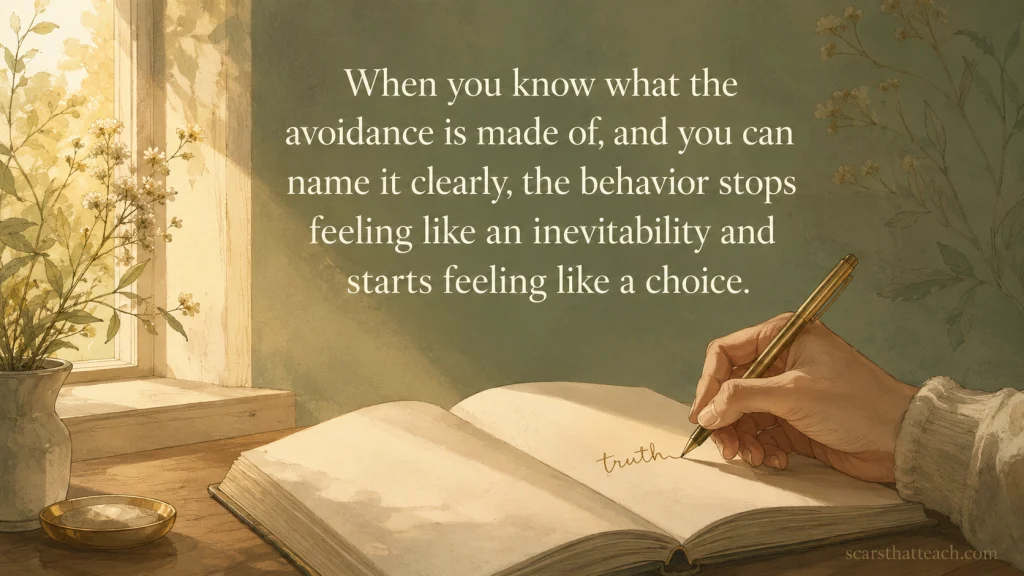
I want to be honest about what understanding procrastination can and cannot do. It does not dissolve the resistance. It does not make the hard task easy. What it can do, when the framing is right, is interrupt the automatic quality of the delay. When you know what the avoidance is made of, and you can name it clearly, the behavior stops feeling like an inevitability and starts feeling like a choice. That is not nothing. It is, in my experience watching people work through difficult things, often the beginning of a different kind of movement.
There is also something worth saying about timing. Most people who struggle with chronic procrastination spent years, sometimes decades, under the impression that they simply lacked willpower or discipline. They tried solutions aimed at that problem and found that the solutions did not work. The fact that the real mechanism was something different, mood regulation rather than laziness, was not available to them when they needed it. If you are reading this late, having carried this for longer than you would have chosen to, that is not a reason for another layer of self-judgment. The lesson still applies whenever it arrives. That is true of most things. It is certainly true of this.
For more on the broader territory this sits within, including the relationship between self-discipline, habits, and the other patterns that shape how we act on what we care about, the self-discipline and growth collection is a reasonable place to continue.
FAQs
🤔 Why do I procrastinate even when I really want to do something?
Wanting to do something and being able to start it are not the same thing. When avoidance is driven by anxiety, self-doubt, or fear of the result, it can attach to the tasks that matter most precisely because the stakes feel highest. The desire is real. So is the resistance. They are not contradictions; they are operating in parallel.
⏰ Is procrastination just bad time management?
The research no longer supports that framing. Chronic procrastination is better understood as a mood-regulation pattern: delay temporarily relieves the negative feeling attached to beginning a task. Time-management systems do not address that mechanism, which is why they tend to help initially and then stop working.
😔 Why does procrastinating make me feel so bad about myself?
The shame that follows delay is often more painful than the task that was avoided. It also tends to generate the same kind of bad feeling that produces the next delay. Understanding that procrastination is an emotional pattern rather than a character defect does not immediately stop the shame, but it does remove one layer of false evidence that you are fundamentally failing.
🔄 Why do I keep procrastinating even though I know it hurts me?
Because the relief from avoiding is immediate and real, while the cost accumulates quietly in the background. That is not irrationality. That is the way short-term emotional relief works in competition with long-term consequences. Knowing the cost does not automatically change the calculation. Changing the emotional texture of starting is a more direct route than telling yourself you know better.
📋 What is the difference between procrastination and laziness?
Laziness is an absence of desire. Procrastination is usually the opposite: the person wants to do the thing, or knows they need to, and still cannot move toward it. Treating them as the same problem produces solutions aimed at motivation that miss what is actually happening, which is avoidance of a specific feeling rather than a general lack of care.
💡 How do I figure out why I procrastinate specifically?
Look at what you are actually avoiding when you delay. Not the task itself, but what the task makes you feel. Boredom, anxiety, self-doubt, fear of a result that falls short, resentment toward the task or the person who assigned it, all of these produce delay but require different responses. The pattern that fits your situation is worth identifying before you try to address it.