
Why procrastination makes you feel like a failure has less to do with the delay itself and more to do with what you do to yourself afterward. Most people respond to procrastinating by being harsh with themselves, assuming the shame will push them to do better next time. Research on this points the other way: self-criticism after procrastinating tends to make the next attempt harder, not easier. This piece looks at why that cycle forms and what actually breaks it.
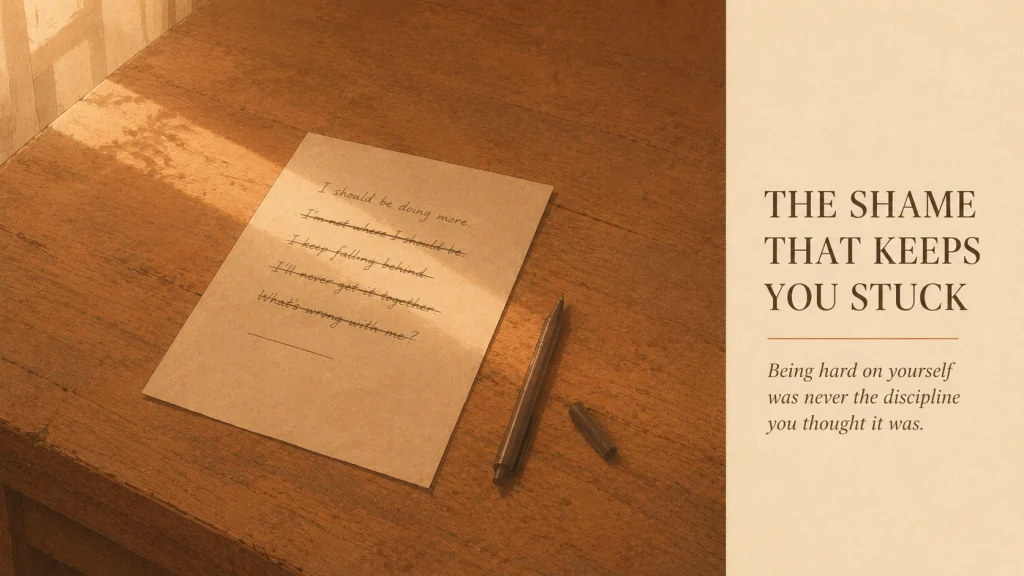
The Shame Comes Before You Even Start Again
I once sat with a man who described, in remarkable detail, every project he had ever started and abandoned. He could tell me the exact month he had stopped, how far he had gotten, and how disappointed he had been in himself each time. What he could not tell me, not once, was what any of those projects had actually been about. The content of his work had disappeared entirely behind how ashamed he felt for not finishing it.
If you are caught in a loop where procrastination makes you feel like a failure, you are not unusual, and you are not lazy in the way that word usually gets used. What is happening underneath is a specific cycle, where the delay itself becomes secondary to the self-criticism that follows it. The shame is not a side effect of putting something off. It is often the thing that keeps the delay going.
The Assumption Almost Everyone Makes About Being Hard on Themselves
Most people who procrastinate respond to it the same way: they get harsh with themselves, assume the harshness will function as motivation, and expect to do better next time as a result. Researcher Fuschia Sirois, who studies procrastination at the University of Sheffield, has described this as close to a universal response, and also a mistaken one. The logic feels sound on the surface. Being disappointed in yourself seems like the responsible reaction to falling short, the kind of accountability that should, in theory, push you to act differently.
What I noticed, listening to people work through this same pattern in very different circumstances, is that the harshness rarely produces the discipline it is supposed to produce. Instead, it produces dread. The task itself becomes tangled up with the memory of feeling like a failure the last time you approached it, and avoiding the task becomes, in a strange way, easier than facing both the work and the shame attached to it.
The harder you are on yourself for procrastinating, the more reasons your mind finds to avoid the thing you are ashamed of not doing.
What the Research Actually Found
Sirois’s work points to something specific: procrastinators tend to be lower in self-compassion, and the self-criticism that follows a missed deadline generates more negative emotion attached to the task itself, not less. That negative emotion is exactly what makes the task harder to approach the next time around. The cycle is not procrastination causing shame and shame fixing the problem. It is procrastination causing shame, and shame making the next attempt at the task feel worse, which increases the odds of delaying it again.
A separate line of research, a 2010 study by Wohl, Pychyl, and Bennett, looked at students and exam preparation specifically. Students who forgave themselves for procrastinating on one exam went on to procrastinate significantly less on the exam that followed. Students who held onto the self-criticism instead showed no improvement at all. The difference was not willpower. It was whether they had let themselves move past the first failure without continuing to punish themselves for it. That distinction matches what I watched play out in person, in people who had nothing to do with exams or deadlines at all. The ones who eventually moved forward were never the ones who had punished themselves the hardest.
Why This Feels Counterintuitive
This sounds simple until you are the one holding it. Going easier on yourself after procrastinating can feel like letting yourself off the hook, as if self-compassion were the opposite of accountability. It is not. The research suggests the opposite relationship: people who forgave themselves were the ones who actually improved, while the ones holding onto shame stayed stuck exactly where they started.
What People Commonly Get Wrong When They Try to Fix This
The most common mistake is treating the shame as useful information rather than as the obstacle itself. People assume that if they stop feeling bad about procrastinating, they will lose whatever edge keeps them from doing it constantly. Most of the time, the shame was never holding that edge in the first place. It is simply weight, added to a task that already felt hard enough before the self-criticism showed up. For a wider look at how that kind of self-judgment shows up around effort and discipline generally, reflections on what real discipline actually requires cover that ground from a related angle.
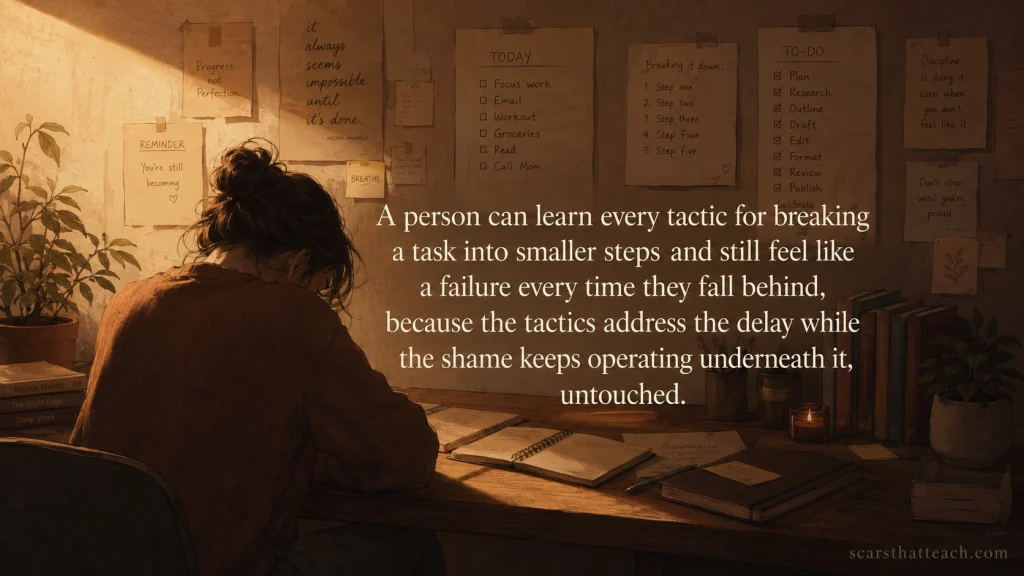
The second mistake is trying to address the shame and the procrastination as if they were the same problem, solvable with the same fix. They are not. A person can learn every tactic for breaking a task into smaller steps and still feel like a failure every time they fall behind, because the tactics address the delay while the shame keeps operating underneath it, untouched.
- You criticize yourself after procrastinating, expecting it to motivate the next attempt.
- You notice the dread around a task growing each time you put it off again.
- You remember past failures on similar tasks more clearly than the task’s actual content.
- You assume self-compassion would mean excusing the procrastination rather than addressing it.
- You feel like a failure as a person, not just someone who is behind on one particular task.
What Actually Helps, Based on What the Research Shows
The most direct thing the research points to is self-forgiveness after the fact, not as a way of excusing the delay, but as a way of clearing the emotional residue that makes the next attempt harder. That does not mean ignoring the pattern or pretending the deadline did not matter. It means separating the fact of having procrastinated from the verdict that you are someone who cannot be trusted with your own time. The first is a single event. The second is a story you keep telling yourself, and it tends to be the story doing the most damage.
In practice, this can look as simple as noticing the self-criticism when it shows up and asking whether it has ever once made the task easier to start. For most people, the honest answer is no. What I watched work, in the people who eventually broke the pattern, was rarely a single dramatic turning point. It was something quieter: a moment where they caught themselves mid-criticism and chose, almost stubbornly, to set the task down and pick it up again later without the running commentary about what their delay said about them. They did not forget that they had been behind. They just stopped treating it as a verdict every single time.
If you are looking for concrete ways to interrupt the delay itself once the shame has loosened its grip, specific approaches to breaking the procrastination habit cover that ground directly, separate from the shame cycle this piece is about.
Final Thoughts: The Shame Was Never the Discipline You Thought It Was
The man who could only describe his abandoned projects in terms of how ashamed he felt had mistaken the shame for accountability for years. It was never doing that work. It was just making the next project harder to start than the one before it. If procrastination has been making you feel like a failure, the way out is rarely more pressure on yourself. It is usually less, applied honestly, without pretending the deadline did not matter. For a wider look at how procrastination shows up in different forms, the broader look at procrastination patterns covers some of that ground from other angles.
FAQs
😞 Why does procrastinating make me feel like such a failure?
The feeling usually comes from treating the delay as proof of who you are, not just something that happened once. That story tends to weigh heavier than the actual task you put off.
🔁 Does being hard on myself after procrastinating actually help next time?
Research on this suggests the opposite. Self-criticism after procrastinating tends to attach more negative emotion to the task, which makes it harder, not easier, to start the next time.
🌱 Isn’t self-compassion just letting myself off the hook?
It does not have to be. Self-compassion separates the fact of procrastinating from a verdict about your character, which research has linked to lower procrastination afterward, not higher.
📚 Is there actual research behind self-forgiveness reducing procrastination?
Yes. A study on students preparing for exams found that those who forgave themselves for procrastinating on one exam procrastinated significantly less on the next one, while those who stayed self-critical showed no improvement.
🧭 How is this different from just learning to stop procrastinating?
Tactics for managing time address the delay itself. This is about the shame that follows the delay, which can keep operating even after someone has learned every tactic available.