What are keystone habits, in plain terms: the small number of habits that, once adopted, quietly shift other unrelated parts of a life without any direct effort aimed at them. Charles Duhigg described the pattern, but most explanations stop at examples like exercise or journaling without saying why those particular habits ripple outward while so many others do not. One of the most consistent mechanisms behind it is identity: a habit that gradually reshapes how you see yourself tends to make other habits feel consistent with that self-image instead of like separate battles. Not every habit that changes, and not every habit that shifts identity, becomes one, which is exactly where most explanations stop looking too soon.

What Are Keystone Habits, and Why This One Question Matters
I watched it happen enough times that I started paying closer attention to the moment right before it. Someone would arrive at a decision so small I could not see how it would change anything, something like getting up fifteen minutes earlier or finally clearing off a kitchen counter, and I would think privately that it would not amount to much. Three months later, the same person would come back changed in ways that had nothing to do with the original decision. A relationship they had been avoiding got a phone call. A habit they had failed to break for years quietly stopped mattering as much. None of it looked connected on the surface.
That is what keystone habits are, at their core: not the biggest or hardest habit someone could pick, but the one that ends up moving other things it was never aimed at. The size of the habit has almost nothing to do with the size of what follows it. That mismatch is exactly why the concept is worth understanding on its own terms, instead of assuming bigger effort always produces bigger change.

Where the Idea Comes From, and What It Actually Describes
Charles Duhigg introduced the term to describe habits that set off a chain reaction into other, unrelated areas of behavior. His observation was that these habits work because they deliver small, consistent wins, and those wins build a kind of internal structure and confidence that other habits can then attach to. A keystone habit does not force anything else to change directly. It creates conditions where change becomes easier to reach for, almost incidentally.
Exercise and journaling are the two examples you will see cited nearly everywhere, and they are accurate as far as they go. They work for a lot of people, which is exactly why they keep getting repeated, not because they are the only habits capable of doing this, or because they work this way for everyone who tries them. Plenty of people exercise consistently for years without it touching any other part of their life. It stays exactly what it is: exercise. Whether a habit becomes a keystone has less to do with which habit it is than with what it happens to connect to in that particular person’s life.
Why Most Habits Stay Exactly What They Are
Most people who try to build a keystone habit on purpose pick something for the wrong reason: it looks disciplined, it sounds impressive, or it is whatever everyone online recommends that season. None of that determines whether a habit ripples outward. A habit stays isolated, doing only what it visibly does and nothing more, when it does not connect to anything the person already cares about, or when it gets treated as one more item on a list rather than something that says anything about who they are becoming.
There are a few signs worth watching for if you want to know whether a habit is actually doing this kind of work, rather than just sitting there as one more thing you do.
- Other, unrelated habits start improving without you deciding to work on them directly.
- You notice yourself describing the habit in terms of who you are, not just what you did that day.
- The habit survives disruption, a bad week, travel, illness, better than habits you have tried to force through willpower alone.
- You feel a mild resistance to skipping it that has nothing to do with the practical cost of skipping it.
It is also worth saying plainly that a keystone habit is not a title a person earns once and keeps forever, and it is not a single slot a life has room for only one of. Some people carry more than one at a time, often without noticing that both are doing the same kind of quiet work. Others go through long stretches with none, which is not a failure so much as a sign that nothing currently in their routine has connected to anything larger yet.
One Mechanism Worth Understanding: Identity
Most confirmed patterns on this topic repeat the same short list of examples without explaining why some habits ripple outward while so many others do not. One important mechanism behind a lot of that spillover is identity. When a habit gradually reshapes how someone sees themselves, unrelated good habits stop requiring their own separate motivation. They start feeling like something a person like that would naturally do.
That distinction changes what you should actually be looking for. The question is not “which habit is hardest” or “which habit gets the most attention online.” It is closer to: which small, repeatable action, if I kept it, would quietly change how I think of myself. That answer lands differently for different people, which is exactly why one habit that changes everything for one person does nothing for another.
- A habit that is easy enough to keep consistently, since consistency is what gives it room to matter, not the difficulty of any single instance.
- A habit that touches a part of self-image the person already cares about, rather than one chosen because it looks impressive from the outside.
- A habit small enough to survive a bad day, since one that collapses under stress never gets the chance to connect to anything.
- A habit that produces a small, noticeable win quickly, since that early confidence is often what carries it forward.
What I Watched This Look Like in Real Rooms
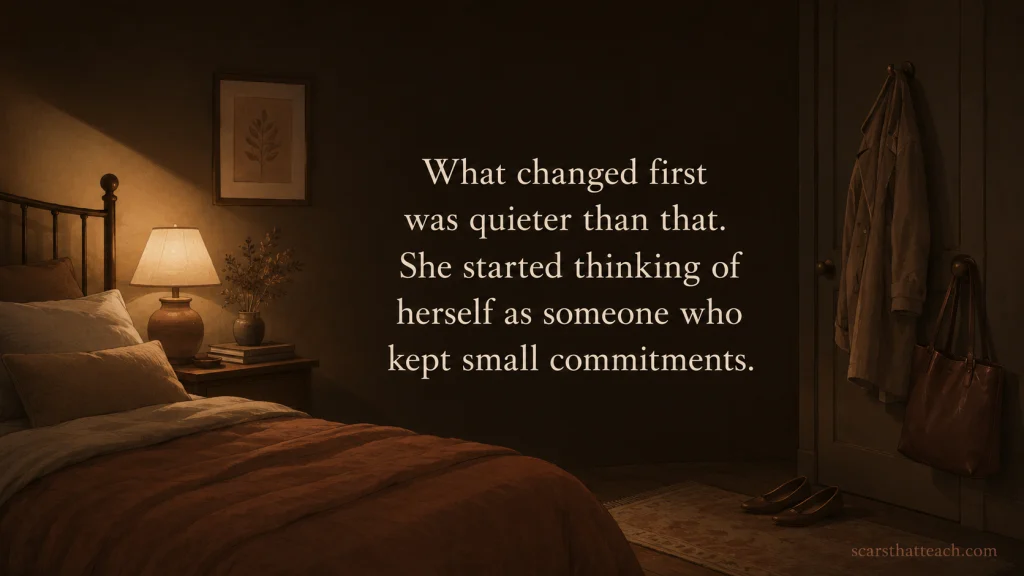
There is a pattern I noticed often enough among the families I sat with to trust it as more than coincidence. A caregiver, worn down from months of hospital routines that left almost nothing that felt like her own, started making her bed every morning before heading in for the day. It was not about the bed. She told me once that if she could walk out the door having done that one thing, she felt like someone who still had some order in her life, even on days when nothing else went right. Within a few months, without deciding to, she was eating regular meals again and had finally returned a call to her sister she had been avoiding for over a year.
None of those other things were the goal. She never set out to fix her relationship with her sister by making her bed. What changed first was quieter than that: she started thinking of herself as someone who kept small commitments, and once that belief took hold, the other habits stopped feeling like separate fights and started feeling like things a person like her would naturally do.
What people commonly get wrong here is assuming a keystone habit has to be impressive or difficult to matter. They pick something ambitious, force it for a few weeks through sheer will, and abandon it when nothing seems to be spreading fast enough. The habit that actually works this way is almost always smaller and less dramatic than the one someone picks when they are trying to impress themselves.
Final Thoughts: Stop Hunting for the One Habit
The mistake most people make when they go looking for one habit that changes everything is treating it like a search for the correct answer, as though there is a single habit out there that will work for anyone who finds it. There is not. What works is smaller and more particular than that: the habit that happens to touch something you already believe about yourself, kept consistently enough to have somewhere to go. You may find one. You may already be carrying more than one without having named it. Either way, it is worth looking for the connection rather than the size of the habit itself.
This concept only makes full sense once you understand the mechanism it depends on, which gets covered more directly in how the cue, routine, and reward loop actually works. If you are drawn more to how a habit reshapes who you believe yourself to be, that gets explored further in a piece on identity-based habits and how they take hold. For the wider picture on staying consistent in general, there is more at how consistency actually holds up over time, and for verified reflections on discipline itself, there is a collection of verified quotes on discipline and self-control worth sitting with alongside this.
FAQs
🔑 What are keystone habits?
Habits that, once adopted, create spillover improvements in other, unrelated areas of a person’s life. The habit itself is often small; the changes that follow it usually are not.
🏃 What are some keystone habits examples?
Exercise and daily journaling are the most commonly cited, but almost any small, consistent habit can work this way if it genuinely shifts how someone sees themselves.
🪞 Why do keystone habits affect areas of life they were not aimed at?
Identity is one of the most consistent mechanisms behind it. When a habit reshapes how someone sees themselves, other habits start feeling consistent with that identity instead of requiring separate motivation on their own.
🏋️ Does exercise always work as a keystone habit?
No. Exercise is a common example because it works for a lot of people, but plenty of people exercise consistently for years without it touching any other part of their life. Whether it becomes a keystone depends on the person, not the habit itself.
🧩 Is there one habit that changes everything for everyone?
No single habit works this way universally. The habit that ripples outward for one person may do nothing for another, since it depends on what that habit happens to connect to in their own life.
🔢 Can someone have more than one keystone habit at a time?
Yes. Some people carry more than one without ever naming it that way. Others go through long stretches with none, which is not a failure so much as a sign nothing has connected yet.
📋 How do I find my own keystone habit?
Look for something small and easy enough to keep even on a bad day, that touches a part of your self-image you already care about, and delivers a quick, noticeable win.