
Most people try to change what they do before they change how they see themselves, and that is usually why the change does not last. Identity based habits work in the opposite direction. You decide who you are becoming first, and the behavior follows because skipping it now feels like betraying that. I watched this pattern for two decades in people who were running out of time, and I still see it in anyone trying to build something that sticks. This piece walks through why outcome focused habits keep collapsing, what actually makes identity driven habits durable, and where people get the idea wrong before they even start.

The Change That Lasts Starts Before the Behavior Does
Identity based habits are not a trick for getting more done. They are the reason some people change permanently and most people do not. In more than twenty years of sitting with people at the end of their lives, I watched this pattern repeat itself in room after room. The ones whose change actually lasted had started describing themselves differently first. Their behavior caught up to match it later, not the other way around.
Nobody in those rooms used the phrase “habits and identity” out loud. But that is exactly what they were describing when they told me how a shift finally held after years of failed attempts. They stopped saying “I am trying to eat better” and started saying “I take care of my body now.” The sentence changed first. The plate changed after. That order matters more than most advice on this topic ever admits.

Why Outcome-Based Habits Keep Falling Apart
Almost all the habit advice a person runs into is built around a result. Run three times a week to lose the weight. Read for thirty minutes to learn more. Save a fixed amount every month to hit a number by a certain age. James Clear made this distinction well known in Atomic Habits, arguing that outcome-based habits are fragile precisely because they are tied to a finish line. Once the weight comes off, or the deadline passes, or the goal quietly stops feeling urgent, the reason to keep going goes with it.
I saw a version of this constantly with families trying to rebuild something after years of distance. Someone would commit to calling a parent every Sunday because a doctor’s visit had scared them into action. For a few weeks it held. Then the fear faded, the doctor’s visit became a memory instead of a warning, and the calls thinned out along with it. The habit had been built on an event, and events end. If you are looking for other ways to build consistency in daily habits once the initial motivation fades, that is a separate conversation worth having on its own.
Strip away the specifics and the pattern is always the same. The habit is anchored to something external, the external thing is finite by nature, so the habit built on top of it is fragile in the same way. A number on a scale gets reached or abandoned. A deadline passes. A scare wears off. None of those things were ever going to last forever, which means nothing tied only to them was built to last either.
The Real Reason Identity-Based Habits Actually Stick
Identity based habit formation starts from a different question entirely. Not what do you want to achieve, but who do you want to be. That framing sounds soft until you understand the mechanism underneath it, and the mechanism is what most sources on this topic skip past. Identity is not tied to an outcome that can be reached or missed. It is continuous. It is something you carry into every ordinary Tuesday, not something you either hit or fail to hit by a deadline.
That continuity is what makes the behavior durable, because once a habit is attached to who you believe yourself to be, skipping it stops feeling like a missed goal and starts feeling like a contradiction. A person who has decided they are someone who shows up for their family does not experience a skipped visit as a scheduling failure. They experience it as a gap between who they said they were and what they actually did, and that gap is uncomfortable in a way that a missed workout target never quite manages to be.
Every Repetition Is a Vote
Clear’s framing treats each repetition of a habit as a vote for the kind of person you are becoming, and I think that is the clearest way to explain why this works. One vote does not decide the election. But enough votes, cast consistently, start to settle the question of who you actually are, not who you meant to be. This is different from anything covered under what keystone habits actually are, since that concept is about which single habit triggers a cascade of others. Identity based change is about the story you are telling yourself with every small repetition, cascade or not.
What This Looks Like Day to Day
The shift from outcome language to identity language shows up in small sentences, and once you know what to listen for, you start hearing it everywhere. Someone becoming the type of person who exercises regularly does not say “I am trying to lose ten pounds.” They say “I am a person who moves every day.” Someone trying to read more does not frame it as a thirty-day challenge. They start calling themselves a reader, and skipping a night starts to feel unlike them rather than like a broken streak.
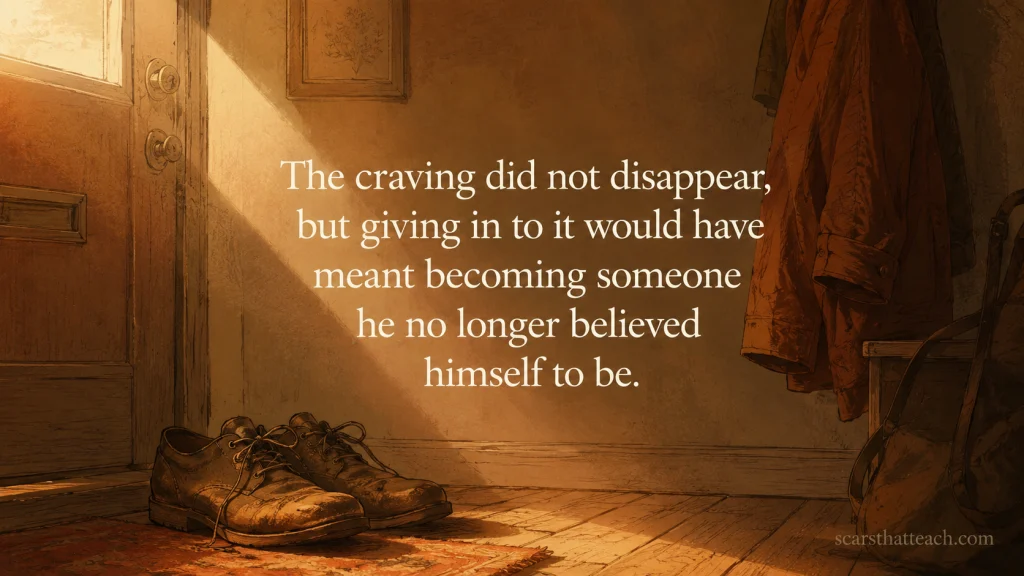
I sat with a man in his final months who had quit smoking twenty years earlier, and the way he told the story stuck with me. He did not say he had white-knuckled it through cravings for a set period. He said that somewhere in the second month, he simply stopped thinking of himself as a smoker who was resisting, and started thinking of himself as someone who did not smoke. After that, the craving did not disappear, but giving in to it would have meant becoming someone he no longer believed himself to be. That is identity driven habits doing the actual work, not willpower.
A few signs tend to show up when this shift is genuinely happening, rather than being borrowed as a slogan:
- The language changes from “I am trying to” to “I am someone who,” without being forced or rehearsed.
- A missed day feels like a contradiction to sit with, not just a broken streak to restart.
- The behavior survives a loss of motivation, because it is no longer motivation doing the work.
- Other people start describing you the way you have started describing yourself, without being told to.
None of that happens overnight, and it should not be expected to. The sentence comes first, but the sentence has to be tested by repetition before it becomes true enough to hold weight.
How the Shift Actually Gets Built
Underneath the discomfort of a skipped habit is something researchers call the self-consistency bias: the mind’s tendency to want its actions to line up with its own self-image, and to feel unsettled when they do not. That bias is not a personality trait some people have and others lack. It runs in everyone, which is exactly why it works so reliably once you know how to point it at something useful instead of letting it sit idle.
In practice, the shift tends to move through three stages, and none of them require the identity to feel true before you begin. First, name the identity in one narrow sentence, tied to a specific area of life rather than a sweeping character trait. Second, prove it with a small, repeatable action, even an inconsistent one at the start, because the proof is what the identity will eventually stand on. Third, let the self-consistency bias do the reinforcing on its own. Once a few repetitions exist as evidence, skipping the next one starts to cost something internally, and that cost is what carries the habit past the point where motivation alone would have quit.
Where People Get This Wrong
The most common mistake I see is treating the identity as something that has to feel true before you are allowed to act on it. People wait to feel like a disciplined person before they behave like one, and that wait can stretch out for years, because the feeling was never going to arrive first. The behavior has to come before the conviction does. You do not become a runner and then start running. You run, inconsistently at first, and the identity forms around the evidence you keep giving yourself.
The second mistake is claiming too large an identity all at once. Deciding you are now “a disciplined person” in every area of life is too broad to survive contact with an ordinary bad week. Narrower claims hold better. Not “I am disciplined,” but “I am someone who keeps commitments to my kids,” or “I am someone who does not go to bed on an unresolved argument.” A specific self-description gives you something concrete to live up to, the same way words about discipline and staying the course tend to land harder when they point at one real situation instead of a general virtue.

Final Thoughts: Change Starts With a Sentence, Not a Streak
Nobody I sat with in their final weeks measured their life by the goals they hit. They measured it by who they had actually become, and by how honestly their actions had matched what they claimed to believe about themselves. Identity based habits are not a productivity method dressed up in softer language. They are a more accurate description of how change has always worked, even before anyone gave it a name. The sentence comes first. The behavior earns it. And most people, in my experience, discover this far later than they needed to.
FAQs
🧠 What are identity based habits?
They are habits built around who you want to become rather than a specific result you want to hit. Instead of running to lose weight, you run because you have decided you are someone who moves every day. The behavior follows from the self-description, not the other way around.
🎯 How is this different from regular goal setting?
A goal has a finish line. Once you hit it, or once it stops feeling urgent, the reason to keep going can disappear with it. Identity has no finish line, so skipping the behavior starts to feel like a contradiction rather than a missed target.
🔁 Why does this actually make habits last longer?
Because it stops being about willpower and starts being about consistency with a story you have already told yourself. Once you believe you are a certain kind of person, skipping the habit creates discomfort on its own, without needing outside motivation to enforce it.
⏳ How long does it take before the identity feels real?
There is no fixed number of days. It comes from repetition, not from a calendar. The behavior has to come first, inconsistently at times, before the self-description starts to feel earned instead of aspirational.
🚪 Where should someone actually start?
Start narrow. Not “I am a disciplined person,” but one specific claim tied to one specific situation, like “I am someone who follows through on what I tell my kids.” A smaller, honest claim survives a bad week better than a broad one does.