
Leaving everything to the last minute is not just a bad habit. For a lot of people it is a specific pattern with its own internal logic: the task does not feel real enough to start until the deadline makes it impossible to ignore. The self-justification that usually accompanies this pattern, “I work better under pressure,” is worth examining, because it is partly true and mostly not, and the part that is not tends to do more damage than people notice until it has been doing it for a while.

Working Best Under Pressure, or Starting Only Under Pressure
The people I sat with who described themselves as someone who worked best under pressure almost never meant what they thought they meant. What they meant, when I asked them to say more, was that pressure was the only thing that had ever reliably gotten them to start. Those are different claims. One is about the quality of the work. The other is about the conditions required to begin it. The first claim is debatable. The second is usually just accurate.
That distinction matters because the self-justification attached to this pattern tends to function as a permission structure. If I work best under pressure, then waiting is not avoidance. It is strategy. It is giving myself the conditions I need to perform. That framing is comfortable enough to repeat, and it survives because the deadline does, in the end, usually get met. The task gets finished. The catastrophe does not occur. The belief gets reinforced another time.
What does not get examined is the cost. Not the cost of missing the deadline, which rarely happens, but the cost of the way the work was done, and the cost to the person who did it. Those are quieter costs, and they accumulate in ways that are easy to overlook precisely because the surface outcome, the finished thing, looks more or less the same.
Why the Deadline Is the Only Thing That Works
Deadline-driven procrastination is a documented pattern, distinct from other forms of delay. The mechanism is fairly specific: some people have a threshold for how consequential a task needs to feel before they can act on it, and without the urgency of an approaching deadline, the task does not clear that threshold. It exists on the to-do list, it is thought about, it may even be partially planned, but it does not feel real enough to generate the kind of focused engagement that would actually move it forward.
The deadline changes the emotional weight of the task. The adrenaline of genuine urgency, the narrowing of focus that comes from time pressure, the sudden clarity about what actually needs to happen: these are real states, and they do produce movement. For people with this pattern, that cocktail of pressure is not just motivating, it is often the only thing that converts intention into action at all. The experience of that conversion is real enough, and reliable enough, that interpreting it as proof of a personal working style is understandable.
What tends to get missed is the question of what would have been available if the same focused engagement had arrived earlier. The pressure does not enhance the work. It enables the start. Those are different things, and conflating them is the core of the self-justification that keeps the pattern in place.
Why Starting Earlier Doesn’t Feel Possible
For people with this pattern, being told to simply start earlier does not land as useful advice, because earlier starting does not produce the same internal state that deadline pressure does. The task sits there and feels inert. Nothing happens. They return to it, they think about it, and the engagement that would actually move it forward refuses to arrive. The pressure-seeking is not laziness. It is an attempt to manufacture a state that the task will not produce on its own.
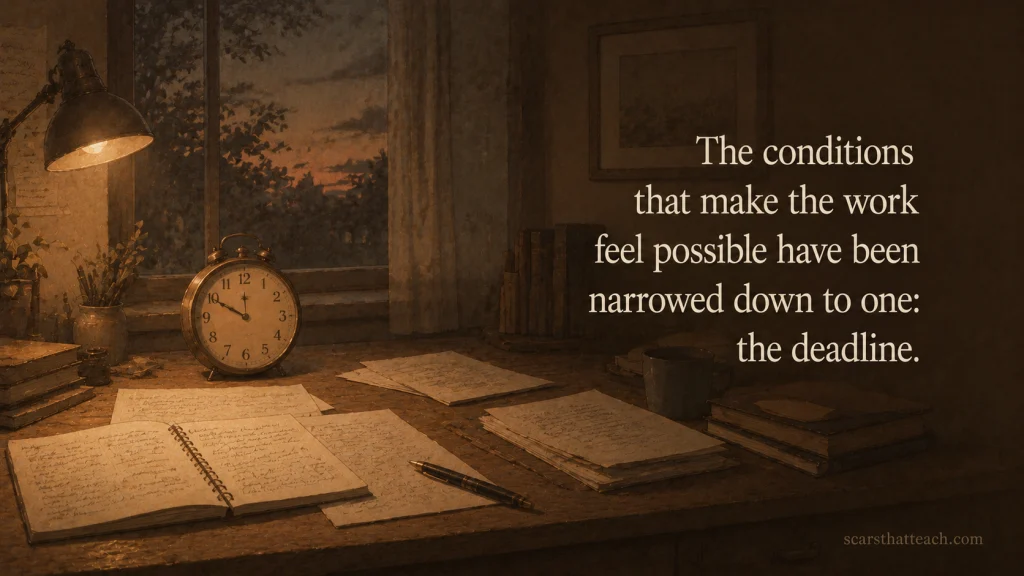
This is partly why willpower-based framings of deadline procrastination tend not to work. The issue is not an unwillingness to work. It is that the conditions that make the work feel possible have been narrowed down to one: the deadline. Understanding that this is a pattern with its own mechanism, rather than a character defect, is one of the more useful things someone with this tendency can do, because it shifts the question from “why can’t I just start?” to “what would need to be different about how the task feels earlier in the process?”
The Part People Don’t Examine Because the Task Got Done
The reason last-minute procrastination persists so effectively is that it usually succeeds on the most visible metric. The deadline gets met. The work gets submitted. The outcome, measured as completion, looks more or less the same as it would have if the work had been done earlier. This makes the pattern very resistant to examination, because the apparent consequence everyone fears, missing the deadline or failing the task, mostly does not happen.
What does happen is harder to see in a single instance. The work produced under last-minute pressure is often not as good as the work the same person would produce with more time. Not always. Some tasks genuinely benefit from compression and do not require iteration. But most tasks that are worth doing at all are worth doing in a way that allows for reconsideration, revision, and the kind of thinking that does not arrive under acute time pressure. The compressed version gets finished. It does not always get to be the version the person was actually capable of producing.
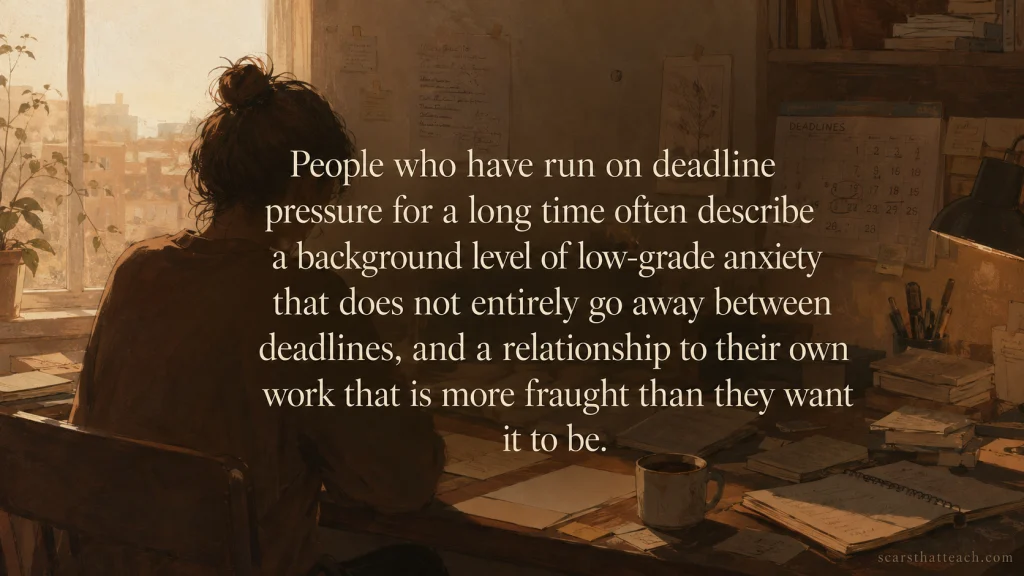
The stress cost is also real and tends to be underaccounted. A pattern of routinely placing yourself in acute urgency has physiological effects that are not neutralized just because the deadline passes. The relief after the deadline is real. So is the accumulated cost of having cycled through that urgency repeatedly, across years, across different kinds of tasks and responsibilities. People who have run on deadline pressure for a long time often describe a background level of low-grade anxiety that does not entirely go away between deadlines, and a relationship to their own work that is more fraught than they want it to be.
- The belief “I work better under pressure” usually describes the conditions for starting, not the conditions for doing the best work.
- Stress from last-minute urgency does not fully dissipate after the deadline passes. It compounds over repeated cycles.
- The pattern is self-reinforcing precisely because the feared consequence, missing the deadline, rarely occurs. The feedback loop never produces a signal strong enough to change the behavior.
None of this means last-minute workers are not capable. Often they are highly capable, and the deadline-pressure system has worked well enough for long enough that it never came under serious scrutiny. The question is not whether the system works. It is whether it is the best version of how the person could work, and what it is costing in the parts of the outcome that are harder to measure than completion.
What Actually Changes the Pattern
Telling someone with this pattern to start earlier is not advice. It is a description of the outcome they already want, without any account of how to get there. What tends to be more useful is working with the mechanism: if deadline pressure is what makes the task feel real and consequential enough to act on, then the question is whether something else can produce that quality of realness earlier in the process, without requiring the urgency to be genuine.
Artificial intermediate deadlines can do some of this work, particularly when they carry real stakes of some kind: social accountability, a commitment to another person, a public intermediate deliverable. The goal is not to trick yourself into believing a false emergency. It is to import some of the conditions that deadline pressure produces into an earlier stage of the process, where the work can actually benefit from them.
Whether that works depends on what is driving the pressure-seeking. Some people need urgency itself, the sensation of time closing in. Others need the specific constraint of running out of time, which is a narrower version of the same thing. Those respond differently to artificial deadlines, and it is worth knowing which one is more accurate for you before deciding whether the strategy is likely to help.
The broader pattern of procrastination, including the forms that are less specifically deadline-driven, is something why you procrastinate covers in more depth. What I can say here is that the deadline version of the pattern has the additional complication of its own successful track record. It is harder to change something that keeps working, even imperfectly, than something that has already visibly failed. That successful track record is also, in most cases, the thing that has been quietly setting the ceiling on what the person was actually capable of producing.

Final Thoughts: The Task Gets Done, But So Does the Cost
The last-minute pattern is one of the more durable ones I have seen, because it generates its own evidence that it is working. Every met deadline is a data point that confirms the system. Every close call becomes a story about coming through when it counted. The costs, to quality, to health, to the gap between what was produced and what was possible, tend not to show up in that accounting. They are real anyway.
What I would offer is not an instruction to change the pattern. That is yours to work out, with whatever support makes sense. What I would offer is a more honest frame for what the pattern actually is: not a working style, not a personality trait, but a narrowed set of conditions for starting, combined with a feedback loop that makes those conditions look more functional than they often are. Naming it accurately is not the same as changing it. But it is usually where change becomes possible.
The full set of procrastination patterns, and the different questions they tend to raise about motivation and self-understanding, are part of the larger conversation at procrastination and what actually drives it. For the questions about discipline and what it actually looks like in people who have built it, the discipline quotes and what they get right section covers some of that ground.
FAQs
⏰ Do I actually work better under pressure, or is that just a story I tell myself?
Mostly a story, though one with a kernel of truth. Pressure reliably gets you started, and starting is real. But starting under pressure and doing your best work are not the same thing. Most tasks that benefit from reflection, revision, or creative thinking are not well served by the conditions that last-minute urgency produces. What you work under pressure is the version that could be finished in time. Whether it is the version you were capable of is a different question.
🧠 Why can’t I start a task until the deadline is close?
Because the deadline is doing the work of making the task feel real and consequential enough to act on. Without that urgency, the task exists on the list but does not generate the internal state that converts intention into action. This is a specific pattern with a specific mechanism, not a sign of laziness or low capability. The question worth asking is what else could make the task feel real earlier, before the pressure is genuine.
😓 What’s actually wrong with leaving things to the last minute if I always get them done?
Two things, mainly. The quality of the work is often not what it would have been with more time, even when the deadline is met, because compression limits the thinking and revision that improve most kinds of work. And the stress of repeated last-minute cycles accumulates in ways that do not fully clear between deadlines. The system works on the most visible metric. It costs something on the ones that are harder to see.
🔄 Is deadline procrastination the same as regular procrastination?
Related but distinct. Deadline-driven procrastination has a specific feature: the delay is tied to a pressure-seeking pattern, where urgency is what finally makes the task feel possible. Other forms of procrastination involve avoidance, overwhelm, perfectionism, or difficulty prioritizing, without necessarily requiring the adrenaline of a looming deadline. The mechanism and what changes it tend to be different.
💡 What actually helps last-minute procrastinators start earlier?
Artificial intermediate deadlines that carry real stakes, usually through some form of social accountability, can help import some of the pressure that genuine deadlines produce. The goal is not to simulate a fake emergency but to make an earlier stage of the work feel real and consequential enough to engage with. What works depends on whether the pattern is primarily about urgency or about the specific constraint of running out of time. Those are worth distinguishing.
😤 Why does advice to “just start earlier” never work for me?
Because that advice describes the outcome without addressing the mechanism. If the internal state that makes work feel possible is tightly coupled to deadline pressure, then starting earlier requires either manufacturing a version of that state or changing the conditions that make only pressure work. Telling someone to start earlier when earlier starting does not produce the necessary internal state is not useful advice. It is a description of what you already want to do.
🎯 Is deadline procrastination a sign of something deeper?
Sometimes, but not always. In many cases it is a well-established habit pattern that has survived because it kept producing met deadlines, not a signal of anxiety disorder, ADHD, or another underlying condition. If the pattern is causing significant distress, affecting important relationships or responsibilities, or feels genuinely out of control, those are reasons to look more carefully with a professional. But a persistent deadline habit that functions and costs you on quality and stress is often just that: a habit pattern with its own reinforcement loop.