
The question of whether productive procrastination actually works has a real answer, but it is not the one most productivity content gives you. Philosopher John Perry built a widely cited case that procrastinators can extract genuine value from their avoidance by deliberately stacking useful secondary tasks around a primary one they are not ready to face. The leading academic researcher in the field of procrastination calls that framing an attempt to find virtue in a self-regulatory weakness. Peer-reviewed research suggests people who substitute productive tasks for avoided ones tend to report worse outcomes, not better ones. What this means for any individual depends on one observable fact: whether the important task ever actually gets done.

The Most Organized People I Have Sat With Were Avoiding Something
In over twenty years of hospice chaplaincy, I watched a pattern repeat often enough to stop calling it a coincidence. The cleanest kitchen I ever encountered in a family home belonged to a woman who, by her own account, had spent three days scrubbing counters and reorganizing shelves before she could bring herself to make a call she had been putting off for months. The most orderly desk I ever saw sat in a room where the man behind it told me he had filed and color-coded everything he owned the weekend before resigning from a job he had spent years dreading. The productivity in both cases was genuine. So was what they were working around.
I raise those observations not to suggest that cleaning a kitchen or organizing a desk is wasted effort. It is not. But there is a difference between getting useful things done and getting useful things done specifically because something more important has become too uncomfortable to begin. That difference matters, and almost no popular productivity writing bothers to name it clearly. The question of whether productive procrastination is actually productive sits right at that line. Understanding what the evidence says about it is worth the time, especially if you have been relying on the concept without examining it closely.
This piece focuses on that specific, contested claim. The broader patterns behind procrastination and what makes them so persistent are covered elsewhere. Here, the question is narrower: does doing other useful things while avoiding your primary task constitute a legitimate strategy, or is it a more comfortable form of the same problem?

What Structured Procrastination Actually Claims
The concept comes from philosopher John Perry, who introduced what he called structured procrastination in an essay that has since been cited across a range of productivity sites. His argument runs something like this: procrastinators are not fundamentally lazy. They are people whose motivation is shaped by avoidance. Given a sufficiently important task sitting at the top of their list, they will reliably complete almost anything else on that list to stay away from it. Perry’s insight was that this tendency can be deliberately exploited. If you position genuinely useful secondary tasks below the primary task you are avoiding, you will complete those secondary tasks, and real work will get done in the process. The procrastinator, in this framing, is not a failure of discipline but a particular kind of motivational engine that just needs the right kind of fuel.
The appeal is easy to understand. It is flattering without being dishonest about the mechanism. It does not pretend the avoidance is not happening. It reframes the avoidance as useful, and suggests that leaning into it strategically is a reasonable substitute for addressing the underlying pattern. Productivity sites have presented Perry’s idea favorably because it is clever and because it meets readers where many of them already are: doing other things instead of the thing they know they should be doing, and wanting a reason to feel good about that.
“The cleanest room in the house is often cleaned the night before the conversation nobody wants to have.”
That is not a criticism of Perry. His observation that procrastinators complete genuine work while avoiding other work is accurate. The contested question is whether that pattern can be structured into something consistently effective, or whether giving it a name and a framework just makes it easier to live with rather than easier to work through.

Why the Leading Researcher in the Field Disagrees
Tim Pychyl, who directs the Procrastination Research Group at Carleton University and has spent decades studying the psychology of procrastination, does not find Perry’s framing persuasive. His position on the concept is direct:
Productive procrastination is an attempt to find virtue in a self-regulatory weakness.
Tim Pychyl, Procrastination Research Group, Carleton University
That is a precise challenge to the premise, not a polite disagreement. Pychyl’s argument is that procrastination is a failure of self-regulation, meaning the capacity to manage behavior in the direction of your own goals. Calling it productive does not change what it is. The task being avoided is still being avoided. The stress attached to that avoidance does not lift because the desk got organized while it was happening.
The peer-reviewed research supports this more skeptical reading. A study published in the peer-reviewed literature examined non-academic procrastinators who responded to an avoided primary task by engaging in productive secondary tasks instead. The finding was not that these people fared better than classic procrastinators who simply did nothing. They reported worse outcomes. The productive secondary work did not offset the cost of continued avoidance. In some cases, it appears to have extended and licensed it, because the secondary productivity made the procrastination feel justified in the moment.
This is worth sitting with if you have used the productive procrastination framing to explain a pattern you already suspect is costing you something. The research does not suggest that completing secondary tasks is harmful in itself. It suggests that completing them specifically as a substitute for an avoided primary task tends not to produce the results the concept promises.
There are recognizable signs that secondary productivity is functioning as avoidance rather than as a genuine step toward the thing that needs doing:
- The secondary tasks get completed reliably, but the primary task keeps moving to the next day without a clear reason.
- Finishing the secondary work reduces the urgency around the primary task, at least temporarily, and that relief becomes part of why the secondary work gets chosen.
- The avoided task is not technically difficult or unclear. It is emotionally loaded, uncertain in outcome, or carries a risk of failure or conflict.
- When all the secondary work is done and nothing else remains, the discomfort about the primary task is still present, unchanged.
- The primary task eventually gets started only under external pressure: a deadline, a consequence, or someone else asking where things stand.
None of these are signs of a strategy working as designed. They are signs of a strategy that is substituting for one. Whether that distinction matters depends on what the primary task actually is and what it has already cost to keep avoiding it.
How to Read Your Own Pattern
The honest answer to whether productive procrastination works depends on one observable fact: does the primary task ever get done, and at what cost? If cycling through secondary tasks eventually generates enough momentum to carry you into the avoided work, that is a different pattern than cycling through secondary tasks until a deadline forces a crisis or the avoided task gets quietly abandoned. Perry’s concept, taken on its own terms, presupposes that the primary task eventually gets started. The secondary productivity is meant to be a runway, not a destination. If it is functioning as a destination, something else is happening.
I have sat with people who carried avoided tasks for years while maintaining genuinely full and productive lives. The productivity was not a sign that the avoidance had been resolved. In many cases, the busyness was part of how the avoidance stayed invisible, to other people and to themselves. I am not offering that as a judgment. It is a pattern, and patterns are worth naming clearly so you can decide what to do with them on your own terms.
There is also the question of what avoidance actually costs in terms of stress over time. A common assumption is that staying productive while avoiding something reduces the anxiety around it. The evidence does not support that assumption well. The avoided task tends to remain present regardless of what else is being accomplished alongside it. For many people, the combination of ongoing secondary productivity and an unresolved primary task runs at a higher sustained stress level than simply starting the avoided task would have required. The secondary work does not cancel the weight of what is being deferred. It just makes the weight easier to rationalize on a day-to-day basis.
If the practical question you are working through is how to actually begin what you have been avoiding rather than how to stay busy around it, what it actually takes to stop procrastinating covers that ground in more depth. This piece is about the narrower question of whether your productive workarounds constitute a real substitute. Based on the evidence, the honest answer is: sometimes, briefly, under the right conditions. Not consistently, and not without a cost that tends to accumulate.
Final: What the Question Is Really Asking
The reason the productive procrastination debate has not settled is that both sides are describing something real. Perry is right that procrastinators complete genuine work in the process of avoiding other work. Pychyl is right that naming this as a strategy does not fix the underlying self-regulatory problem, and that the research does not show it producing the outcomes its defenders claim. Both things can be true at the same time, and they are.
What I have noticed, across years of sitting with people who had run out of time to rationalize their patterns, is that the question “is this actually productive?” is rarely the question underneath the question. What people are usually asking is closer to: does doing other useful things justify not doing the one thing I know needs doing? That question does not have a universal answer. It depends on what the avoided task is, what it has cost to keep avoiding it, and how much of the secondary productivity is genuinely useful versus how much of it is the mental equivalent of cleaning a kitchen the night before a conversation nobody wants to have.
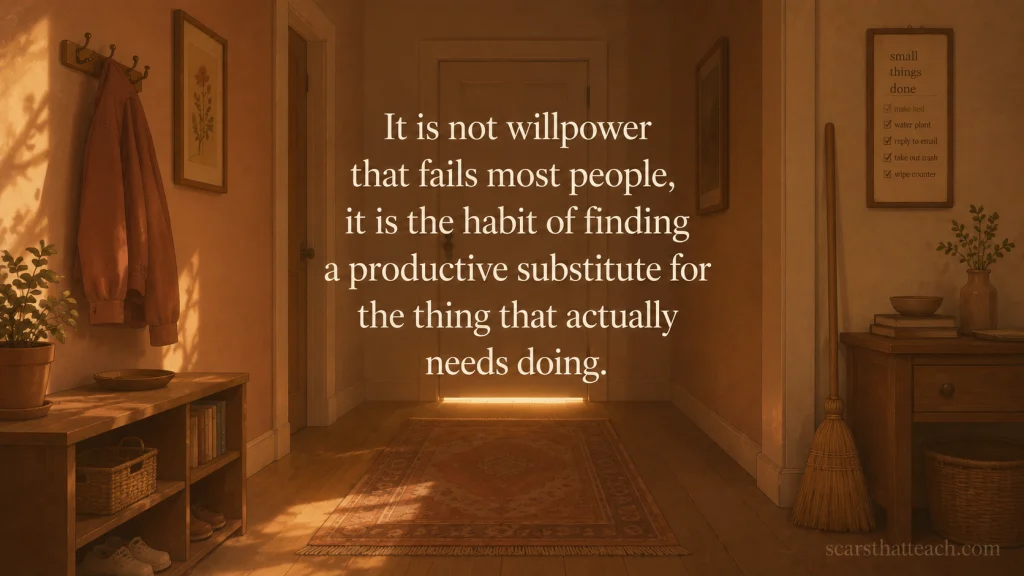
A lot has been written about self-discipline and what it actually costs to defer the things that matter. The observations that tend to hold up over time on discipline and avoidance circle back to the same point in different words: it is not willpower that fails most people, it is the habit of finding a productive substitute for the thing that actually needs doing. The people I sat with who regretted their patterns of avoidance rarely regretted the secondary tasks they had completed along the way. They regretted the primary tasks they had kept moving forward until there was no time left to start them.
FAQs
🤔 Is productive procrastination actually a real strategy or just a rationalization?
Both descriptions are partially accurate, which is what makes it a genuinely contested question. Philosopher John Perry made a real case for deliberately structuring secondary tasks around an avoided primary one. The leading academic researcher in procrastination, Tim Pychyl, argues it is an attempt to give virtue to a self-regulatory weakness. The research on outcomes leans toward Pychyl: people who substitute productive tasks for avoided ones tend to report worse results, not better.
📋 What is structured procrastination and where does the idea come from?
It is John Perry’s term for an approach where a procrastinator deliberately positions useful secondary tasks below a primary avoided task, then completes those secondary tasks as a way of staying productive while avoiding the primary one. The idea is that real work gets done in the process and that this pattern can be structured intentionally rather than left to chance.
😓 Does staying productive while procrastinating actually reduce stress?
The evidence suggests not reliably. The avoided primary task tends to stay present regardless of how much useful work surrounds it. For many people, the combination of ongoing secondary productivity and an unresolved primary task generates more sustained stress than simply starting the avoided task would have required in the first place.
🔍 How do I tell whether my productive procrastination is helping or just delaying?
The clearest indicator is what happens to the primary task. If secondary work creates momentum that eventually carries you into the avoided task, the pattern is functioning as designed. If the primary task keeps moving to the next day while secondary work gets completed reliably, the secondary productivity is functioning as avoidance. The destination is the thing that tells you which one you are in.
⏳ Should I try to stop productive procrastination or learn to use it better?
That depends on whether your pattern is actually producing the avoided task, eventually. If it is, there may not be much to change. If the primary task consistently gets deferred regardless of how much secondary work gets done around it, then the framing is not helping you do what needs doing. At that point, the pattern itself is worth reconsidering rather than optimizing.