Comparing yourself to others does not make you feel worse because comparison itself is the problem. It makes you feel worse because of which comparisons your mind reaches for first, and what you are actually measuring against what. I watched this pattern surface in people who, by any outside account, had built good lives. This piece looks at why upward comparison to an idealized version of someone else’s life is such a reliably unfair fight, and why feeling worse after scrolling, glancing, or measuring yourself against someone else is not a sign that something is wrong with you.
The Sentence I Heard Most From People Who Had What They Wanted
There was a sentence I heard often enough, from people who by any reasonable measure had built the lives they had once said they wanted, that I started waiting for it before they finished their first thought. It usually began the same way: I know I shouldn’t, but whenever I see her, or whenever I think about him, or whenever I picture what their life looks like now. It was rarely envy in the ugly sense. It was something quieter and more exhausting, a low hum of feeling behind no matter how full the room around them actually was.
That pattern is at the center of why comparing yourself to others makes you miserable even when your own life is going fine. The comparison itself is not optional in the way people wish it were. What is worth understanding is why certain comparisons reliably leave you feeling worse while others barely register, because the difference is not random. It comes down to direction and target, and once you can name both, the feeling stops being a mystery and starts being something you can actually work with.
Why Looking Up Hurts More Than Looking Down Helps
Research on social comparison draws a clear line between two directions a person can look. Upward comparison means measuring yourself against someone who appears to be doing better, and it reliably deflates how you evaluate yourself in the short term. Downward comparison means measuring yourself against someone who appears to be doing worse, and it reliably has the opposite effect, elevating self-evaluation, at least temporarily. This is not a personality flaw or a sign of insecurity. It is a documented and consistent pattern, traced back to research by Wheeler and Miyake in 1992 on the upward comparison effect, and Wills in 1981 on the downward comparison effect.
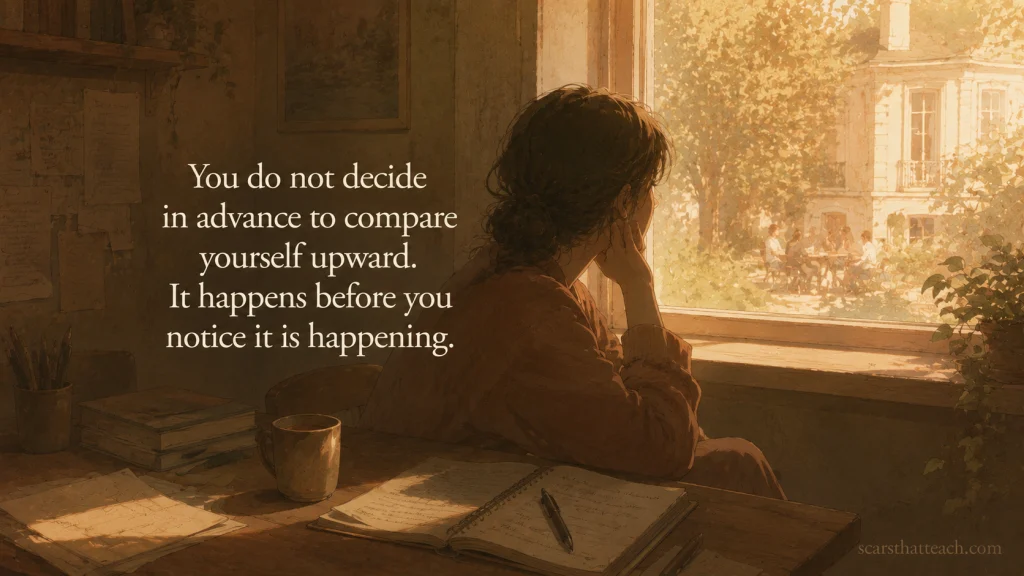
What surprised me most, watching this play out in people’s actual lives rather than in a research summary, is how rarely anyone gets to choose which direction their mind goes. You do not decide in advance to compare yourself upward to the person who seems to have it more figured out. It happens before you notice it is happening, usually triggered by something small, a passing comment, a photo, a memory of someone you used to know. By the time you notice the feeling, the comparison has already been made and the outcome has already landed. That is part of why people experience this as something that happens to them rather than something they are doing, and that experience is more accurate than it might sound.

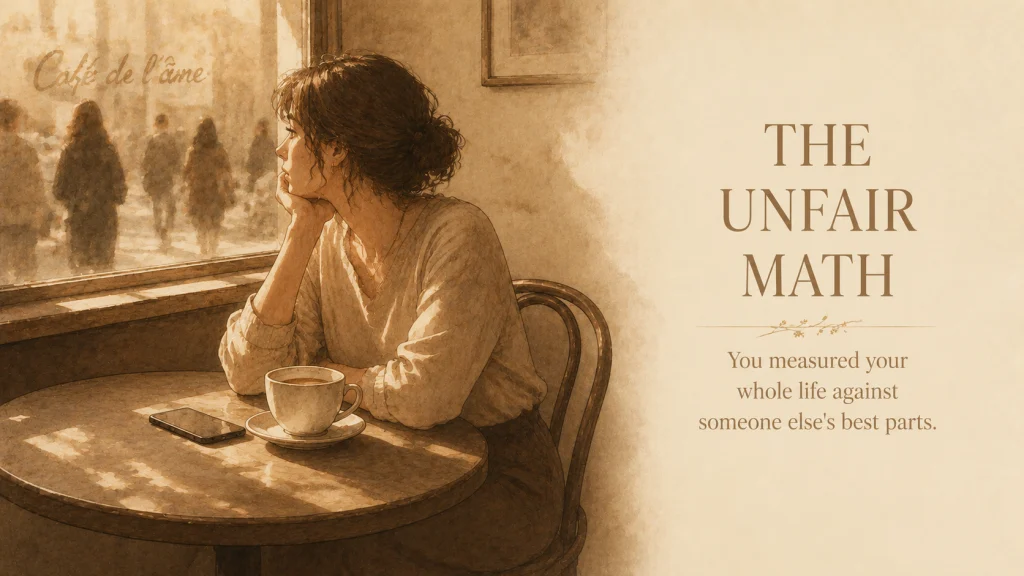
The Unfair Math of Comparing Your Whole Life to Someone’s Highlights
What gets less attention than the upward and downward distinction is why upward comparison to an idealized target is so much more damaging than upward comparison to a real person you actually know well. If you compare yourself to a close friend whose struggles you have watched up close, the comparison stays roughly honest. You know about the divorce, the years they spent broke, the argument with their sibling that still has not healed. The picture you are comparing yourself to includes the difficult parts, because you were there for some of them.
An idealized target does not offer you that. Whether it is someone you knew years ago whose life now exists to you only through occasional updates, or someone you have never met whose presentation is curated and selected by design, the version you are comparing yourself to has already had its hardest parts removed before it ever reached you. You are measuring the whole of your own ordinary reality, with its unremarkable Tuesdays and its unresolved problems, against someone else’s highlights. That is not a close contest. It was never meant to be one. The comparison feels unfair because it actually is unfair, structurally and from the start, regardless of how good or bad either person’s life genuinely is underneath the surface either of you can see.
I think this is the piece people miss when they tell themselves to simply stop comparing, as though the problem were a bad habit they could quit through willpower alone. The habit is not the core issue. The core issue is that the comparison was rigged before it began, comparing two things that were never actually equivalent.
What This Feeling Does and Does Not Mean About You
It is worth being direct about what this pattern does not mean. Feeling worse after an upward comparison is not evidence that your life is actually lacking, and it is not a clinical symptom that requires a diagnosis. Mood and self-evaluation can dip in response to comparison without that dip meaning anything deeper is wrong. If a low mood from comparison becomes constant, or starts resembling something heavier and more persistent than a passing sting, that is a conversation worth having with a professional who can actually assess it, not something to sort out by reading further on a screen.
What this feeling does mean is something more specific and more useful. It means the comparison your mind reached for was upward, aimed at a target whose harder parts you could not see, and that the math behind that particular comparison was never built to be fair. Some people respond to that information by stepping back from whatever channel keeps surfacing those idealized comparisons in the first place. Others find it more useful to simply notice the pattern out loud when it happens, naming it as it occurs rather than letting it settle in unexamined. Neither response erases the instinct to compare. That instinct is not going away. What changes is your relationship to what it tells you, and how much weight you let it carry once you can see the shape of what actually happened.
Final Thoughts: The Comparison Was Never the Fair Fight It Felt Like
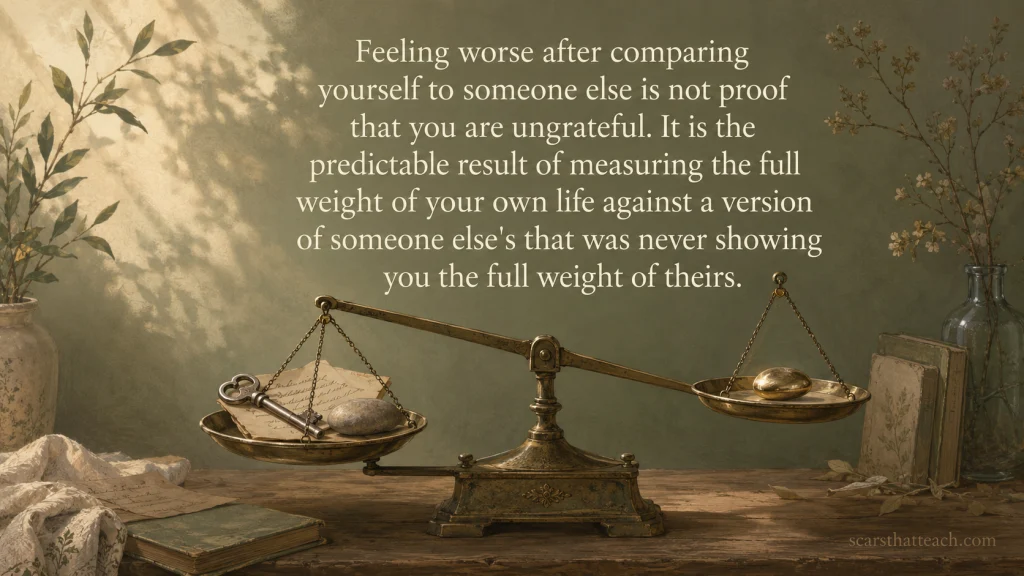
If there is one thing worth carrying out of this, it is that feeling worse after comparing yourself to someone else is not proof that you are ungrateful, insecure, or failing to appreciate what you have. It is the predictable result of measuring the full weight of your own life against a version of someone else’s that was never showing you the full weight of theirs. That distinction matters more than it sounds like it should, because it changes the question from what is wrong with me to what exactly was I actually comparing.
This is one piece of a larger pattern worth understanding. If you are curious why the instinct to compare exists in the first place, that is covered in why we compare ourselves to others. If a particular channel seems to make this worse for you specifically, that gets its own look in why social media makes comparison worse, and what to actually do once you have named the pattern is addressed directly in how to stop comparing yourself to others.
For the broader collection of questions on this subject, the full overview lives at comparing yourself to others. And for words that speak more directly to how you see your own worth, there is more waiting in self love quotes.
FAQs
🤔 Why does comparing myself to others make me feel worse even when my life is good?
Because the comparison is usually upward and aimed at an idealized version of someone else’s life, one that has already had its hardest parts removed. You end up measuring your whole reality against someone else’s highlights, which is not a fair comparison to begin with.
📉 Is it normal to feel insecure after comparing myself to someone doing better?
Yes. Upward comparison reliably produces a short-term dip in self-evaluation, and this has been documented consistently in social comparison research. It is a common response, not a personal failing.
⚖️ Why does comparing myself to someone doing worse make me feel better?
Downward comparison works in the opposite direction of upward comparison, temporarily boosting self-evaluation. Both directions are part of the same underlying pattern, just pointed differently.
🧠 Does comparing myself to others mean something is wrong with me?
No. The instinct to compare is common and persistent, and feeling a dip in mood after an upward comparison is not a diagnosis or a sign of failure. If that low mood becomes constant rather than passing, it is worth discussing with a professional rather than trying to self-diagnose.
🛑 How do I stop comparing myself to an idealized version of someone’s life?
Start by naming the comparison out loud when it happens, since unexamined comparisons carry more weight than ones you have actually looked at directly. From there, practical steps depend on the specific channel doing the most damage in your situation.