
Perfectionism and procrastination seem like opposites. One produces high standards. The other produces delay. But they are not opposites. They are two nodes of the same circuit. Perfectionism delays action because anything less than the ideal outcome would count as failure, and the conditions for a perfect outcome never quite arrive. The advice to simply lower your standards misses the mechanism. What actually helps is different from that, and understanding why explains the delay in a way that makes it possible to work with.

The Most Unfinished Projects Belonged to the Most Exacting People
In my years as a chaplain, I heard many people describe things they had never finished. Manuscripts, businesses, projects, conversations, creative work of all kinds. The people I most expected to have unfinished projects were the ones who described themselves as disorganized or easily distracted. But the most unfinished projects, the ones described in the most detail, with the clearest account of what had been planned and why it had stalled, belonged to a different kind of person entirely.
They were people who could tell you exactly what perfect would have looked like. The right moment had not arrived. The conditions were not yet right. There was more research to do, more preparation, one more thing to learn before beginning. The project existed in elaborate detail in their minds. The page, or the canvas, or the spreadsheet, remained largely empty.
That is not laziness. It is something more specific, and more interesting, and considerably harder to address with the usual advice.

Why High Standards Produce Delay
The standard account of perfectionism treats it as an asset that occasionally goes too far. Set high standards, work hard to meet them, and you produce excellent work. The problem, in this framing, is simply that sometimes the standards are set too high, and the solution is to bring them down to something more achievable.
That framing misses what is actually happening. Perfectionism does not just raise the bar for finished work. It applies the same bar to starting. When a perfect outcome is the only acceptable outcome, an early draft, a rough attempt, a first pass at something that might be mediocre, does not feel like progress. It feels like failure. And what you do not start cannot fail.
Research in psychology on the perfectionism-procrastination link, including work cited in Psychology Today drawing on CBT research published in Behavior Therapy, frames these two patterns not as separate problems but as two expressions of the same underlying dynamic. The perfectionist standard makes starting feel premature, because starting means producing something that is not yet perfect, and producing something imperfect feels worse than producing nothing. The nothing, at least, still holds open the possibility of eventual perfection.
The Conditions That Never Quite Arrive
This is the mechanism that the “lower your standards” advice fails to address. The perfectionist is not waiting because they feel lazy. They are waiting because starting before the conditions are right would mean doing something in a compromised way, and that feels worse than waiting. The problem is that the conditions for a perfect outcome, by definition, never fully arrive. There is always one more thing to learn, one more preparation to make, one more reason why right now is not quite the moment.
The waiting is not irrational from inside the perfectionist’s framework. If the only acceptable outcome is an excellent one, and if you do not yet have what you need to produce an excellent outcome, then waiting is the logical response. The framework itself is the problem. A standard that eliminates the learning curve eliminates starting, because no one begins anything new already knowing how to do it excellently.
What the perfectionist is effectively requiring is that they skip the part of the process where they are not yet good at the thing. That part cannot be skipped. It can only be avoided, which means the project stays in the planning stage indefinitely, where it is safe from the judgment that actual work would invite.

Why Lowering Your Standards Is Not the Answer
Most practical advice for perfectionist procrastination arrives at the same destination: lower your standards, accept good enough, embrace imperfection. This advice is not entirely wrong. A finished thing that is imperfect is more useful than an unfinished thing that might have been perfect. But the advice tends to fail in practice, and it fails for a specific reason.
Telling a perfectionist to lower their standards asks them to adopt a framework that feels, to them, like a capitulation. The high standard is not experienced as a problem. It is experienced as the thing that separates careful work from careless work, meaningful effort from sloppiness. Asking someone to abandon that distinction does not address the underlying fear. It just asks them to act as if they did not have the fear, which is not the same thing and does not produce the same result.
What the research on this pattern points toward instead is self-compassion: not lower standards for the work, but a different relationship to the inevitable imperfection of the process of producing the work. The standard for the finished product can remain high. What changes is the tolerance for the necessarily messy middle, the drafts, the attempts, the failures that are part of how any creative or intellectual work actually develops. A perfectionist who can hold those two things separately, high standards for outcomes and realistic acceptance of process, can start in a way that one who cannot make that distinction typically cannot.
That is a harder internal shift than lowering your standards. It is also more durable, because it does not require pretending to care less than you do.
Final Thoughts: What the Unfinished Projects Were Actually Protecting
The people I described at the beginning, the ones with the most elaborately unfinished projects, were almost always protecting something by not finishing. Not consciously, and not out of cowardice in any simple sense. They were protecting the version of the project that existed only in their minds, where it was still perfect, where it had not yet been subjected to the judgment of completion. Finishing would have meant finding out whether the actual work measured up to the imagined version. Not finishing meant never having to know.
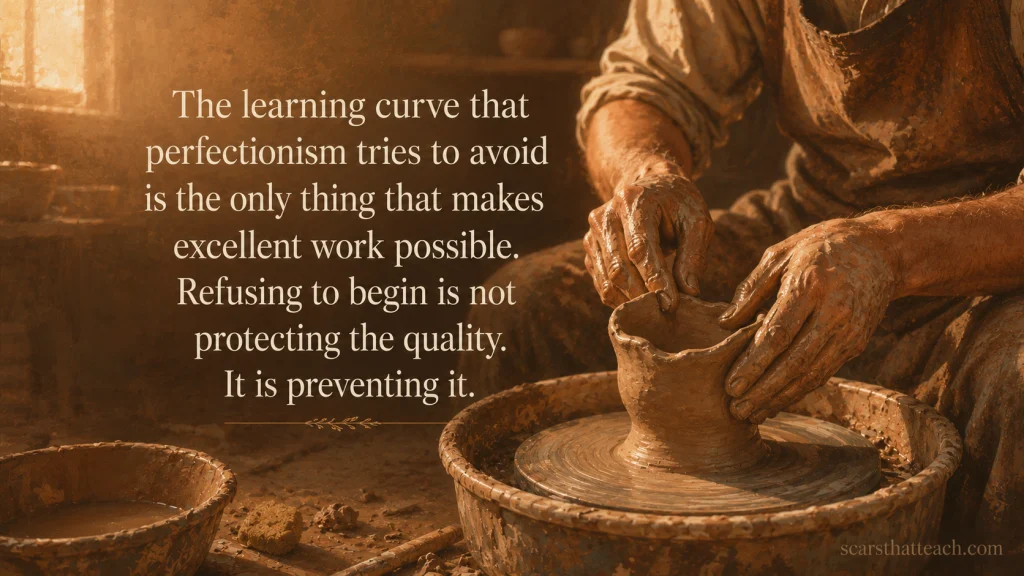
That is a real cost, even if it does not feel like one in the short term. The projects that exist only as plans take up space, produce ongoing low-level guilt, and prevent the accumulation of the experience that would actually improve the work. The learning curve that perfectionism tries to avoid is the only thing that makes excellent work possible. Refusing to begin is not protecting the quality. It is preventing it.
If what you are dealing with is more specifically about fear of judgment or failure rather than perfectionist standards in particular, the related pattern in how fear of failure drives procrastination covers that dimension more directly. For the wider context of what procrastination looks like across its different forms, what procrastination actually is and why it happens is where to start. And what people who have built genuine consistency in difficult work have said about the early, imperfect stages of it is captured in what discipline actually looks like from the inside.
FAQs
🤔 Why do perfectionists procrastinate if they have high standards?
Because perfectionism applies the same high standard to starting that it applies to finishing. When only a perfect outcome is acceptable, an early draft or rough attempt counts as failure. Not starting avoids that failure while keeping the possibility of an eventual perfect outcome alive.
🔍 Is perfectionist procrastination the same as regular procrastination?
Not quite. General procrastination is often about avoiding the discomfort of a specific task. Perfectionist procrastination is specifically about the impossibility of beginning without already being excellent at the thing, which eliminates the learning curve that actually makes excellent work possible.
💡 Does lowering your standards actually help with perfectionist procrastination?
Rarely, in practice. Telling a perfectionist to care less about the quality of their work asks them to adopt a framework that feels like capitulation. What tends to work better is separating the standard for the finished work from the tolerance for the necessarily imperfect process of producing it. Those are different things, and holding them separately is what makes starting possible.
🌱 What actually helps perfectionist procrastination?
Self-compassion toward the process, not lower standards for the outcome. The research on this pattern points consistently toward the ability to tolerate the messy, imperfect middle stages of work without treating them as evidence of failure. That tolerance is what makes starting possible without requiring you to pretend to care less than you do.
⏳ Why does waiting for the perfect conditions never work?
Because the conditions for a perfect outcome, by definition, never fully arrive. There is always something else to learn or prepare. The waiting is logical from inside the perfectionist framework, but the framework itself is the problem. The learning curve that perfectionism tries to skip is the only thing that eventually produces the excellent work it is aiming for.