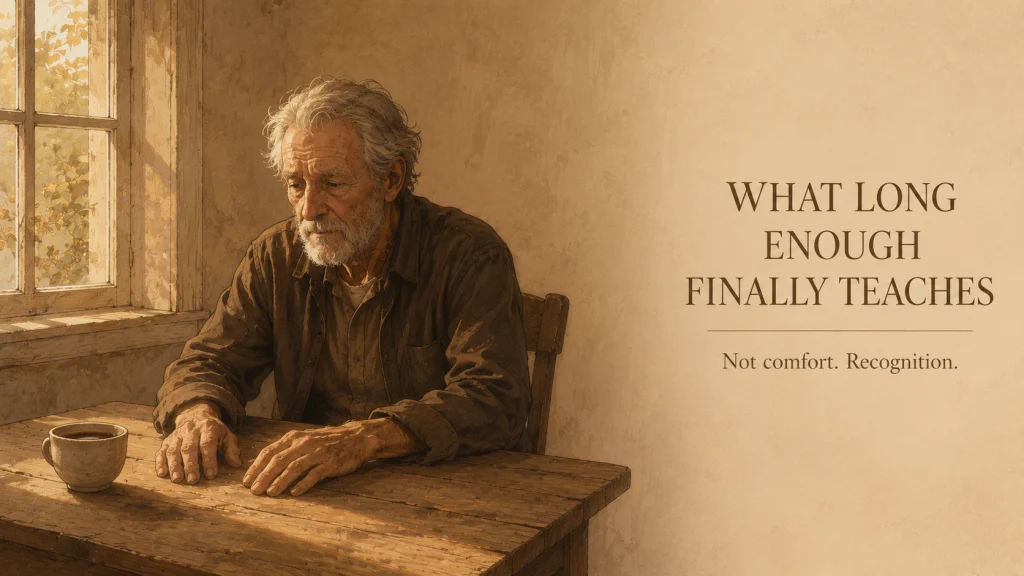
Most collections of life lessons quotes treat every line as interchangeable, stack them, share them, move on. What I noticed over two decades in hospice work is that the wisdom people actually carry to the end of their lives clusters around four things: what long experience slowly teaches, what patience really costs, what happens when we stop trying to control outcomes, and what an honest reckoning with mortality tends to clarify. This is not another flat list. Each quote here is placed where it belongs, in the domain of lived wisdom it most honestly addresses.
The Most Useful Life Lesson I Ever Heard Was Not Delivered as a Lesson
A man I sat with near the end of his life said something I have been turning over ever since. He was not speaking to me directly. He was speaking to his son, who had asked him what he wished he had understood earlier. He paused for a long time and then said, quietly: “That most things I worried about were already over by the time I got around to worrying about them.” He said it the way someone states a fact about the weather. No drama. No regret in his voice. Just observation, delivered after a very long time of watching himself and the world.
I did not fully understand what he meant until years later. He was not saying that worry is pointless. He was saying something more precise: that the mind tends to arrive at the crisis after the crisis has already decided. And that a life spent in that lag, between what is happening and the story we construct about it, is a particular kind of suffering that almost no one names directly.
That is what the best life lessons quotes actually do, when they are good. They name something that was already true but that most of us had not found language for yet. The problem is that almost every place you go looking for them, Goodreads, Pinterest, the usual corners of the internet, presents them as a flat list. Fifty quotes about strength. One hundred quotes about wisdom. Every line given equal weight, no matter what it is actually pointing at. You scroll through and nothing lands because nothing has been placed in context. A quote about patience sits next to a quote about mortality sits next to a quote about gratitude, and the reader walks away with nothing because they were given everything at once.
What follows is different. I have organized these quotes the way I came to organize the patterns I saw in those rooms: by the domain of lived experience each one most honestly addresses. Not what they sound like, but what they are actually about.
What Long Experience Actually Teaches
There is a version of wisdom that is assembled from reading. And there is a version that comes from having been inside something long enough to see its pattern. The two feel different when you encounter them. One has the texture of a summary. The other has the texture of recognition.
Marcus Aurelius wrote in his private journal, never intending anyone else to read it, that a man who has lived well has already had everything worth having, and that what remains is repetition. The full passage, from Book 9 of the Meditations, is worth reading in its original context, but the core observation is one I saw confirmed many times: people who had built lives with real substance in them did not arrive at the end asking for more time. They arrived asking why they had spent so much of it managing things that turned out not to matter.
“Nowhere can man find a quieter or more untroubled retreat than in his own soul.”
That line is from the Meditations, Book 4. Marcus was writing it to himself during one of the most demanding stretches of his life as emperor, wars on the frontier, administrative strain, personal losses. He was not describing a state he had achieved. He was reminding himself that it was available. That distinction matters. The quotes people most often reach for in hard moments are the ones that describe an accomplished peace. The ones that hold up are the ones written by people still inside the difficulty, finding something real to stand on.
The pattern I saw most often in people who had genuinely learned from long experience was not equanimity in the abstract. It was a specific, earned willingness to stop arguing with what had already happened. Not forgiveness, exactly. Not acceptance in the therapeutic sense. Something quieter than either of those: the recognition that the past is finished, and that most of the suffering people carry in their sixties and seventies is still being powered by arguments with their forties and fifties.
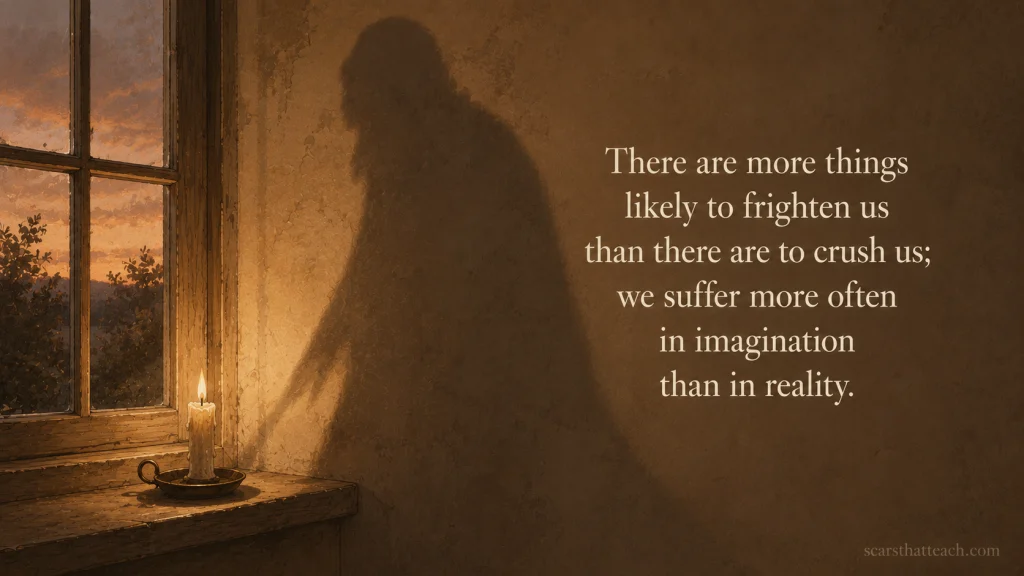
The wisdom quotes most worth keeping are the ones that address this directly. Seneca wrote, in Letter 13 of his letters to Lucilius: “There are more things likely to frighten us than there are to crush us; we suffer more often in imagination than in reality.” That line traces to a verified primary source. And what makes it worth more than most quotes on the subject is that Seneca was not writing from a position of comfort. He was writing under Nero, aware of his own precariousness. The observation was not theoretical for him. Wisdom earned under real pressure lands differently than wisdom assembled from a quiet life.
The lessons that emerge from genuinely long experience tend to cluster around a few things:
- The distinction between what can still be changed and what has already been decided rarely becomes clear until much later than it should.
- Most of the pain that persists well into later life is not about what happened. It is about the story that has been built around what happened, and maintained.
- The things people describe as regrets are almost never the bold choices. They are the ones that were never made, the things left unsaid, the conversations that were delayed until they became impossible.
- A life with genuine relationships in it is almost always reported as a rich life, regardless of most other circumstances. A life organized primarily around external achievement rarely is.
None of that is surprising to read. Almost everyone who encounters it will say yes, of course. The harder question is what it costs to actually know it, rather than simply having read it. That is the gap the best life lessons quotes address, and why a flat list of them misses the point entirely. The insight that lands on a Tuesday at 3am when you cannot sleep is not the insight you wrote down in a notebook at thirty. It is the one that finally connected to something you lived through.
For a much deeper treatment of what people who have lived long lives report learning, the work of sitting with that question across many conversations over years, life lessons from the elderly explores those patterns in full.
The Quotes That Actually Address Patience
Of all the qualities wisdom literature tries to describe, patience is probably the most misrepresented. The way it gets described, in quotes, in advice, in the motivational corner of the internet, treats it as passive. As waiting. As a kind of practiced endurance that looks serene from the outside and feels like nothing much from the inside.
That is not what patient people describe. What patient people describe is an active process of deciding, repeatedly, not to act on the first version of their reaction. It is not the absence of feeling. It is the practice of not treating every feeling as instructions.
Seneca wrote in Letter 1 of his letters to Lucilius: “Omnia, Lucili, aliena sunt, tempus tantum nostrum est,” which translates as “All things, Lucilius, belong to others; time alone is ours.” This is often quoted in the context of urgency, of not wasting time. But read in context, it is equally about the opposite: the patience that comes from understanding what is actually yours to spend and what is not. You cannot be patient with anything you are treating as your possession. The moment you need an outcome to go a particular way, waiting for it to go that way is not patience. It is anxiety with a quieter face.
“Putting things off is the biggest waste of life: it snatches away each day as it comes, and denies us the present by promising the future.”
– Seneca, On the Shortness of Life –
That quote sits in productive tension with patience. What Seneca is describing is not the patience that waits for the right moment. It is the impatience of deferral, the habit of postponing the things that matter while tending to the things that feel urgent. A person can be extremely patient in the wrong direction: waiting for the relationship to get better on its own, waiting for the conversation to become easier, waiting until the grief has passed enough that it feels safe to look at. That is not patience. That is avoidance wearing patience’s clothes.
What I noticed in people who described themselves as patient, and who seemed to mean it in a way that held up, was something more precise. They had learned, at some cost, to distinguish between the situations where waiting served something real and the situations where they were simply not ready to act and calling it patience. The first kind produces something. The second kind produces more of the same, accumulated.
The wrong move, and I saw it made often, was to treat patience as its own answer. Someone in a difficult relationship, or a long stretch of grief, or a period of real uncertainty, would read a quote about patience and feel temporarily steadied. Then the steadiness would wear off and they would go looking for another quote. The quote was doing the work the situation required from them. That is a recognizable pattern, and it is worth naming clearly, because understanding what patience actually asks is the entry point to being able to practice it. There is a fuller account of what that practice looks like, and what most people consistently get wrong when they try to develop it, in the material on how to be more patient.
The Relationship Between Control and Peace
The most-quoted idea in all of Stoic philosophy is the distinction between what is within our control and what is not. Epictetus opens the Enchiridion with it. Marcus Aurelius returns to it in the Meditations so many times it is clear he did not feel he had mastered it. He felt he needed the reminder. That is not a footnote. It is, I think, the most important thing about the idea.
No one who has genuinely reckoned with the control question reads those quotes as a comfort. They read them as a discipline. The comfort is downstream of the discipline, and only available to people who have done the actual work of asking, repeatedly and honestly, which category any given situation belongs in. Most people do not do that work. Most people read the idea, find it self-evidently correct, agree with it enthusiastically, and then spend the next several years in exactly the same relationship with control that they were in before they encountered it.
“The chief task in life is simply this: to identify and separate matters so that I can say clearly to myself which are externals not under my control, and which have to do with the choices I actually control.”
– Epictetus, Discourses, 2.5.4-5 –
What that passage actually requires is uncomfortable. It requires sitting with the fact that most of what people spend their emotional energy on, the outcome of the conversation, how someone receives what you said, whether the relationship recovers, whether the other person changes, falls entirely in the category of things not within their control. And that is not a liberation when you first fully understand it. It is a loss. The fantasy that sufficient effort, sufficient care, sufficient waiting, sufficient love, will eventually produce the outcome you need, that fantasy does not dissolve comfortably. It dissolves slowly, and what it leaves behind takes time to get used to.
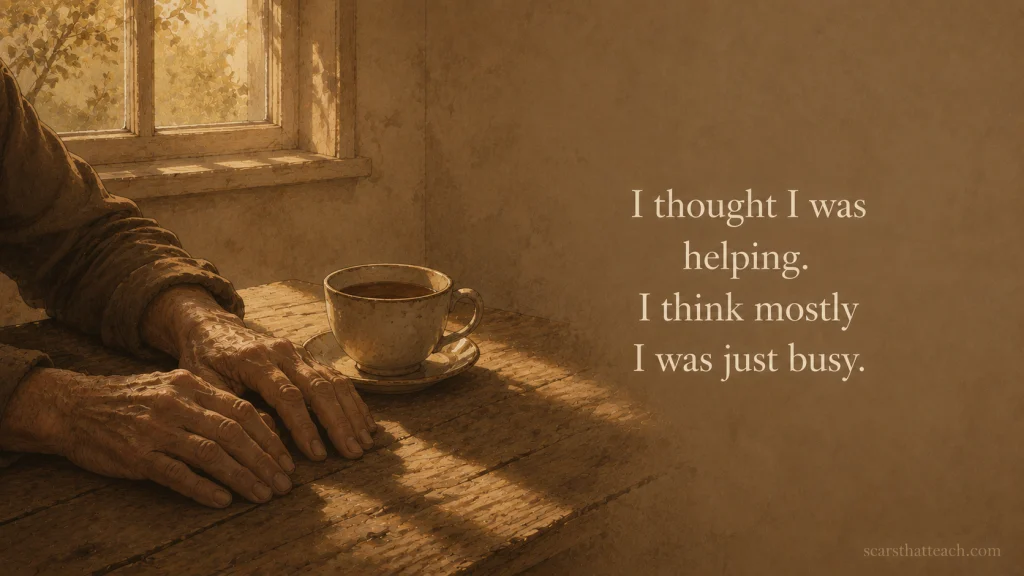
A woman I sat with once, in the last weeks of her life, told me she had spent forty years trying to manage her daughter’s relationship with grief. Every loss the daughter experienced, the mother had tried to intervene, to soften, to redirect, to shorten the duration of pain. She was not a controlling person in any obvious sense. She was a kind person. But she had never been able to tolerate watching her daughter suffer without trying to act on the suffering, and so she had spent four decades working on something that was never hers to manage. By the time we spoke, she did not describe this with bitterness. She described it with something closer to bemused resignation. “I thought I was helping,” she said. “I think mostly I was just busy.”
That is what the control question actually looks like when it has been lived, rather than read. The quotes that address it honestly point not to peace as the immediate outcome but to an ongoing process of negotiation with one’s own assumptions about what is possible to affect and what is not. The peace, where it comes, arrives after a great deal of that negotiation. Understanding what is actually involved in that process is the subject of a much longer conversation about letting go of control.
What an Honest Reckoning with Mortality Tends to Clarify
The quotes that get grouped under mortality are the ones people are most likely to encounter in a meaningful context and least likely to sit with for long. There is a reflex to move through them quickly, to register the thought, find it either comforting or uncomfortable, and return to the surface. I understand the reflex. I also watched, over twenty years, what it costs people.
Marcus Aurelius wrote a version of the same reminder to himself so many times across the Meditations that scholars have noted it as almost compulsive. One of the clearest passages is from Book 4: “Think of yourself as dead. You have lived your life. Now take what’s left and live it properly.” The Gregory Hays translation renders it most directly. The point is not morbidity. The point is the same one the Stoics returned to again and again: that the awareness of a limit changes what happens inside it.
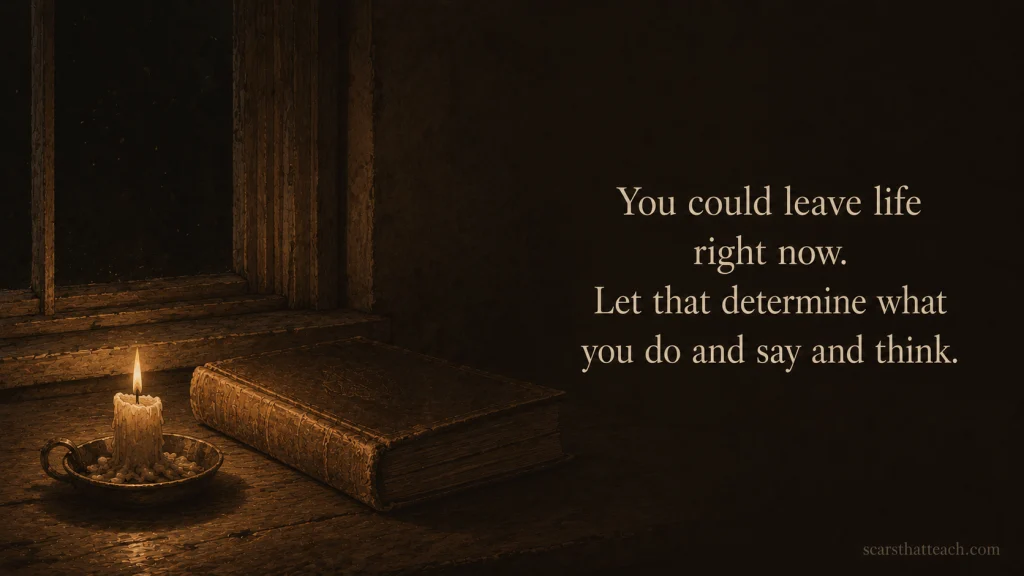
“You could leave life right now. Let that determine what you do and say and think.”
– Marcus Aurelius, Meditations, Book 4.17 (Gregory Hays translation) –
That is not a comforting quote. It is not designed to be. And it is not the kind of thing that lands as useful when you read it in a list between a quote about courage and a quote about kindness. It lands when you have just received news that redraws the timeline, your own, or someone you love, and suddenly the abstract becomes concrete. I have seen people read that line in a hospital waiting room and say nothing for a very long time. That silence is not emptiness. It is the sound of something shifting.
What mortality clarifies, for almost everyone who actually sits with it rather than around it, tends to be surprisingly specific. It is rarely the large things. People do not, in my experience, discover at the end of their lives that they should have traveled more or worked less. Those are the answers we assume we will give because they sound right. The actual answers are almost always smaller and more precise: a specific person they never fully said the thing to, a specific period of their life they spent managing the wrong problem, a specific fear they organized years around that turned out to be groundless.
The quotes that illuminate this are not the ones that present mortality as a backdrop for urgency. They are the ones that ask the harder question: given that this is finite, what are you doing with the attention you have right now? Seneca, in Letter 12, writes about old age not as a diminishment but as a condition that allows a man to see his life clearly for the first time. The line that has stayed with me from that letter: “When a man has said, ‘I have lived,’ every morning he arises he receives a bonus.”
There is much more to be said about what actually happens when people turn toward this question rather than away from it. I have written about that at length in the section on thinking about your own mortality, which is less about death itself than about what happens to the quality of living when the fact of death is no longer kept at arm’s length.
What Most People Get Wrong When They Go Looking for This
The search for life lessons quotes is almost always motivated by something real. Someone is carrying a specific weight and hoping to find language for it, or confirmation that other people have navigated something like what they are navigating. That is a reasonable thing to want. The mistake is trusting the attribution without checking it.
A significant portion of the most widely circulated lines in this genre are either misattributed, paraphrased so loosely they bear little resemblance to what was actually written, or simply invented and assigned to a name that grants them authority they would not otherwise have. This is not a minor editorial problem. It matters for a specific reason: a line carries different weight depending on who said it, when, and under what conditions. Seneca writing about fear while politically vulnerable under Nero is a different thing from the same sentiment written by someone who has read about Stoicism and distilled it into a shareable format. The origin is not decoration. It is part of the meaning.
The sites that dominate this space, Goodreads, BrainyQuote, Pinterest, do not verify attributions. They aggregate. A quote gets shared enough times with a famous name attached and the name sticks, regardless of whether the person ever said anything like it. Marcus Aurelius alone has dozens of lines attributed to him online that do not appear anywhere in the Meditations or in any credible secondary source. The quotes feel Aurelius-adjacent, which is enough for most people, and they get passed along.
The practical test is simpler than most people expect. For any line attributed to a Stoic philosopher, look for a book title, a letter number, or a specific passage reference. The three primary sources are the Meditations for Marcus Aurelius, the Moral Letters to Lucilius and On the Shortness of Life for Seneca, and the Discourses and the Enchiridion for Epictetus. All of them are freely available in full text online. If you cannot locate the line in the actual text, or in a cited scholarly source, the attribution is suspect. A useful, anonymous observation is still useful. It just does not need a borrowed name on it.
The same standard applies to the more contemporary quotes that circulate alongside the ancient ones. A line about regret attributed to a famous writer who has no record of saying it is a claim, not a fact. Treating it as a fact, and building your thinking around it, is building on ground that might not hold. What I watched people do in those hospital rooms and living rooms was not quote famous thinkers. They said what they had actually learned, in plain language, with no name attached. That plainness was part of what made it land.
Final Thoughts: What to Take From This, and Where to Go Next
The man whose words I started with, the one who said that most of what he had worried about was already over by the time he got around to worrying about it, was not describing a philosophy. He was describing a pattern he had noticed across the arc of his own life. That is a different thing. A philosophy can be adopted. A pattern that has been observed across many years, at some cost, is harder to borrow. You can only come to it by being willing to look at what you have been doing with your attention.
The quotes here are not meant to settle anything. A line from Marcus Aurelius does not resolve what you are carrying. A passage from Seneca does not make the hard conversation easier. What they can do, when they land right, is give you a frame for something you have been carrying without language for it. That is not nothing. But I would rather be honest about what it is than let you leave thinking that reading the right thing changes the situation. The situation is yours. The reading is just a start.
Each of the domains covered here has a great deal more in it than a few quotes and a few paragraphs can hold. The four directions this material points toward are the four hubs this site builds on:
| Where to Go Next | What It Covers |
|---|---|
| Life Lessons From the Elderly | What people who have actually lived long lives report learning, the patterns that showed up across many conversations, not a summary of what we assume they would say. |
| How to Be More Patient | Not patience as a personality trait or a waiting posture, but as a practice with a specific shape, and what most people consistently misunderstand about it. |
| Letting Go of Control | What the control question actually asks of you when you take it seriously, beyond the idea, into the difficult and specific work of applying it to a real situation. |
| Thinking About Your Own Mortality | What changes in the quality of daily living when the fact of death is no longer kept at a careful distance, and why most people find that change clarifying rather than frightening. |
Take whatever landed and follow it. Leave the rest for later, or not at all. Wisdom does not expire, and it does not require you to absorb it all at once.
FAQs
📖 What are the most meaningful life lessons quotes, and why do so few of them actually help?
The most meaningful ones are the ones written by people who were inside difficulty when they wrote them, not looking back from comfort. Seneca writing near the end of his life, Marcus Aurelius writing to himself during a war. They land because they carry real weight. Most quote collections fail because they present everything as equally applicable, regardless of what the reader is actually trying to understand.
🧭 What is the most important life lesson people learn late?
From what I saw over two decades: that most of the things people spent years trying to manage or change were never actually within their power to manage or change. The suffering was real. The effort was genuine. But it was aimed at the wrong target, and most people did not see that until very late.
🕰️ What do quotes about patience get wrong?
They treat patience as passive, as a kind of dignified waiting. Real patience is an active practice of repeatedly deciding not to act on the first version of a reaction. It is not comfortable and it is not serene. It is a discipline that has to be chosen again and again, usually under conditions where it is the last thing you feel like choosing.
💭 Why do so many people find Marcus Aurelius quotes about mortality easier to share than to act on?
Because sharing is costless and acting is not. Reading “you could leave life right now” takes three seconds. Sitting with what that actually changes about how you are spending your attention this week is a different kind of work entirely. The quote is the beginning of the question, not the answer.
⚠️ How do I know if a life lessons quote is actually verified or just made up?
If you found it on Pinterest, Goodreads, or BrainyQuote, trace it before you trust it. Many of the most widely shared lines are misattributed or invented. Look for a specific source: a book title, a letter number, a chapter reference. If you cannot find one, treat the line as useful but anonymous, rather than borrowing the authority of a name that may not belong to it.
🔄 Is there a faster way to tell if a life lessons quote is worth sitting with?
Ask what it is actually describing. Not what it sounds like, but what specific situation or experience it is pointing at. A quote that could apply to everything usually applies to nothing. The lines that hold up are the ones with a precise subject: a particular kind of loss, a particular moment of reckoning, a thing a person noticed after a very long time inside something difficult.