
Toxic people quotes are most useful not when they feel clever but when they feel true, and what feels true depends heavily on who your toxic person actually is. This collection is organized by relationship type rather than theme, because what you need to hear when the difficult person is a parent is not the same as what you need when it is a friend, or a former partner you are still making sense of. Each section pairs one piece of earned language with a brief interpretation and routes toward the writing where the fuller picture lives. The goal is not a list to scroll through. It is a place to locate yourself.
The Moment Your Own Words Run Out
I have sat with hundreds of people in the final weeks and months of their lives, and one of the things that surprised me early in my work was how often someone would reach for someone else’s words to describe their own experience. Not because they had nothing to say. Because what they were holding had not yet found its shape in their own language. A person could explain their situation in practical terms, could describe events and timelines clearly, but when it came to naming what it had actually felt like to spend years inside a relationship that diminished them, they sometimes stopped mid-sentence and said: I do not have the words for this.
That is what toxic people quotes are actually for, at least the ones worth anything. Not the ones designed to make someone feel righteous or vindicated, though that is sometimes what a person needs in the moment. The ones that carry real weight are the ones that make you stop and think: that is exactly what this has felt like. That moment of recognition is not small. It means something you have been carrying alone now has company. And having company with a hard thing, even in the form of someone else’s sentence, can shift something.
The people who go looking for this kind of language are not, in my experience, weak or without clarity. They are usually somewhere in the middle of figuring out what they are dealing with. A parent who picks at everything they do and calls it love. A friend who is somehow never quite honest with them. A partner who has made them feel incrementally smaller over years. The quote does not solve any of that. What it does is give them a handhold, something to stand on while they decide what comes next.
When someone shows you who they are, believe them the first time.
– Maya Angelou –
What makes that line so durable is not the sharpness of it. It is the permission. People who end up in damaging relationships often spend months or years trying to see past behavior toward intent, trying to understand the why before they allow themselves to respond to the what. That line collapses the distance. It says: the behavior is the information. You do not need to understand the reason before you decide what to do with what you already know.
What the Lists You Have Already Found Are Missing
If you searched for quotes about toxic people before arriving here, you almost certainly found a flat list. Fifty quotes. A hundred. Sometimes one with clinical sourcing, organized around toxic people traits rather than relationships, which gets closer to useful but still leaves the reader to work out how dismissiveness or control shows up differently in a parent versus a friend. The format does not change: you scroll until something resonates, and then you are still on your own to figure out what to do with it. That is the limit of the undifferentiated list. It does not know anything about your situation, so it cannot do anything except hope a particular sentence catches something.
The problem is not the quotes themselves. The problem is that what you actually need depends heavily on who your toxic person is, and that distinction is almost never made in the places you find this content. The four situations below are genuinely different from each other. They require different language and, more importantly, different paths forward.
- Family: The toxicity often predates your ability to recognize it. It was the environment you came up in. That makes it harder to name and harder to hold at a distance, even once you see it clearly.
- Friendship: The damage tends to compound quietly, without any moment dramatic enough to name. By the time the pattern is visible, it has often been present for years.
- Loneliness inside a relationship: Some people spend years surrounded by someone who does not actually see them. The isolation that creates is real, and it is different from ordinary aloneness.
- A relationship that is over: The ending does not end the weight of it. The questions a damaging relationship leaves behind can persist long after all contact is gone.
What follows is one section for each of these situations: one piece of language that fits that relationship type, a brief interpretation, and a route toward the writing that goes deeper. Not a list to read through in one sitting. A place to find the section that fits where you actually are.
When the Toxic Person Is Family
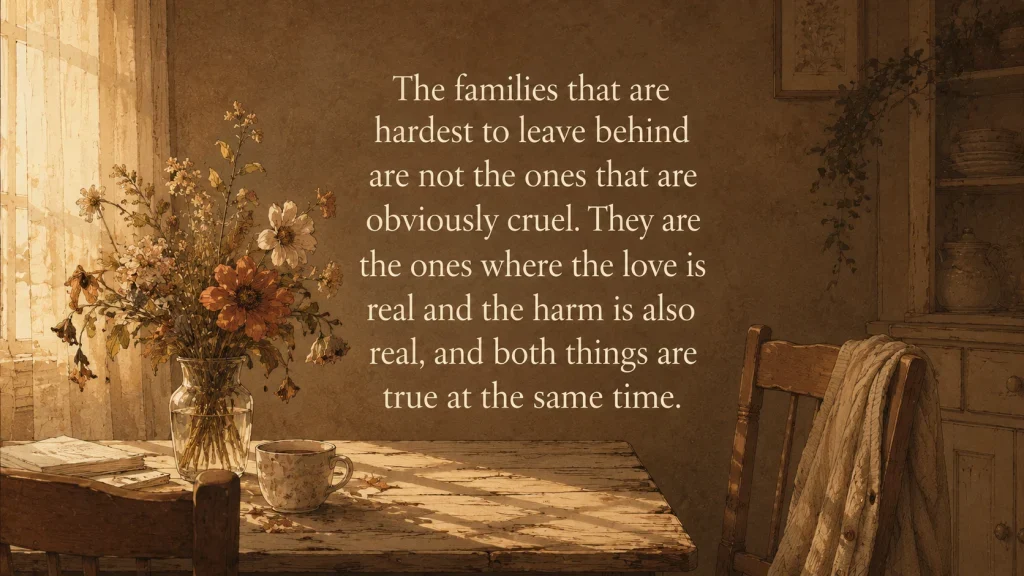
“The families that are hardest to leave behind are not the ones that are obviously cruel. They are the ones where the love is real and the harm is also real, and both things are true at the same time.”
What I have noticed across two decades of sitting with people who were reckoning with family relationships is that this particular kind of damage is the hardest to name clearly. It rarely looks like what you would expect. A parent who genuinely loves you and cannot stop undermining you. A sibling who drains every room they walk into without ever doing anything you could point at directly. A dynamic that was established long before you had the capacity to question it, which means by the time you can question it, it already feels like the definition of normal. That is the specific problem with family toxicity. The baseline was set for you.
There is a particular kind of grief that comes with having a toxic family member. It is not the same as losing someone. It is more like grieving someone who is still present and still causing harm, someone you are supposed to love and do love and also need to protect yourself from. Most people take years to name that correctly, if they ever do. Some only arrive at it in the final period of their lives, when the energy required to maintain the story that it was all fine is no longer available to them.
The language for this situation is different from the language for toxic friendships or the aftermath of a damaging partnership. If this is where your situation lives, the writing on what toxic family dynamics actually look like goes into the specifics of what this pattern involves and what people find when they finally look at it without the usual explanations in the way.
When the Toxic Person Called Themselves Your Friend
“The friendships people regret most are rarely the clearly bad ones. They are the ones where the damage happened in increments small enough that no single incident ever seemed like a reason to say something.”
Toxic friendships are strange because the accumulation of harm often happens quietly. There is no single incident that feels large enough to justify naming it. You feel worse after spending time with this person and better when they are not around, and yet somehow that observation never becomes the conclusion it should. The ambiguity is usually not an accident. People who are consistently unkind in close relationships tend to be good at keeping each specific instance just small enough to explain away.
What I have heard from people reflecting on these friendships, often late in life and with the clarity that comes from having nothing left to protect, is not anger at the other person. It is a kind of bewilderment at themselves. Not at having been deceived, exactly. At having spent years applying generous explanations to a pattern that was not that complicated once they stopped working so hard to interpret it charitably. That bewilderment is worth understanding, because it is not stupidity. It is the predictable result of caring about someone who kept the evidence of what they were doing just ambiguous enough to absorb into a more charitable story.
If this is your situation, the writing on recognizing fake friends and what they cost you covers why these relationships are so difficult to read clearly and what that difficulty is usually about, before it covers what comes after.
When the Damage Left You Feeling Alone
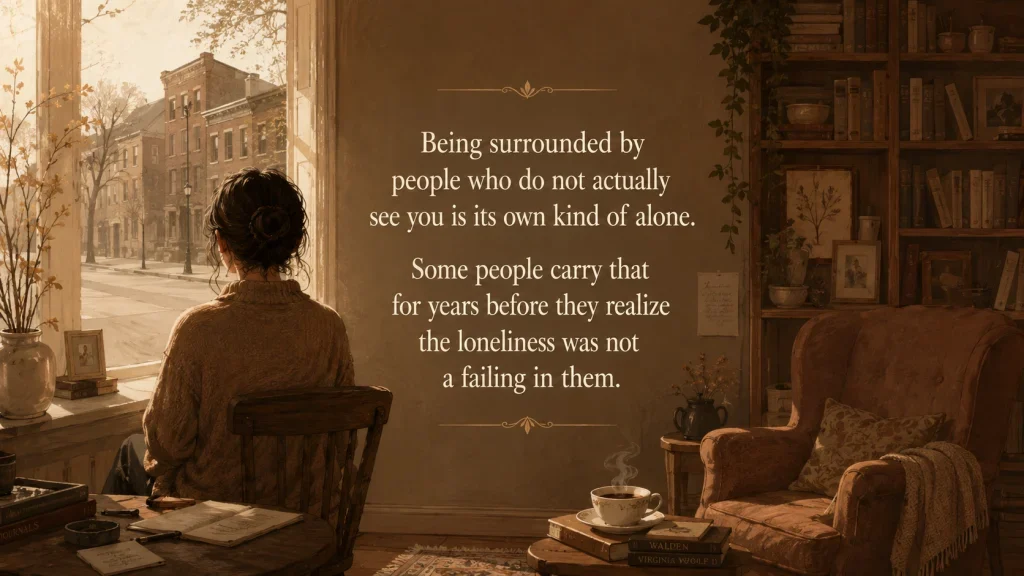
“Being surrounded by people who do not actually see you is its own kind of alone. Some people carry that for years before they realize the loneliness was not a failing in them.”
There is a kind of loneliness that has nothing to do with being by yourself. It is the loneliness of being around the wrong people, of being present in a relationship and still not being known by it. Toxic relationships produce this. Not always visibly. Sometimes the absence of real connection inside a relationship is so gradual that the person inside it begins to assume the emptiness is theirs to fix, a problem with their own capacity rather than a result of what the relationship has been doing to them.
I have seen this pattern surface in people who spent years with someone controlling, someone persistently dismissive, someone who needed so much that there was never room for an honest conversation about anyone else’s experience. The loneliness that results is different from ordinary aloneness. It carries a quality of having been negated, of having offered something genuine and had it ignored or made smaller than it was. That is worth naming separately from the relationship itself, because some people recover from the relationship before they recover from that specific damage.
If what sits heaviest right now is that quality of isolation, the writing on loneliness that forms inside toxic relationships addresses what that kind of loneliness actually is, how it develops inside a relationship rather than from the absence of one, and what becomes possible when it is named clearly.
When the Relationship Is Over but the Weight Is Not
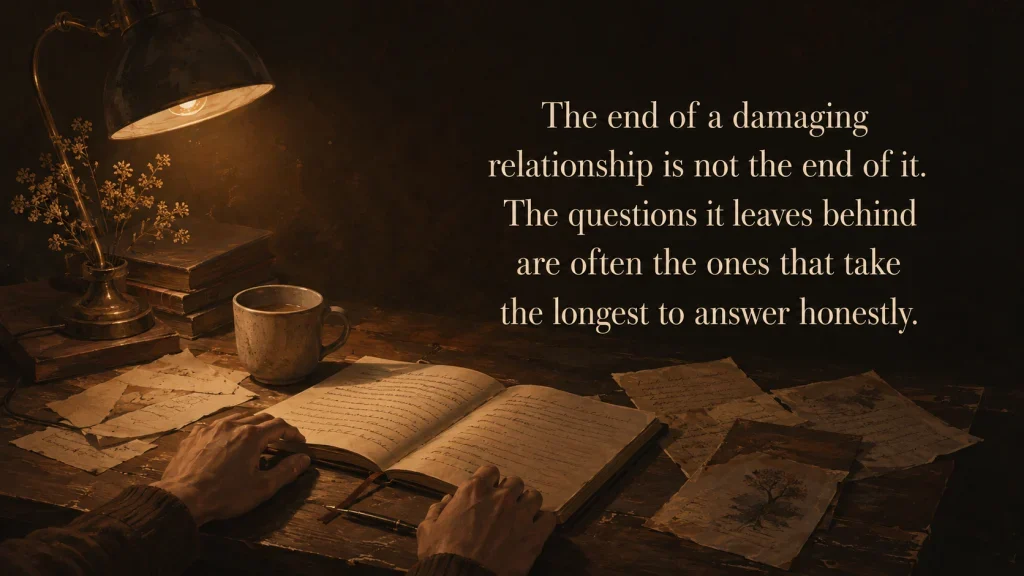
“The end of a damaging relationship is not the end of it. The questions it leaves behind are often the ones that take the longest to answer honestly.”
There is a particular difficulty in realizing that removing someone from your life does not automatically remove their effect on it. Contact gone. The relationship finished. And still: the self-doubt, the instincts that got calibrated to a relationship that was not safe, the habit of explaining yourself that you developed around someone who required constant explanation. People who have been inside genuinely damaging partnerships often find that letting go of a toxic person is not a single act. It is a longer process of understanding what the relationship actually was, which is different from what they were told it was or what they had agreed to believe.
The language people reach for in this situation is different from what they needed while they were inside it. They are not trying to name what is happening to them in the present. They are trying to make sense of what happened and what it left behind. The quotes that matter here are not about boundaries or self-protection in the abstract. They are about the specific kind of clarity that becomes possible when the noise of the relationship itself is gone and what remains is a clearer look at what it actually cost and what it actually taught.
If this is where you are, the writing on lessons that damaging relationships leave behind is built for people on the other side of something, still working through what it left and what they want to carry forward from it.
Final Thoughts: What Language Can and Cannot Do
A quote cannot end a difficult relationship or quiet twenty years of accumulated harm. A piece of language, no matter how precisely it names the thing, does not do the work of deciding what to do next. I want to be plain about that. What it can do, when it lands in the right moment, is give someone a frame they did not have before. A way of saying: this is what this is. I know this now. That is not nothing. But it is also not everything, and two decades of sitting with people in the hardest moments of their lives taught me the difference.
The people who tend to find their footing after damaging relationships are rarely the ones who found the best quote. They are the ones who eventually got clear enough about what they had been inside to stop explaining it away. Language helps with that. So does time, and in some cases the right kind of support from someone who actually knows how to sit with this kind of pain. If what you are carrying feels like more than written language can touch, that is worth paying attention to. A therapist with experience in relational harm can do things a collection of quotes cannot, and knowing that is not a failure.
What this site can do is offer the specific kind of language that tends to be useful before, during, and after the harder work: words for naming what you are inside, for recognizing a pattern you have been too close to see clearly, and for understanding what it leaves behind. Browse by relationship type. Find the section that fits where you actually are. What you do with it is yours.
Where to Go from Here
Each of the four sections on this site covers a distinct relationship type. The writing in each goes past language into what the situation actually looks like, what people commonly get wrong about it, and what a clearer picture of it tends to make possible. Start with wherever your situation actually lives.
| What It Covers | What to Expect |
|---|---|
| Toxic Family Members | Why family toxicity is the hardest kind to name, and what becomes possible when you finally do |
| Fake Friends | How toxic friendships stay below the threshold of what feels like a reason to act, and what that pattern is actually about |
| Loneliness | The specific kind of isolation that forms inside a relationship, and how it differs from ordinary aloneness |
| Lessons from Heartbreak | What damaging relationships leave behind after they end, and how to work through it without pretending it was nothing |
FAQs
💬 What makes a quote about toxic people actually useful?
A useful quote names something you have been feeling without language for it. What matters is the recognition, the sense of: yes, that is exactly what this has been. That moment of having a feeling named by someone else is what gives a quote traction. If it does not produce that, it is just decoration.
🧠 Why do people search for quotes when dealing with a toxic person?
Usually because their own words are not quite landing yet. Finding someone else’s sentence that fits gives them a way to begin naming what they are inside. It is also a form of validation: seeing a pattern described clearly by someone else makes it harder to talk yourself out of what you already know you have seen.
🤐 What do most people get wrong when trying to deal with a toxic person?
They focus on managing each incident rather than naming the pattern. The energy goes toward responding to specific behavior rather than stepping back far enough to see what all of it has in common. Naming the pattern does not automatically tell you what to do next, but it is the prerequisite for almost any decision that holds.
💔 How is a toxic family member different from a toxic friend or ex-partner?
With a toxic friend or ex-partner, you can usually identify a point where the relationship changed or a pattern you can trace. With family, there is often no such point. The dynamic was present before you had the language or the distance to evaluate it, which means it did not arrive as something new. It was already the air. That makes creating distance harder, not just emotionally but practically, because the relationship is woven into obligations, shared history, and other people who need you to behave as though nothing is wrong.
🌿 How do you protect your peace from someone you cannot fully remove from your life?
Mostly by being very clear, privately, about what you will and will not offer the relationship going forward. Full removal is not always possible. What is almost always possible is reducing what the relationship costs you, which usually starts with being honest about what it is and what it is not, rather than what you wish it were.