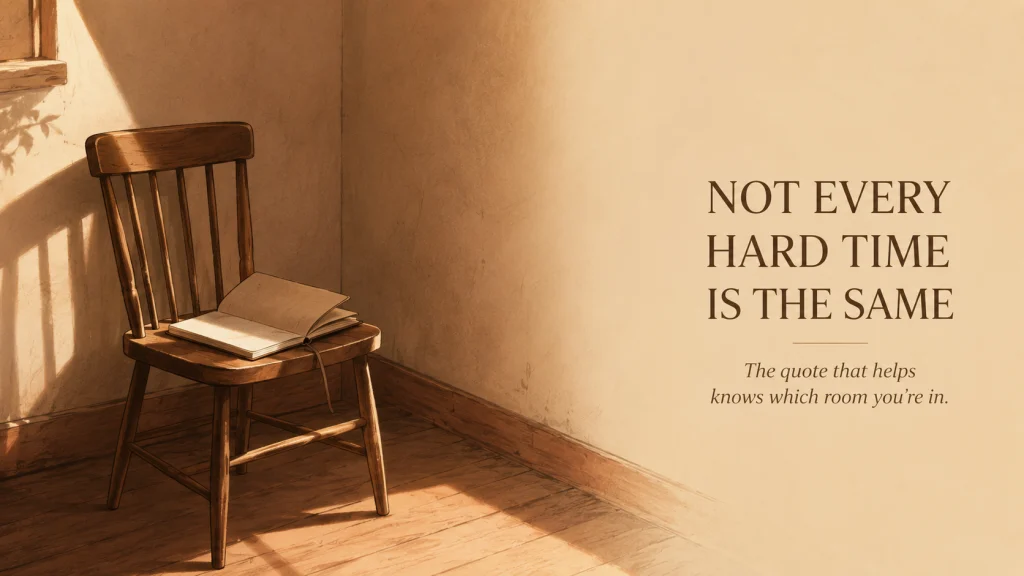
The quotes that hold up under real pressure are rarely the ones about success. After two decades sitting with dying patients and their families, I noticed that the language people actually needed was specific to the kind of hard moment they were in, not failure as a broad category. This collection organizes quotes about failure, starting again, regret, and grief by situation: the four distinct kinds of hard that most lists fold into one. Not every hard time is the same kind of hard. The quotes that help are the ones that know the difference.
The Quotes That Survive the Hard Room
Quotes about failure circulate constantly. They appear on office walls, in graduation speeches, in the kind of productivity writing that treats every setback as a minor delay on the way to eventual success. Most of them are not wrong exactly. They just describe a different room than the one most people are actually sitting in when they go looking for one.
The rooms I sat in for twenty years were not productivity rooms. They were rooms where something had already come apart, where the thing that had been hoped for was not going to happen, where a relationship or a body or a version of a future had ended in ways that no amount of reframing would fix. The quotes people needed in those rooms were different. They needed language that made room for the failure, not language that rushed past it toward something better.
Samuel Beckett wrote one of the most quoted lines about failure in the 1983 prose piece Worstward Ho. What he actually wrote, in context, was darker than its modern use suggests. Not a call to bounce back, but a recognition of how futile and necessary the attempt is anyway.
“Ever tried. Ever failed. No matter. Try again. Fail again. Fail better.”
– Samuel Beckett, Worstward Ho (1983) –
What makes this land, I think, is not optimism. It is permission. Permission to fail again, not as a step toward eventual success, but because trying is the only thing left to do. The people I sat with near the end of their lives understood this instinctively. What they were looking for was not encouragement to succeed. It was permission to still be human inside the failure they were carrying. That is a different kind of quote than most lists offer.
Why the Situation Changes What Helps
The standard failure quote list treats starting over, regret, self-blame, and grief as interchangeable. They are not. A person trying to figure out what to build after their career or marriage collapsed is in a genuinely different place from a person who has spent twenty years not saying something they needed to say to someone who is now gone. The life lessons that hold from genuinely hard times are specific to the kind of hard moment they came from. The quotes that reach each of them are not the same quotes. Handing someone the wrong kind of language at the wrong moment does not just fail to help. It can feel like a dismissal of what they are actually in.
What I saw, more times than I can count, is that the wrong kind of encouragement lands like an implication that the person is doing their grief or regret incorrectly. “Failure is just a stepping stone” is not what someone needs when the thing they are mourning is not a stepping stone. It is a person, or a relationship, or a version of their own life that they cannot go back and repair. The four situations that come up most consistently, and that call for genuinely different kinds of language, are these:
- You need to start over because the life you had, or were building, is no longer available to you.
- You are carrying regret for something that was never done or said, and you cannot go back to change it.
- You made a real mistake, and you have been unable to let yourself off the hook for it.
- You are inside grief, and something or someone is simply gone.
Each of these calls for a different kind of honesty. What follows is organized by that distinction rather than alphabetically or by sentiment, which is where most quote collections leave you to figure it out yourself.
When You Need to Start Over
Starting over is one of those phrases that sounds more manageable than it is until you are inside it. The problem is rarely a lack of motivation or vision. It is that starting over requires letting go of the identity and the set of assumptions that went with the life you had, and that is not a small thing. The people I watched attempt this near the end of their lives were not struggling with effort. They were struggling with the question of who they were going to be now that the version of themselves they had built was no longer available.
The instinct, when facing that question, is to reach for something that tells you it is going to be fine. I understand the pull of that. But what I found, again and again, is that the starting over quotes that actually land in these moments are not the ones that promise a better outcome. They are the ones that honestly name what the transition costs. Starting over is not a reframe. It is a loss, and then, if you are willing, a beginning. Those are two different things, and most encouragement collapses them into one, which skips the part that actually needs to be held.
T.S. Eliot wrote the lines that name this most precisely in “Little Gidding,” the final poem of his Four Quartets. He was not writing about starting over in any practical sense. He was writing about the relationship between endings and beginnings near the end of his own life, and what he produced has held because it is accurate rather than encouraging:
“What we call the beginning is often the end. And to make an end is to make a beginning. The end is where we start from.”
– T.S. Eliot, “Little Gidding,” Four Quartets (1942) –
What holds in this is the sequence. Not “endings lead to better things” as a comfort, but something more specific: the beginning is already inside the ending, and you cannot reach it without first naming the end fully. Most people trying to start over discover this slowly and backwards. They move toward something new before they have actually finished grieving what ended, and the unfinished grief follows them forward without ever announcing itself.
There is a pattern I saw often enough to stop calling it a coincidence. The people who came through a real starting-over period with something intact were almost never the ones who minimized what they had lost. They were the ones who let the loss be real first, and then, from that honesty, found something worth building next. The people who moved past the loss without naming it tended to carry a low-grade grief forward into whatever came after, never quite able to name what was still weighing on them years later. The harder questions about what a genuine fresh start asks of you, and what the people who have been through it actually found, are what the material on starting over after loss or failure goes into directly.
When Regret Is the Weight You Are Carrying
Regret for what was never done is a different kind of weight than regret for a mistake you made. Both are real, but the regret for the thing that was never said, the conversation that kept not happening, the choice that went unmade until the window closed entirely, has a quality that most encouragement cannot reach. It sits in the past tense permanently. There is no action available to resolve it. The only direction it can be worked on is internal, which is exactly what most advice about failure is not designed for.
The quotes about regret and moving on that circulate most widely tend to treat regret as a thinking error: something to correct by shifting perspective or deciding to release it. That is not what most people carrying serious regret are dealing with. William Faulkner understood something about this in Requiem for a Nun that most people spend years not wanting to admit. His character says it plainly, in a way that does not offer comfort so much as it offers clarity:
“The past is never dead. It’s not even past.”
– William Faulkner, Requiem for a Nun (1951) –
What people often want when carrying this kind of regret is permission to put it down. What the Faulkner line offers instead is something harder: the acknowledgment that it will not stay down, because it is still here, still active, still shaping how the present feels. The unfinished thing is not stored away. It is ongoing. That is not comfortable. But in my experience, the people who found some genuine peace with their regrets were almost never the ones who managed to stop thinking about them. They were the ones who found a way to carry them that was less punishing, which starts with being honest about what they were actually carrying and why it still mattered. If that is the kind of work you are in, what the people carrying unfinished business found when they finally looked at it directly is what the material on lessons learned too late is organized around.
When You Cannot Forgive Yourself for a Mistake
Self-forgiveness gets oversimplified into a sequence of steps almost immediately when people start writing about it. The actual difficulty is not a process problem. It is that the person who made the mistake and the person trying to forgive the mistake are the same person, without the distance that forgiveness usually requires. You cannot walk away from yourself. Whatever happened stays in the room with you. The most common failure I watched in people working through genuine self-blame was not a lack of effort. It was a conflation: they had decided that the mistake was who they were, rather than something they had done.
The distinction sounds small. It is not. A mistake is an event. It has a before and an after. It does not have to define the whole account. The quotes for self-forgiveness that do real work are not the ones that minimize the mistake. They are the ones that refuse to let the mistake be the final word. Maya Angelou spoke to this directly in an interview from her writing life, in language that does not minimize the defeat but refuses to let it be the final word:
“You may encounter many defeats, but you must not be defeated.”
– Maya Angelou, Black Women Writers at Work (1983) –
The line draws a distinction between encountering defeat and being defeated, and that distinction carries real weight when you are inside genuine self-blame. A defeat is an event. It happened at a specific moment, in a specific set of circumstances, and what it says about who you are is worth sitting with honestly. What it does not do, on its own, is settle that question permanently. Most people who struggle to forgive themselves have not made a conscious decision to let the mistake define them. They have simply let the self-blame continue unchallenged until it began to feel like the truth. What actually interrupts that process, and why it is consistently harder than it sounds, is what the work on how self-forgiveness actually works addresses at length.
When You Are Inside Grief
Grief is the one category where the most common encouragement tends to do the most damage. The standard set of consolations, the ones about time healing, about honoring a memory by living fully, about the person being somewhere better, all carry the implicit message that grief is a problem to be solved by moving through it in the right way. The people who struggle most with grief, more often than not, are the ones who have absorbed that message and cannot understand why they are failing at it. They are not failing. They are in it. Those are different things, and the language they need is language that knows the difference.
C.S. Lewis wrote about his own grief after the death of his wife in a notebook that was eventually published as A Grief Observed. He was not writing for an audience. He was writing to try to make sense of what was happening in his own body and mind, in real time, without knowing how it would end. What he produced is one of the most honest accounts of grief I have encountered, and it contains a line I have not found a better way to say:
“No one ever told me that grief felt so like fear.”
– C.S. Lewis, A Grief Observed (1961) –
The passage continues to describe the physical texture of that fear in detail: the restlessness, the fluttering in the stomach, the sense of a blanket between himself and the rest of the world. What I found, sitting with people inside this kind of pain, is that the recognition alone was sometimes the only thing that helped. Not a solution. Not a roadmap. Just the confirmation that what they were experiencing was real, had a name, and had been felt by someone who wrote it down clearly. If you are in that place now, the specific questions grief raises and what those inside it most need to know are at the center of what the material on grief and loss covers.
Final: What Makes a Quote Actually Work
A quote earns its place not by being eloquent but by making someone feel recognized in the middle of something they have not been able to put language to. That is a specific thing. Not every quote about failure does it, and the ones that try to do it for every reader at once tend to do it for no one in particular. The ones that hold tend to have been written by people who were not trying to inspire anyone. They were trying to describe something honestly, usually something they themselves were inside.
What Beckett, Faulkner, Angelou, Eliot, and Lewis share is honesty about cost. Beckett did not write about failing better because he had found a way to make failure painless. Faulkner did not write about the past still being present because he wanted to comfort anyone. Eliot did not frame endings and beginnings as motivation. Lewis did not write about grief feeling like fear because he had gotten through the worst of it. They wrote what was true in the room they were actually in. That is what makes language survive the hard moment rather than dissolving in it.
I spent two decades in rooms with people who had been carrying things for years without the language to name what those things were. When they found a phrase that fit, it did not fix anything. But it gave them a frame, and sometimes that is the only thing that makes it possible to actually look at what you are holding. If you know which kind of hard you are in, what follows points toward where the harder questions about each situation are addressed.
Where to Go From Here
The four situations in this piece each carry their own specific set of questions, patterns, and hard truths that a collection of quotes can only point toward. Most lists leave the reader to figure out which piece applies to their situation. What follows organizes the deeper material by the kind of hard you are actually in, so you are not searching through general failure content for something that was never written with your specific situation in mind.
| Where to Go | What It Addresses |
|---|---|
| Starting Over After Loss or Failure | What the transition actually costs, what distinguishes the people who come through it intact, and what beginning again asks of you beyond motivation. |
| Lessons Learned Too Late | Carrying regret for what was never done or said, and what to do with it when going back is no longer possible. |
| Forgiving Yourself | Why self-forgiveness is structurally different from forgiving someone else, what makes it genuinely hard, and what actually makes it possible. |
| Grief and Loss | What grief actually feels like from the inside, what the standard consolations consistently get wrong, and what the people inside it most need to know. |
If you are not sure which of these fits where you are right now, the last FAQ question below offers a way to think about that.
FAQs
💬 Why don’t most failure quotes actually help when you’re in a hard moment?
Because most of them were written for people who need encouragement to try again, not for people carrying regret, navigating grief, or trying to forgive themselves for something real. They describe a situation where effort and attitude are the main variables. That is not always the situation. The wrong kind of encouragement in the wrong moment can feel like being told you are grieving incorrectly.
❓ What is the most honest quote about grief?
C.S. Lewis wrote in A Grief Observed that grief felt so like fear that the physical sensations were nearly identical. He was writing to himself, not for an audience, which is why it holds. It does not offer comfort in the usual sense. It offers recognition, which in my experience is often more useful than comfort when you are inside the worst of it.
🪞 Why do people carry regret even when they know it is not helping them?
Because regret is not primarily a thinking problem. It does not respond to logic or to the knowledge that it is pointless to carry. Faulkner’s observation that the past is never dead points to why: the unfinished thing is still active, still present, still shaping how the present feels. The work is not learning to think about it differently. It is finding a way to live honestly with what cannot be changed.
🔄 What does starting over actually require that no one tells you about?
Grieving the life that ended before building the one that comes next. Most people skip this step, not because they are lazy but because the cultural framing of starting over emphasizes momentum and forward motion. What I saw, again and again, is that the people who moved forward fastest without naming their loss tended to carry it forward unacknowledged into the next version of their life.
🧩 How do I know which kind of hard I am actually in right now?
Ask what you are waiting for. If you are waiting for an opening, you are likely in a starting-over situation. If you are waiting for a feeling to lift that is tied to something specific you did or did not do, you are probably in regret or self-forgiveness. If you are waiting for something to feel normal again after a loss, you are in grief. These are not clean categories, and you may be in more than one. But naming what you are actually waiting for tends to clarify which kind of hard is doing most of the work.
📖 What makes a quote worth keeping rather than just worth reading once?
The ones worth keeping were almost always written by someone who was inside the experience, not observing it from outside. They describe something specific rather than something universal. And they tend to offer recognition rather than resolution, which is the more honest thing to offer when the situation does not have a clean resolution available.