The real reason you procrastinate has very little to do with time management, even though that is how almost everyone is taught to think about it. I noticed early on that the people most frustrated with their own procrastination were rarely undisciplined anywhere else in their lives. They were simply very good at avoiding one particular feeling. This piece looks at what procrastination researchers have actually found underneath the habit, and why the useful question is not how to manage your time better, but what feeling you are avoiding by not starting.
The Procrastinators Who Were Disciplined Everywhere Else
I noticed a pattern that did not match the usual story people tell about procrastination. The people most frustrated with their own delay were often disciplined in every other part of their lives. They kept commitments to other people without fail. They showed up on time, followed through on promises, managed difficult responsibilities under real pressure without falling apart. And yet there was one task, sometimes one specific kind of task, that they would circle for days or weeks without starting, while berating themselves the entire time for a lack of discipline that clearly was not the actual problem.
That mismatch is the first clue that procrastination is not really a willpower failure. A person capable of discipline everywhere else in their life does not suddenly lose that capacity for one task unless something else is going on underneath it. What I eventually understood, watching this play out again and again, is that the people avoiding the task were not avoiding the task itself. They were avoiding a feeling the task brought up, and putting the task off was the fastest available way to make that feeling stop.
Why Time Management Was Never the Real Problem
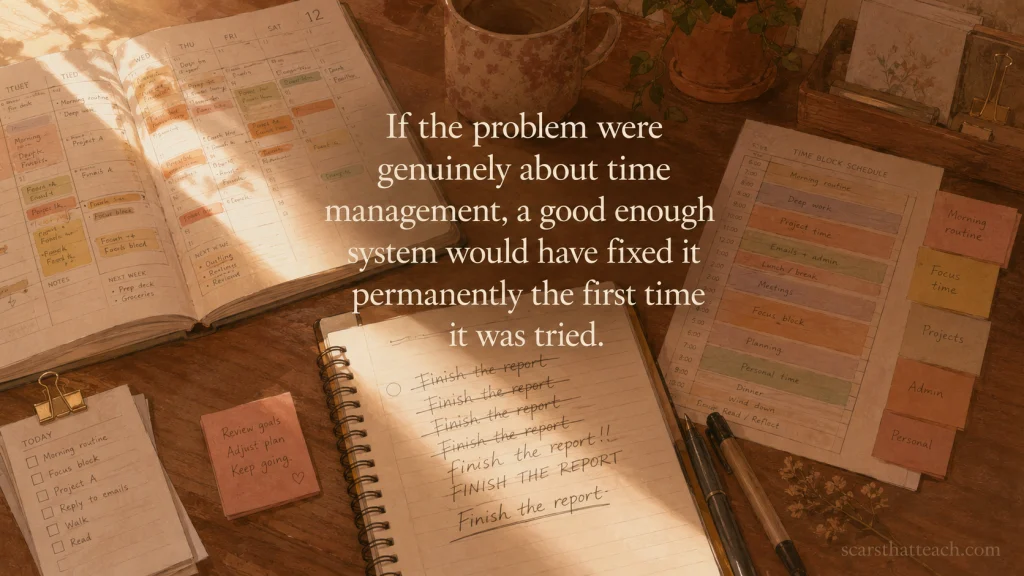
Procrastination is commonly treated as a time-management problem, something to be solved with better planning, clearer deadlines, or more disciplined scheduling. Most general advice on the subject defaults to this framing, and it is intuitive enough that it rarely gets questioned. If someone is not getting things done on time, the assumption goes, they must need a better system for managing their time.
The trouble with that framing is that it does not match what actually happens when people procrastinate. Most chronic procrastinators already know how to make a schedule. Many of them have tried dozens of systems, apps, and planning methods, often successfully for a while, before falling back into the exact same pattern with the exact same kind of task. If the problem were genuinely about time management, a good enough system would have fixed it permanently the first time it was tried. The fact that it does not suggests the system was never addressing the actual cause. Something else was driving the avoidance the whole time, and it was not a missing app or a poorly designed calendar.
The Research Has Moved Past the Time-Management Explanation
Researchers who study procrastination closely have largely moved away from the time-management explanation entirely. Fuschia Sirois, a researcher at the University of Sheffield, and Joseph Ferrari, a researcher at DePaul University, have both described procrastination as fundamentally an emotion-regulation problem rather than a planning problem. In their framing, a person delays a task in order to escape the negative feeling that task triggers right now, even while knowing, often quite clearly, that the delay will create more stress later. The decision is not a failure to plan. It is a short-term trade, relief now for a worse outcome later, made by a brain that is responding to the immediate feeling rather than the long-term consequence.
This reframes the entire question in a way that actually helps. Instead of asking how do I manage my time better, the more accurate question becomes what feeling am I avoiding by not starting this. That feeling is rarely the same from person to person, or even from task to task. It might be the fear of doing something badly and finding out you are not as capable as you hoped. It might be a boredom so intense it feels almost physically unbearable to sit inside. It might be something closer to dread, tied not to the task itself but to what the task represents: a conversation you do not want to have, a decision you are not ready to make, a piece of feedback you are afraid to receive. The task is rarely the actual obstacle. The feeling sitting underneath it is.
What Actually Happens Once You Name the Feeling
Naming the feeling does something a new productivity system never quite manages, because the feeling, left unnamed, tends to operate on its own without resistance. The moment you can say plainly, even just to yourself, that you are avoiding this because it might confirm you are not good enough, or because it forces a conversation you have been dreading, the avoidance loses some of the automatic quality it had a moment earlier. It does not disappear. But it stops being invisible, and an avoidance you can see is easier to work with than one that simply runs in the background and gets blamed on laziness afterward.
This is also why the same person can procrastinate badly on one kind of task and never on another. It is not that their discipline fluctuates from task to task. It is that different tasks trigger different feelings, and only some of those feelings are intense enough to make avoidance feel like the faster option. A task that brings up fear of failure gets circled for weeks. A task that brings up nothing in particular gets done without a second thought, by the same person, often on the same afternoon. Systems and planning tools can still be genuinely useful once the underlying feeling has been named. Before that, they were never going to solve a problem they were never built to see.
Final Thoughts: You Were Never as Undisciplined as You Thought
If you have spent years calling yourself lazy or undisciplined over a pattern that does not show up anywhere else in your life, it is worth considering that the label was never accurate. What you were actually doing was avoiding a feeling, efficiently and consistently, in the one area where that feeling kept showing up. That is not a character flaw. It is a pattern with a specific mechanism, and mechanisms can be looked at directly in a way that vague self-criticism never allows.
For other specific patterns underneath procrastination, including perfectionism, deadline-seeking, and avoiding tasks you actually want to do, the wider collection of questions on this subject lives at procrastination. For words that speak to the harder work of following through on what actually matters to you, there is more in discipline quotes.
FAQs
🧩 Why do I procrastinate even when I know it will cause more stress later?
Procrastination researchers describe this as an emotion-regulation problem rather than a planning problem. Delaying the task relieves a negative feeling right now, even though it creates more stress later, because the decision is driven by the immediate feeling rather than the long-term consequence.
⏰ Is procrastination really a time-management problem?
Not according to current research. Most chronic procrastinators already know how to plan and schedule. The pattern persists because it is rooted in avoiding a specific feeling, not in a lack of planning skill.
😶 Why am I disciplined everywhere else in my life but not with certain tasks?
This is a common pattern, and it usually points to a specific feeling tied to that particular kind of task, such as fear of doing it badly or dread of what the task represents, rather than a general lack of discipline.
🔍 What question should I ask instead of how do I manage my time better?
Ask what feeling you are avoiding by not starting the task. That question tends to be more useful than another scheduling system, because it addresses the actual mechanism behind the delay.