
Self-love quotes fill the internet, but almost none of them tell you which one applies to your specific situation. What you need when you do not believe you are capable is not the same as what you need when you cannot stop measuring yourself against other people, and neither is the same as what someone needs who has spent years putting everyone else first. This collection organizes the most enduring lines in this space by the kind of struggle they are actually addressing, pairs each with a brief interpretation, and routes toward the writing that goes deeper into that specific challenge.
The Most Uncomfortable Quote I Ever Read Aloud
The most uncomfortable compliment I ever gave someone was not through a carefully chosen letter or in a hospital hallway. It was reading a line about self-worth out loud to a woman who had spent thirty years quietly arranging every room she lived in for other people’s comfort, and who had never, as far as I could tell, done the same for herself. I was visiting her at home, several weeks into hospice care. She had asked me to read something to her. I chose a few lines about deserving your own attention and care. And then she went very still in a way I had not seen from her before.
Not upset. Not moved in the way people sometimes are when something lands. Just still. And then she said, plainly, that no one had ever said anything like that about her to her face. She had heard these ideas before. She had said versions of them to other people, to her children especially, for decades. She had just never applied them to herself. Not once that she could remember.
That is what self-love quotes are actually for, at least the ones that carry any weight. Not the ones designed to make a person feel briefly better about their situation. The ones worth reading are the ones that produce that particular kind of stillness, the recognition that something true has just been said about your life and you have been living as though it did not apply to you. That is not comfortable. And it is not supposed to be. Understanding what the most enduring of these lines are actually arguing for is where this starts.

What Self-Love Quotes Are Actually Saying
The most recognizable lines in this space tend to cluster around three claims. The first is that love has to start inward: that how you treat yourself sets a ceiling on what you are able to give and receive in every other relationship. The second is that self-worth is not earned through performance, comparison, or external validation. The third, and the hardest, is that neglecting yourself is not a virtue, even when it presents itself as generosity. Self-worth quotes in the most lasting tradition of this writing are not about confidence as a feeling. They are about how a person organizes their relationship with their own life.
None of this is difficult to understand in the abstract. That is part of the problem. These ideas make perfect sense until a person has to apply them to their own specific circumstances, where the exceptions feel obvious and the resistance feels justified. The person who has always put others first will read a line about deserving your own love and immediately think of three people who need them more urgently. The person who struggles to believe in their own capability will read a line about self-worth and quietly add an asterisk that excludes their particular situation. The quote lands and then the exception arrives right behind it.
To love oneself is the beginning of a lifelong romance.
– Oscar Wilde –
That line appears in one of Wilde’s plays and has outlasted nearly everything else he wrote for the stage, probably because it is making a more serious claim than it sounds like on first reading. It is not an argument for vanity or self-absorption. It is an argument for continuity. The relationship you have with yourself is the one that runs underneath every other relationship in your life, and tending to it is not a distraction from caring about other people. In most cases, it is a precondition. That argument is harder than it looks. The people most in need of hearing it are usually the ones with the strongest reasons already assembled for why it does not apply to them.
What the Lists You Have Found Are Missing
If you searched for self-esteem quotes or self-love quotes before arriving here, you almost certainly found a flat, undifferentiated list. Fifty quotes. A hundred. Sometimes organized loosely by mood or theme, more often not organized at all. The format assumes that the reader will scroll until something resonates and then know what to do with it. That assumption is the problem. The self-worth struggle is not one thing, and the quote that matters to someone who cannot believe in their own capability is not the same quote that matters to someone who has spent their whole adult life deferring to other people’s needs.
There are three distinct situations underneath the broad search for this kind of language, and they require different framing and different paths.
- Doubting your own capability: The problem here is not lack of evidence. Most people in this situation have done things that should count. The issue is a double standard applied consistently, where other people’s accomplishments get credited and their own get explained away.
- Measuring worth through comparison: The comparison never resolves because the metric keeps moving. Someone ahead on one measure gets replaced by someone ahead on the next, and the discomfort stays structurally identical while the targets change.
- Consistently putting everyone else first: This one often does not feel like a self-worth problem at all. It feels like character. The difficulty is that a habit this old tends to present itself as identity rather than pattern, which makes it harder to examine.
Each section below addresses one of these situations directly: one piece of language that fits, a brief interpretation of what it is actually claiming, and a route toward the writing that covers the fuller picture. Not a list to read through in sequence. A way to find the version of this that matches where you actually are.
When You Do Not Believe You Are Capable
No one can make you feel inferior without your consent.
– Eleanor Roosevelt –
Self-confidence quotes often address the gap between what a person believes about themselves and what their actual history would demonstrate if they looked at it honestly. That gap is rarely about missing evidence. Most people who struggle to believe in their own capability have done things that count, in some cases many things. The problem is the standard of accounting. They tend to apply a more lenient measure to other people’s accomplishments than to their own. Someone else’s small win gets credited. Their own gets filed under luck, circumstance, or the bare minimum that any reasonable person would have managed.
“The pattern I observed most often in people who doubted their own capability was not that they lacked evidence of competence. It was that they had two different accounting systems: one for themselves and one for everyone else. Other people’s mistakes were circumstances. Their own were character.”
Eleanor Roosevelt’s line is precise in a way most self-confidence writing is not. It does not tell you to believe in yourself, which is advice that tends to land nowhere. It locates the problem more specifically: the experience of feeling inferior is something you are participating in, not just receiving. Something external delivers the prompt, but the conclusion is one you draw. That is not a comfortable observation. It is also a useful one, because it means there is somewhere to actually work. Not with the other person, and not with some abstract goal of self-belief. With the part of the process you have direct access to.
If what you are carrying sits closest to this, the writing on what the self-confidence struggle actually looks like goes deeper into where this pattern comes from and what tends to shift it over time.

When You Cannot Stop Measuring Yourself Against Others
“The person measuring themselves against everyone around them is usually not trying to win anything. They are trying to locate themselves. The problem is that it never works, because a self located only through comparison has no anchor of its own.”
Comparing yourself to others is one of the more relentless forms of self-worth difficulty because the comparison never actually closes. There is always someone who appears to be further ahead, more certain of what they are doing, more put-together in the ways that seem to matter. The metric keeps moving, and the logic underneath it is circular: once I have done X, I will feel okay about myself, and once X is done, the measure becomes Y, and the discomfort stays structurally identical even as the specific targets change.
“The people I sat with who had spent years measuring themselves against others rarely remembered, at the end, who those people even were. What they remembered was the feeling of coming up short, and the conclusion they had drawn from it about themselves. The comparison fades. The verdict it produced does not.”
What I noticed in people who had spent years inside this pattern is that the comparison was rarely really about the other person being used as the benchmark. It was about a standard they had been holding themselves to that had never been openly examined. Where that standard came from, and whether it was actually theirs in any meaningful sense, was one of the more useful conversations I had with people who were willing to have it. Not because answering it fixed the habit immediately. Because naming an external standard as external is the beginning of being able to choose whether to keep it.
If this is closer to your situation, the writing on why comparing yourself to others is so hard to stop addresses what this pattern is actually doing underneath the surface and what becomes possible when you can see it more clearly.
When You Keep Giving Yourself Away
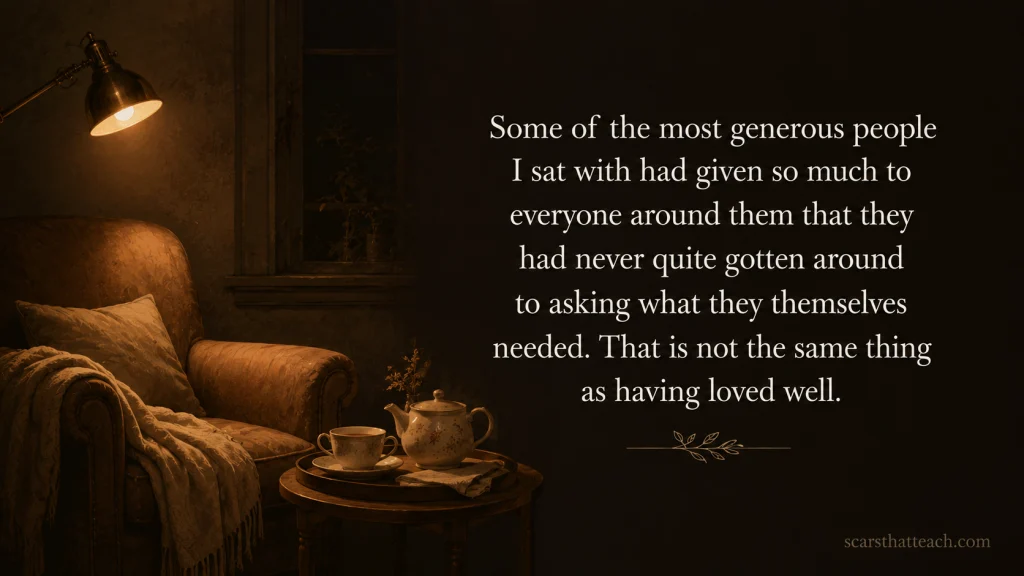
“Some of the most generous people I sat with at the end of their lives had given so much to everyone around them that they had never quite gotten around to asking what they themselves needed. That is not the same thing as having loved well. It took most of them a long time to see the difference.”
There is a particular kind of person who arrives at the later part of their life having been reliably present for everyone around them and who has somehow never turned that same quality of attention toward their own life. This is not a failure of self-love in the abstract, the kind that could be addressed with a quote on a coffee mug. It is a habit, usually a very old one, of treating their own needs as the category that gets addressed after everything else is handled, which means it almost never gets addressed at all.
The difficulty specific to this situation is that the habit tends to feel like character rather than pattern. A person who consistently puts others first does not generally experience this as self-neglect. They experience it as who they are, sometimes as the thing they are most proud of about themselves. The possibility that this could be something they do rather than something they are is often the most uncomfortable reframe available to them. In my experience it is also, when a person can sit with it, one of the most useful. The woman I mentioned at the start of this piece had never framed her situation in those terms. The quiet that came over her when she heard a quote about deserving her own love was not the quiet of recognition. It was the quiet of something being named for the first time.
If the self-love conversation feels hardest when it seems to require taking something away from other people, the writing on what people-pleasing costs you and where it comes from covers why this pattern develops and what putting yourself back into the equation actually looks like in practice.
Final Thoughts: What a Quote Is Actually Good For
A quote is not a solution. I have sat with enough pain to know that the right sentence does not do what honest, sustained attention to your own life actually requires. What a quote can do, when it lands in the right moment for the right person, is make something visible that was previously undefined. Not fixed. Visible. And there is real value in that, because a person cannot work with something they have not yet been able to name. The woman at the beginning of this piece did not need me to solve anything for her. What she needed, in that specific moment, was for something true to be said about her life in a room where she could hear it. That is what the best of this kind of writing offers. Not answers. A moment of recognition.
The quotes that have lasted in this space, the ones people return to for reasons other than that they sound reassuring, tend to do one of two things. They make a hard claim plainly, without softening it into something easier to walk away from. Or they locate the problem precisely enough that the reader knows exactly what they are being asked to look at. Neither of those things is comfortable. That is not an accident. The self-love conversation is uncomfortable by definition for anyone who has been avoiding it, and a quote that papers over that discomfort with warmth is not doing anyone a service.
Browse by situation rather than by mood. Find the section that matches where you actually are, not where you think you should be or where you would prefer to be. What you do with it from there is yours.
Where to Read from Here
Each of the three sections on this site covers a distinct version of the self-worth struggle. The writing in each goes past any single quote into what the pattern actually looks like, why it forms, and what tends to shift when a person can see it clearly. Start with whichever situation matches your own most closely.
| What It Covers | What to Expect |
|---|---|
| Self-Confidence | Why believing in your own capability is harder than the evidence should make it, and what actually tends to shift it |
| Comparing Yourself to Others | What the comparison habit is really doing underneath the surface and why the metric keeps moving no matter what you accomplish |
| People-Pleasing | Why consistently putting others first can feel like generosity while costing you something more significant than it appears |
FAQs
💬 What does self-love actually mean in practice?
Not what it tends to sound like. It is less about feeling good about yourself and more about treating your own needs as information worth taking seriously, with something close to the attention you apply to other people’s needs. For most people who struggle with it, the practical version starts with noticing when they are not doing that, rather than with any particular positive feeling about themselves.
🧠 Why do self-love quotes sometimes make things worse?
Usually because the gap between what the quote says and where the reader actually is feels too large to cross. A quote telling you that you deserve love is not useful if the deeper problem is that you do not believe it, and saying it louder does not close that gap. The quotes that tend to help are the ones that name something specific about the pattern rather than assert something about how you should feel.
🤐 Is self-love the same as selfishness?
No, though the confusion is understandable, particularly for people raised to treat self-sacrifice as a virtue. Selfishness takes from others. Self-love is closer to maintaining yourself in a way that makes sustained care for others actually possible. The people I sat with who had given everything to everyone around them for decades were not, in many cases, the ones best positioned to be genuinely present for the people they loved. That is worth thinking about.
🌿 How do you start working on self-worth when it has never felt natural?
Slowly, and without expecting a feeling to arrive first. The feeling of self-worth tends to follow behavior rather than precede it. Small things: noticing when you apply a harsher standard to your own efforts than you would to anyone else’s. Naming what you need in a conversation rather than assuming it does not matter. The shift is usually gradual and often uncomfortable, which is not a sign that something is going wrong.
💪 Can you work on self-love while still wanting to improve yourself?
Yes, and confusing the two causes real problems. Wanting to grow and treating yourself with basic care are not in conflict. The version that does cause harm is using the desire for improvement as a reason to withhold care from yourself until you have achieved something. That is not a growth orientation. It is a condition attached to your own worth, and it tends to stay in place regardless of what you actually accomplish.