
Procrastination and laziness are often treated as the same thing, by the people around you and by yourself. They are not. Laziness is an unwillingness to act. Procrastination is an active avoidance of something specific, usually accompanied by guilt, anxiety, and full awareness that you are avoiding it. The distinction matters practically, because the advice that works for one does not work for the other, and applying the wrong fix tends to be read as more evidence of the very thing you were trying to disprove.

The Apology She Did Not Owe
I sat with a woman in her late seventies during the last months of her life. She was, by her own account, someone who had been lazy her whole life. She said it more than once, and each time with a particular quality of settled regret, as though this was a verdict long since handed down and finally accepted.
The thing was, every time she told the story of her life, she described someone who worked constantly. She had raised children largely alone. She had held jobs she did not like for decades. She had organized, showed up, managed, done. What she had avoided, the one thread I could hear running through every account, was a single category of thing. Not work in general. Not responsibility. She had avoided, consistently and with great ingenuity, the one task in each chapter of her life that frightened her most. The conversation she did not have. The aspiration she did not pursue. The door she did not open because she could not be certain what was behind it.
That is not laziness. That is procrastination of a very specific kind, and the difference matters, because she had spent decades absorbing a label that did not describe her and drawing conclusions about herself that did not follow.
What Each Word Actually Means
Laziness, in the strict sense, is an absence of motivation to act. The lazy person does not want to do the thing and is not particularly troubled by not doing it. There is no internal conflict. There is no guilt accumulating in the background. The task sits there and the person remains indifferent to it. This exists. It is a real state. But it is not especially common as a chronic condition, and it is almost never what procrastination looks like from the inside.
Procrastination is something structurally different. It involves active avoidance of a specific task, not a general disinclination to act. The person procrastinating is typically aware of the task, aware that they are not doing it, and experiencing some degree of anxiety or guilt about the gap between the two. They may be doing other things, sometimes many other things, with real energy. What they are not doing is the one task that carries some charge they are not ready to approach.
That charge is the key difference. Joseph Ferrari, a psychologist at DePaul University who has spent decades researching procrastination, has noted explicitly that procrastination was historically misread as laziness or disorganization when it is actually an avoidance strategy. The person avoiding is not without motivation. They often have a great deal of it. They are directing it away from the specific thing that feels threatening, not absent from the room entirely.
The Guilt Is the Signal
One of the most reliable ways to distinguish procrastination from laziness is the presence of guilt. A lazy person, by definition, is not particularly bothered by their inaction. A person procrastinating is almost always bothered by it, often significantly. They think about the task they are avoiding. They feel the weight of it. They make plans to start it that do not materialize. They lie awake occasionally with some awareness of the gap between what they are doing and what they know they should be doing.
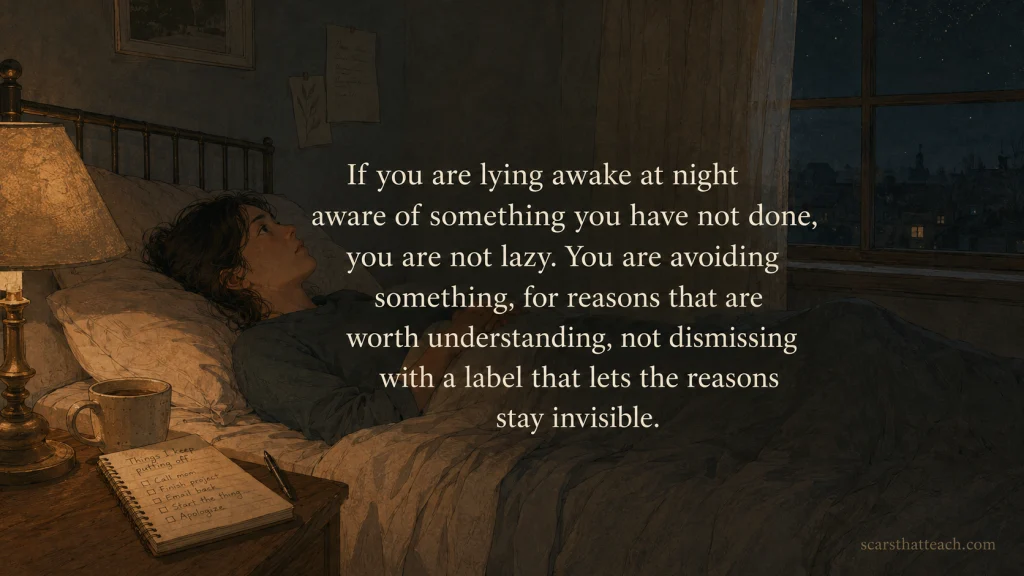
That guilt is not useful, and it tends to compound the problem rather than resolve it. But its presence is informative. If you are lying awake at night aware of something you have not done, you are not lazy. You are avoiding something, for reasons that are worth understanding, not dismissing with a label that lets the reasons stay invisible.
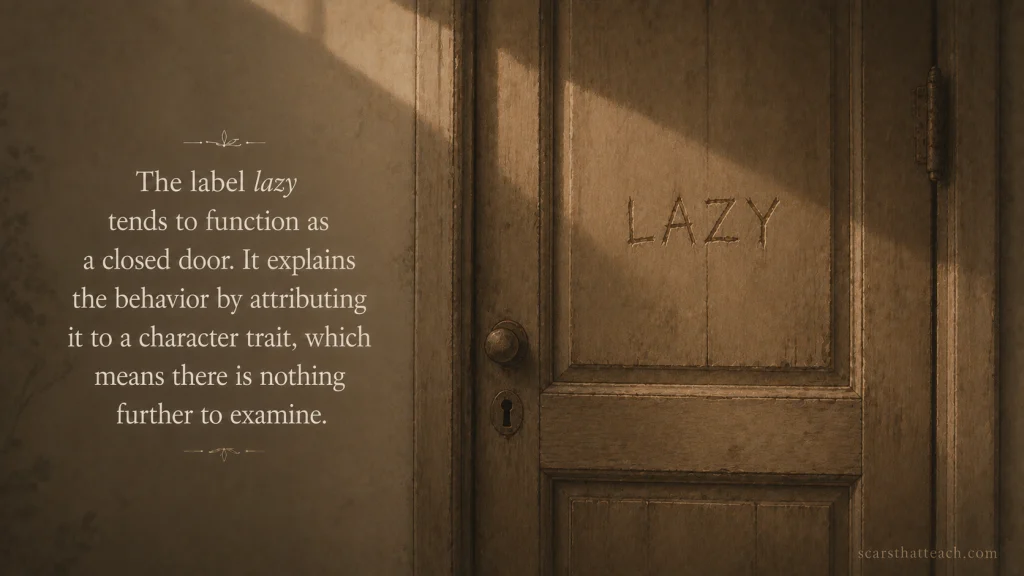
The label lazy tends to function as a closed door. It explains the behavior by attributing it to a character trait, which means there is nothing further to examine. You are simply the kind of person who does not do things. Procrastination, understood correctly, opens the door rather than closing it. It asks: what is this avoidance actually about, and why this task specifically?
Why the Distinction Matters in Practice
Most people who have struggled with procrastination have also tried the standard motivation-based advice at some point. Set goals. Remind yourself why this matters. Think about how good you will feel when it is done. Break it into steps, which is better advice but often misapplied. Find accountability. All of this is advice designed, at its core, to increase your motivation to act. And it fails, often and reliably, on procrastination that is actually avoidance.
It fails because the problem is not a motivation deficit. The motivation is frequently present. What is absent is the willingness to tolerate the emotional experience of starting the specific task. More reminders of why it matters do not reduce that cost. They add pressure without addressing what is actually blocking the start. The result tends to be that the person tries the motivation approach, it does not work, and they conclude that this is further evidence that they are lazy or that something is wrong with them.
That conclusion is the practical consequence of applying the wrong framework. If you misidentify what you are dealing with, the treatment does not fit, and the failure of the treatment gets attributed to the person rather than to the mismatch.
What does work for procrastination is different in kind. It involves reducing the emotional cost of starting rather than increasing motivation. Making the first action small enough that the barrier drops. Removing the exits before you need them. Changing the terms of the agreement you are making with yourself from “finish this” to “be present with it for a short, defined period.” These approaches do not require more motivation. They require less resistance at the threshold. That is a different problem with a different solution, and the solution only becomes available once you have correctly identified what you are dealing with, which is why how to stop procrastinating starts from a different premise than motivation advice does.
Why the Mislabeling Happens
Procrastination looks like laziness from the outside because the visible output is the same: the thing is not getting done. The internal experience is entirely different, but that is not visible to observers, and often not clearly visible to the person experiencing it either. When you have been told repeatedly that you are lazy, or when the behavior has been explained to you in those terms, you eventually adopt that frame and stop looking for a more accurate one.
The woman I described at the beginning had been using the lazy framework for so long that she had stopped examining what was actually true about her relationship to avoidance. She could point to specific fears, specific thresholds she had never crossed, specific tasks that had accumulated enormous weight over the years. None of that was laziness. All of it was avoidance of the recognizable procrastination kind. But the label had been there longer than the examination, and it had done what labels do: it explained the behavior in a way that discouraged further inquiry.
If you are reading this because someone has told you that you are lazy, or because you have told yourself that, the question worth asking is whether the behavior they are pointing to is actually indifference or actually avoidance. The two look similar from a distance. Up close, they feel nothing alike.

Final Thoughts: The Label That Closes the Door
The woman I sat with during those last months was not, in any sense I could identify, a lazy person. She was a person who had worked hard for a long time and had avoided, with great consistency, the things that frightened her most. When I said something to that effect, she was quiet for a moment and then said she had not thought about it that way.
She was in her late seventies. There was not much time to think about it differently. That is not a tragedy I can do anything about. But the number of people who arrive at that kind of recognition much later than they needed to, because a label was accepted early and never questioned, is one of the patterns from my work that has stayed with me.
Procrastination and laziness are not the same thing. They share a surface appearance and almost nothing else. Getting clear on which one you are dealing with is not a minor semantic distinction. It is the difference between a problem that has a solution and a verdict that forecloses looking for one. For a broader account of what self-discipline and avoidance look like over a life, the observations in what people who have built genuine discipline actually say about it are worth reading alongside this. And if you are also working through the shame that tends to come with long-term procrastination, the wider context of what procrastination actually is and why it happens covers the fuller picture.
FAQs
🤔 Is procrastination the same as laziness?
No. Laziness is a general unwillingness to act, without much internal conflict about it. Procrastination is an active avoidance of something specific, almost always accompanied by guilt and anxiety. The two look similar from the outside and feel nothing alike from the inside.
😔 If I procrastinate a lot, does that mean I’m lazy?
Almost certainly not. People who procrastinate are often highly motivated in general, and frequently very active in areas other than the one they are avoiding. The avoidance is usually specific to tasks that carry some kind of emotional charge, not evidence of a general disinclination to act.
🔍 How can I tell if I’m procrastinating or just being lazy?
The most reliable indicator is guilt. If the thing you are not doing is sitting in the back of your mind, accumulating weight, and producing some degree of anxiety, you are procrastinating. If you genuinely do not think about it or feel troubled by it, that is a different state. Most people describing their own behavior as laziness are describing something much closer to procrastination.
💡 Why doesn’t motivation-based advice work for procrastination?
Because procrastination is not a motivation problem. The issue is the emotional cost of starting a specific task, not a lack of desire to act in general. Advice aimed at increasing motivation adds pressure without reducing that cost, which is why it tends not to work and why its failure gets misattributed to the person rather than the approach.
🧠 Why is procrastination so often mistaken for laziness?
Because the visible result is the same: the task is not getting done. The internal experience, guilt, avoidance of something specific, full awareness of the consequences, is entirely different, but that is not visible to observers. Researchers like Joseph Ferrari have noted that procrastination was misread as laziness for a long time before it was understood as an avoidance strategy in its own right.