
Self-discipline is not a character trait distributed unevenly at birth. It is a regulatory capacity, one that degrades under specific conditions and can be shaped when you understand which part of the system is actually failing. The popular model, that willpower is a finite tank you either have or deplete, turns out to be less settled than the self-help canon suggests. What the more durable research points to is a system driven by executive function, not a reservoir of moral strength, and that distinction changes everything about how you approach building it.
What Self-Discipline Actually Is, and Why the Standard Advice Tends to Miss It
The people I remember describing themselves as disciplined, across twenty years of sitting with people at the end of their lives, had almost nothing in common in terms of raw willpower. Self-discipline, as they actually lived it, was not about resistance. It was about arrangement. What they had built, almost without exception, was a life where the path of least resistance pointed in the direction they wanted to go. Not a stronger will. A simpler set of options.
One pattern I watched often enough to stop treating it as coincidence: the people who had maintained something difficult over decades rarely described the effort as heroic. They described it as boring. They had made the behavior so structural, so embedded in the texture of daily life, that there was rarely a dramatic moment of resistance. A woman I sat with once told me she had exercised consistently for thirty years not because she loved it, but because she had made not exercising require more effort than going. That is not inspiration. That is design. Most people trying to build self-discipline are working in the opposite direction, trying to overpower a drive from the inside, while the outside stays exactly as it was.
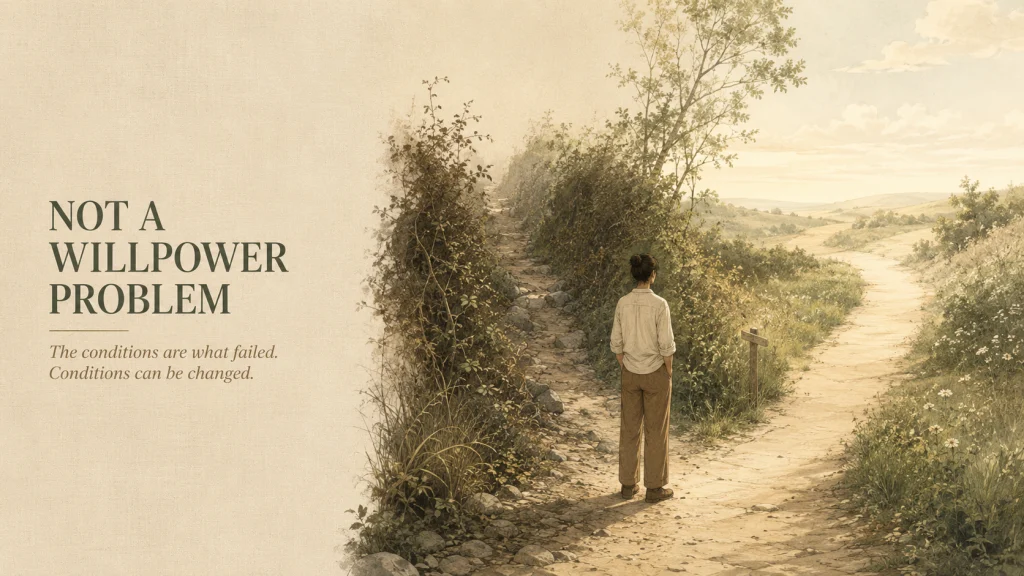
That gap between what the popular conversation about discipline promises and what actually produces lasting change is worth understanding before you reach for any specific technique. Not because the techniques are useless, but because applying them to the wrong model of the problem tends to produce the same cycle: push hard, something gives, fail, conclude the failure says something about your character. It usually does not. What it says something about is the conditions.
Willpower, Self-Control, and Self-Regulation Are Not the Same Problem
Part of why advice about discipline tends to be generic is that the terms underneath it get used interchangeably, even by the people writing the advice. The American Psychological Association distinguishes three related but meaningfully different things: willpower, self-control, and self-regulation. Most people reach for the word willpower when what they are actually trying to build is something closer to self-regulation. Those are different problems with different leverage points.
Willpower, in this framing, is the immediate in-the-moment capacity to resist an impulse. It is what you are using when you close the tab or push the plate away. Self-control is the broader pattern over time, the consistent management of your own responses across situations. Self-regulation is the full system: the way a person monitors their own behavior, adjusts when things go off course, and moves toward longer-term goals without constant conscious intervention. Most people speak about willpower when the actual breakdown is happening somewhere in the self-regulation system. That is a different diagnosis, and it calls for different tools.
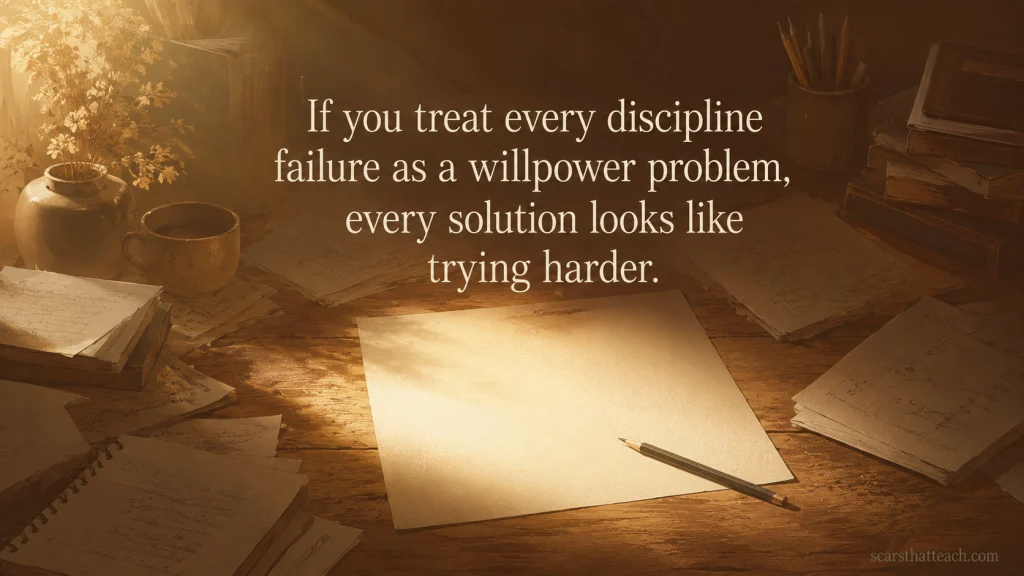
The practical implication is this: if you treat every discipline failure as a willpower problem, every solution looks like trying harder. If you recognize it as a self-regulation problem, solutions start to look like reducing the number of decisions you have to make, managing the conditions that affect your cognitive capacity, and structuring the environment so that failure requires more effort than success. That is a more tractable problem. It is also, in my observation, closer to what the people who have actually built something lasting were doing, whether they used that language or not.
The Willpower-as-Resource Model: What the Research Actually Shows
The most influential framework for thinking about willpower in recent decades is the ego depletion model, associated primarily with psychologist Roy Baumeister. The core claim is straightforward: willpower draws on a limited resource, and after exerting self-control in one domain, you have less available for the next. Research appearing to show that judges granted fewer paroles later in the day, or that blood glucose levels tracked with self-control performance, made this model feel settled. It became the operating assumption behind much of the practical advice that followed.
The problem is that the foundation is less solid than it appeared. A 2014 review in Frontiers in Psychology by Evan Carter and colleagues found that the ego depletion literature had been significantly shaped by publication bias. Positive findings were published. Null results, experiments where the depletion effect simply did not appear, largely were not. When researchers accounted for that bias, the effect size shrank substantially. A large-scale replication attempt found similar difficulties. None of this means the concept is entirely without basis. It means the confident version of it, the one that entered popular culture as settled fact, was built on shakier ground than advertised.
What appears to hold up better is a more qualified claim: belief about depletion may matter as much as any actual physiological depletion. People who hold the view that willpower is unlimited tend to show fewer signs of depletion than people who believe it runs out. That is not an argument for positive thinking. It is an argument for not treating every moment of flagging motivation as confirmation that a finite tank has emptied, because that interpretation tends to license giving up.
Why Discipline Collapses Under Stress, and What That Actually Means
The reframe that maps better onto what I watched play out across two decades treats chronic low discipline not as a character flaw but as a stress-driven regulatory capacity problem. The underlying mechanism is executive function, the set of cognitive processes responsible for planning, impulse management, and handling competing demands. Adele Diamond’s 2013 review of executive function research in the Annual Review of Psychology establishes clearly that this system is acutely sensitive to stress, insufficient sleep, and cognitive overload. Those are not background conditions. They are direct inputs into whether discipline shows up at all.
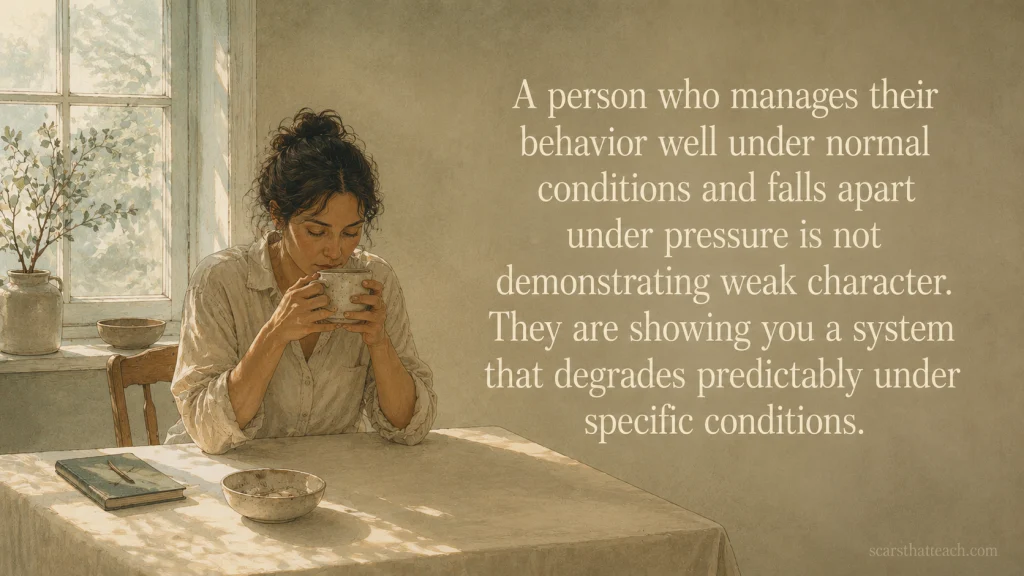
What that means in practice is that a person who manages their behavior well under normal conditions and falls apart under pressure is not demonstrating weak character. They are showing you a system responding predictably to conditions that overload it. The same person, facing the same behavioral challenge, with less sleep, more unresolved stress, and a higher decision load, will have a different regulatory capacity than they had on their best day. Treating those failures as moral evidence is not only inaccurate. It tends to generate shame, and shame is one of the more reliable ways to deepen the underlying problem rather than address it.
I saw this pattern often enough with the families I worked with. Adult children trying to maintain health behaviors, stay present, hold together difficult relationships, all while carrying an enormous caregiving load, would describe their inability to follow through on even small commitments as evidence of personal weakness. It was never that. It was a regulatory system running with too many demands and not enough recovery. Naming that accurately is not an excuse for the behavior. It is the beginning of being able to actually change the conditions.
This framing also explains why self-discipline tips that work reliably for one person fail entirely for another. A technique that reduces decision fatigue helps someone whose regulatory system is intact but overloaded with too many choices. The same technique does nothing for someone whose system is depleted by chronic stress the technique does not touch. The specific version of the problem matters. Identifying it is the work that most people skip on the way to the list of strategies.
What Building Self-Discipline Actually Requires
The popular version of how to be more disciplined tends to produce a list of techniques applied uniformly to all problems. Wake earlier. Remove your phone from the room. Use an accountability partner. Some of those work, but they work because they address something specific about the person’s situation, not because they are universally effective. The honest version of building self-discipline begins one step earlier, with identifying which piece of the system is actually broken.
There are a few distinct failure points that tend to look identical from the outside but require different responses:
- Environmental setup: The behavior you want to do is harder than the behavior you are trying to avoid. More motivation will not fix this. The solution is structural, changing what requires effort and what does not.
- Regulatory depletion from stress or overload: Your capacity for self-control is being consumed elsewhere before you reach the behavior you are trying to change. Trying harder here produces frustration, not results. Reducing the total load is what helps.
- Identity mismatch: You are attempting to act in ways that conflict with how you understand yourself. Techniques applied to this problem tend to produce short-term compliance followed by collapse, because the underlying conflict remains untouched.
- Motivation confusion: What you are trying to discipline yourself into doing is something you do not actually want, or want for reasons that do not survive examination. Discipline applied to the wrong goal tends to produce cycles of effort and abandonment that get misread as a failure of will.
None of those are willpower problems. Each one calls for a different kind of intervention. The skill in building self-discipline, if it is a skill, is less about learning to resist more and more about learning to look clearly at which situation you are actually in. Most people skip that assessment entirely and go straight to trying harder. That is usually why they are back where they started within a few weeks.
Which Version of the Problem Is Yours
Self-discipline is not one thing. The person who cannot get out of bed for anything, the person who is rigidly controlled at work but collapses at home, and the person who holds it together until a difficult week arrives are all dealing with different problems that happen to share a name. The general advice about discipline addresses none of them specifically, which is most of the reason it tends not to hold.
If the question you are carrying is why the desire to be disciplined has never actually translated into lasting change, the more precise version of that question is probably why you have no self-discipline in the first place. That tends to involve looking honestly at the conditions shaping your regulatory capacity, not at your character. If the problem is that you are disciplined in some parts of your life but not others, that is not inconsistency. It is a predictable feature of how self-regulation works across different domains, and understanding the pattern changes where you put your effort.
There is also a real difference between self-discipline versus motivation and what each one can realistically do. Motivation is variable by design. Discipline, when it is functioning, is supposed to operate even when motivation is not present. Conflating the two leads people to wait for the feeling before they act, and the feeling is not reliable enough to build on.
For anyone who has already tried the standard approaches and is looking to recover after a period of consistent failure, that is also a specific situation with its own shape. What works for maintaining discipline under normal conditions does not map cleanly onto what is needed to rebuild self-discipline after it has broken down. The recovery process has its own logic, and applying maintenance strategies to it tends to produce the same failure again.
If you are looking for something closer to a curated set of honest observations on what discipline actually requires, stripped of the motivational framing, the discipline quotes collection is worth reading for what it is: not inspiration, but a set of framings from people who built something difficult over time and were honest about what it cost.
Final Thoughts: Self-Discipline Is Not a Character Verdict
The thing that makes self-discipline hard is not a shortage of desire. Almost everyone who struggles with it wants to behave differently. What they are missing is not the wanting. It is a clear understanding of the mechanism, and specifically of which part of the mechanism is failing for them in their actual life, not in the general case.
What those two decades gave me, more than anything, was a clear picture of what lasting behavioral change actually looks like from the inside. The people who had built something real in themselves, a steadiness, a capacity to follow through without constant heroic effort, rarely described willpower as the mechanism. They described choices about their environment. They described what they had decided to stop treating as negotiable. They described having made their lives harder to fail in, quietly, over a long time, without making a production of it.
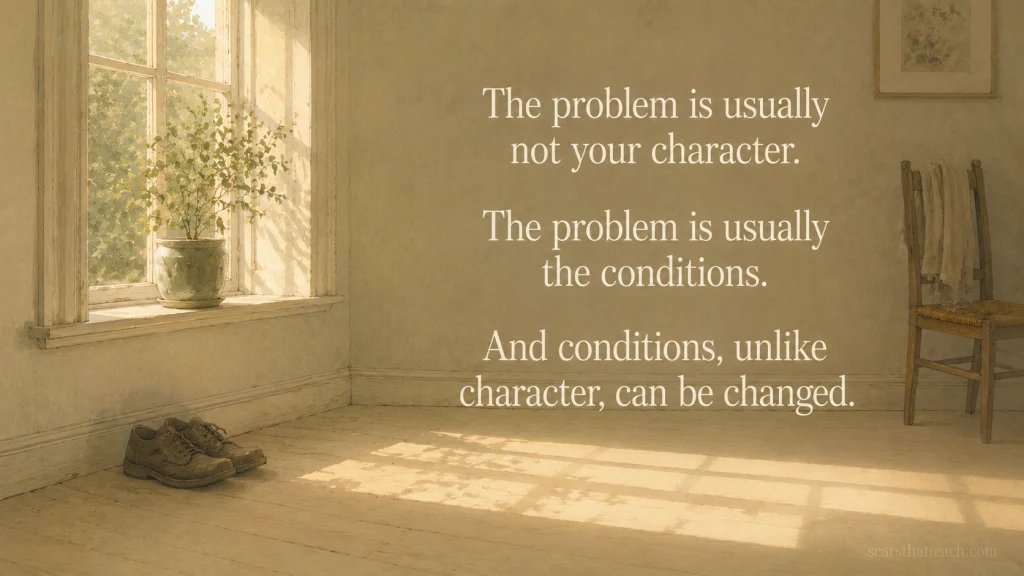
The research that has held up best reflects something similar. Self-regulation is a system, not a reservoir. It degrades under specific, identifiable conditions and recovers under others. It can be shaped, supported, and worked with deliberately. What it cannot be is simply overpowered by wanting to be a better version of yourself. If there is one thing worth holding onto from any of this: the problem is usually not your character. The problem is usually the conditions. And conditions, unlike character, can be changed.
FAQs
🧠 Is self-discipline something you are born with or something you can build?
It is not fixed at birth. Self-regulation is a capacity, and like most capacities it responds to conditions. The people I watched who had built something lasting in their own behavior did not start with more of it. They built structures around themselves that made consistent behavior easier to maintain and harder to abandon. That is something that can be done deliberately, at any age.
⚡ Does willpower actually run out during the day?
The research on this is less settled than most people have been told. The ego depletion model, which held that willpower is a finite resource that depletes with use, has faced serious challenges from replication failures and publication bias concerns. What appears to be more reliable is that stress, sleep deprivation, and cognitive overload degrade the executive function system that regulates behavior. That is a different mechanism than a simple willpower tank, and it responds to different interventions.
😔 Why does lack of self-discipline feel like such a personal failure?
Because the dominant framing around discipline treats it as a character trait, something you either have or lack, rather than a regulatory capacity that responds to conditions. That framing turns every failure into a referendum on who you are. What tends to help is noticing that the shame rarely produces the change. It produces avoidance. The more productive question is not “what is wrong with me” but “what is the system actually running on right now, and what would change the conditions.”
🔄 Why do I have self-discipline in some areas of my life but not others?
This is actually the norm, not the exception. Self-regulation does not transfer automatically across domains. A person can be rigidly disciplined at work and fall apart at home, or exercise consistently while eating poorly, without that being a contradiction. The conditions, the environment, the stakes, and the amount of cognitive load each domain carries all affect whether discipline shows up. Understanding which conditions are supporting it in the areas where it works tells you something about what is missing where it does not.
📋 What is the most common mistake people make when trying to build self-discipline?
Applying techniques before diagnosing the problem. Most people skip directly to the list of strategies, whether that is waking earlier, removing distractions, or using accountability partners, without first identifying which part of the system is actually failing. A technique that reduces decision fatigue helps someone who is overloaded. The same technique does nothing for someone whose discipline is collapsing under chronic stress. The right intervention depends entirely on the right diagnosis.