
Most people approach self-discipline as a test of how much resistance they can generate in the moment. That approach tends to hold until it does not, which is usually when conditions are hardest. The more dependable path is not building stronger resistance but reducing the number of times you have to resist in the first place. This piece explains why the environment-based approach outlasts the willpower-based one, and what it actually looks like when applied honestly.
The Most Self-Disciplined Person I Sat With
The clearest example of self-discipline without willpower I have ever seen came from someone who would never have described what she was doing that way. She visited her dying husband every day for eleven months. Not most days. Every day, including days she told me she was sick, days when the drive felt impossible, days when she arrived and sat quietly for an hour and left without either of them saying much. I had been a hospice chaplain long enough to know how rare that kind of consistency is, and I assumed she was running on something most people do not have.
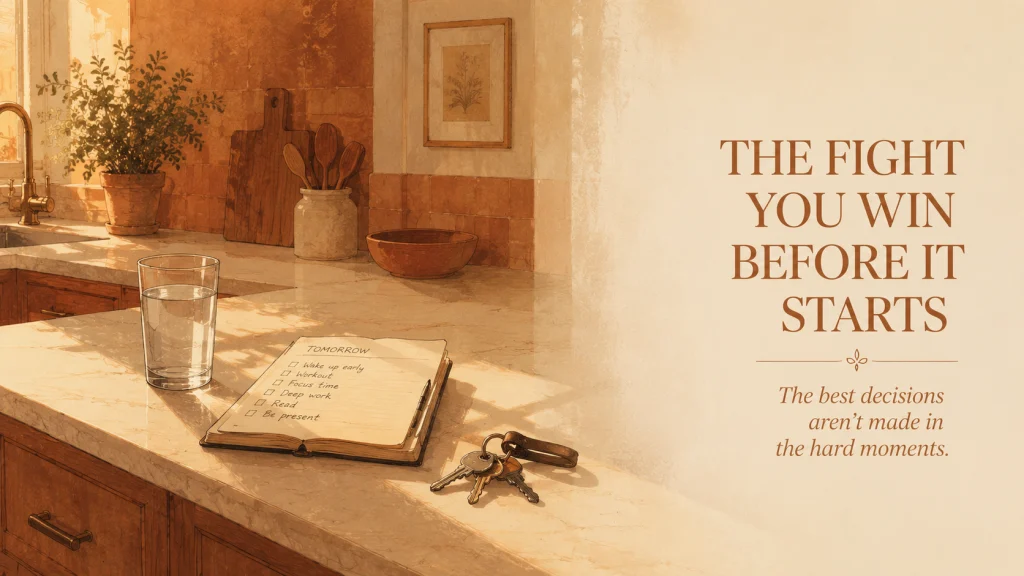
I asked her once, near the end of her husband’s life, where she found it. She said she was not sure she had anything unusual. What she had done, early in his stay, was decide she was not going to keep making the decision every morning. She laid out her clothes the night before. She had the same breakfast. She left at the same time. She drove the same route. The whole sequence was built so there was no window in her day where the question of whether to go could come up again. She had answered that question once, weeks earlier, and structured everything else around that answer.
What struck me was not the cleverness of it. It was how little it required of her in the moment, compared to what I had watched other people spend on the same kind of consistency. She had moved the fight somewhere it was easier to win, and then arranged her days so she rarely had to fight at all.

Why the Willpower Model Keeps Letting People Down
The popular version of self-discipline is built on a particular assumption: that willpower is something you have in a fixed amount on any given day, that it gets used up through the demands of the day, and that the people who succeed are the ones who can generate more of it, or refill it faster, or find ways to conserve it. Roy Baumeister’s ego-depletion research gave that framework a name and a body of studies behind it. The model became widely cited and shaped how most people think about discipline, and how most advice about it gets written.
The replication record on that research has been mixed enough that the model itself is now contested. Whether willpower depletes in the specific physiological way the original studies suggested is genuinely unclear. What matters practically is that the core assumption, that in-the-moment resistance is something you can reliably train and strengthen over time, has not held up as cleanly as the original framing suggested. The more modest and more durable observation is that resistance is unreliable. Not always, not for everyone, but reliably unreliable in the conditions where it is most needed: late in the day, when you are tired, when you are under stress, when the temptation has shown up repeatedly and you have been holding it off for days. Those are exactly the conditions under which resistance tends to give way.
What I noticed across two decades of chaplaincy work was not academic. I watched caregivers try to sustain difficult behaviors through force of intention alone. The ones who held longest were almost never the ones who seemed to be gripping hardest. They were the ones who had arranged their circumstances to require as little in-the-moment gripping as possible. A better way to think about willpower, I think, is not as a fuel source but as an emergency brake: something that works when you reach for it in a specific hard moment, not something you can reliably drive on every day. Even what people have said about the nature of discipline across generations tends to reflect this distinction without always naming it: the emphasis falls on structure and practice, not on the daily effort of resistance.
What Environment Design Actually Does
Most advice about friction-reduction is framed as a list of tricks. Remove the junk food from the house. Delete the apps. Put the book on your pillow. Leave the gym bag by the door. The framing is almost always: here is an easier way to do the thing you want to do. And the word “easier” is what makes it sound like cheating, like you are not really building discipline so much as lowering the bar for yourself.
That framing misses the actual mechanism. When you reduce friction between yourself and a behavior you want to maintain, or increase friction between yourself and one you are trying to avoid, you are not making the behavior easier. You are moving the decision. The person who buys snacks and brings them home faces something like thirty small decisions across the week, most of them happening when they are tired, distracted, or already worn down. The person who decides not to buy them at the store makes one decision, in a context where they are probably rested, deliberate, and not in the middle of anything difficult. The fight does not disappear. It gets relocated to a moment when the conditions for winning it are genuinely better.
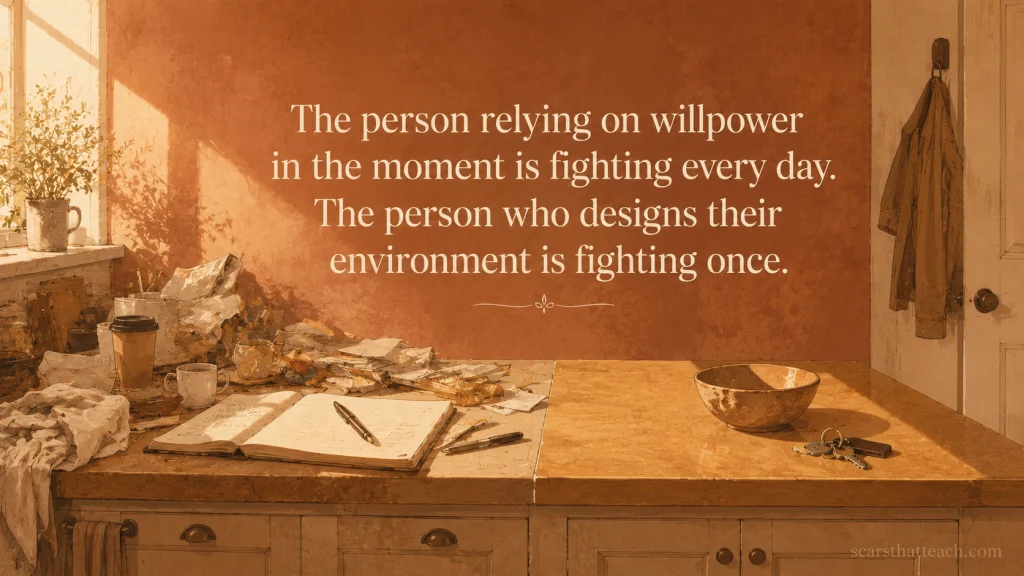
“The person relying on willpower in the moment is fighting every day. The person who designs their environment is fighting once.”
Discipline through environment design is not a trick. It is a more honest accounting of what discipline actually costs, and where you are best positioned to spend it. Treating willpower as a primary strategy means planning to win a fight that is hardest to win precisely when it matters most. Changing the environment means choosing where the fight happens, which is a different kind of control, and in most cases a far more reliable one.
What makes this hard to accept is that it sounds too easy. If you do not have to resist, how is that discipline? I think that question has the causality backwards. The discipline is in the decision you make before the difficult moment arrives. That is where the real work lives, and it is also where most people are not paying attention. A caregiver I sat with once had stopped keeping alcohol in the house during a stretch of acute family stress. She was not choosing discipline every evening. She had chosen it on a Wednesday afternoon, in a calm moment at the store, and her environment was carrying the weight from there.
Knowing the mechanism and applying it honestly are different things. The gap between them has a specific and recognizable shape.
Where People Go Wrong and What to Do Instead
The most common mistake I see in how people approach this is changing their intention while leaving the environment exactly as it was. Someone decides to eat better and plans to make different choices at the kitchen counter at 10pm, after the day has already done its full damage. Someone resolves to stop checking their phone and plans to exercise more control starting the next morning, the phone still charging on the nightstand. The intention changes. The environment stays the same. The same decisions keep coming up at the same difficult moments, with the same results, and the person concludes they do not have enough willpower when the actual problem is that they never changed the setup.
Reducing reliance on willpower works the opposite direction. The decision happens first, in the best available conditions, and the environment gets rebuilt around it. What that looks like is specific to the situation, but the logic holds across most of them.
- If you want to exercise consistently, decide the night before exactly what you will do and when you will leave. The morning question becomes “what time am I going,” not “do I feel like it today.” Those are very different questions.
- If you want to reduce time lost to a phone or device, remove the specific apps that pull the most time rather than planning to resist opening them. Reinstalling something takes more friction than opening what is already there. That gap is small, and it is enough.
- If you want to read more, put the book somewhere you will see it and move whatever you tend to reach for first to somewhere less immediate. Most reading happens because a book is nearby. Most not-reading happens because something else is closer.
- If you are trying to avoid a specific behavior when you are under stress, look at what you have accessible during those moments and change it before the stress arrives, not during it. In-the-moment environment redesign almost never works. Advance environment redesign almost always does something.
None of these replaces commitment. But commitment expressed through a changed environment holds more reliably than commitment expressed through a daily decision made under the exact conditions that make decisions hardest. The caregiver I described at the start was not less committed to showing up than someone who grits through every morning. She had put her commitment somewhere it could actually hold.
Final Thoughts: The Fight You Do Not Have to Win Every Day
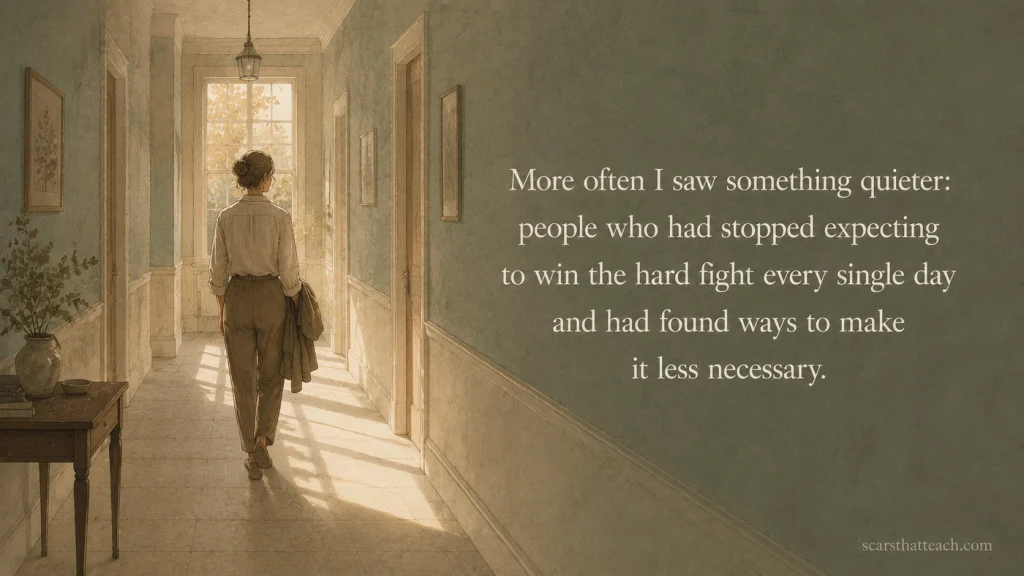
What those two decades in hospice work taught me about discipline was not what I expected going in. I expected to see people with strong wills holding up under pressure. I did see that, sometimes. More often I saw something quieter: people who had stopped expecting to win the hard fight every single day and had found ways to make it less necessary. That is not giving up on discipline. That is a more honest relationship with how human reliability actually works under real conditions.
Willpower is not nothing. There will be moments when the environment is what it is and resistance is the only tool available. But it is not a primary strategy. It is what you fall back on when the better options are gone. If you are building your discipline primarily on willpower, you are building on the thing most likely to fail exactly when it is tested hardest. That is not a personal failure. It is a design problem.
The environment-based approach does not require you to be a different person than you are right now. It requires you to make fewer in-the-moment decisions under the worst conditions, and more deliberate ones in advance under better ones. That trade is available to most people, most of the time. If you are still working out what discipline looks like across other parts of your life, other dimensions of self-discipline are worth sitting with alongside what is here.
FAQs
🧠 Is it really possible to build self-discipline without willpower?
Willpower does not disappear from the equation entirely, but it does not have to be the main structure. Environment design and advance decision-making reduce how often you need to call on it. Most people who seem highly disciplined are not resisting more. They have arranged things so there is less to resist in the first place.
🔄 What is the difference between willpower and self-discipline?
Willpower is what you use in the moment when you are facing a decision you would rather not make. Self-discipline is the broader capacity to act in line with what you actually want over time. You can build self-discipline in ways that reduce how much willpower any given day requires. They are related, but they are not the same thing.
🏠 What is environment design in the context of self-discipline?
It means changing the physical or digital space around you so the behaviors you want are easier to reach and the ones you want to avoid require more effort. The point is to move the decision out of a stressful moment and into a calmer one, or to remove the need to make it repeatedly throughout the day.
😓 Why does willpower always seem to fail at the worst moments?
Because the worst moments are exactly when resistance is hardest to sustain. Tired, stressed, and repeatedly tempted are the conditions where in-the-moment willpower is least reliable. That is not a personal failure. It is how that particular approach tends to perform under real conditions.
📋 How do I start using environment design instead of willpower?
Pick one behavior you are currently sustaining or avoiding through daily resistance. Ask where the decision is actually happening, and whether you can move it to a calmer moment or remove the need to make it repeatedly. Start with the smallest concrete change to the physical setup around that one behavior and see what it costs you.