
The most common explanation for chronic low self-discipline is that something is wrong with you. The research tells a different story. What looks like weak character is almost always something more specific: a regulatory system under more strain than anyone around you can see, burning through its capacity before you ever get to the moment that requires control. This is not a reframe designed to let you off the hook. It is a more accurate account of what is actually happening, and it matters because the practical question it leads to is more useful than the one most people spend years asking themselves.

The Kindest Thing Anyone Ever Said to Him
There was a man I sat with in his last few weeks who told me that the kindest thing anyone had ever said to him was that his repeated failure to change was not proof that he was defective. It was evidence that he had spent years trying to regulate himself under more stress than anyone around him could see. He had tried, genuinely and often, to build discipline. He had made promises to himself and broken them. He had concluded, somewhere along the way, that this was a fixed fact about who he was. The person who said otherwise to him was a doctor, and it was nearly the end of his life before he heard it.
I have thought about that conversation many times since. Not because it was unusual. Because it was not. The number of people I sat with who had spent decades carrying the belief that low self-discipline was a character verdict, something that revealed the kind of person they fundamentally were, was large enough that I stopped treating it as an individual problem. It was something closer to a shared misunderstanding. And most of the advice that exists on the subject does very little to correct it.

Where the Character Explanation Comes From
The idea that self-discipline is primarily a matter of character has been around long enough that most people treat it as obvious rather than as an assumption worth examining. The more recent version of this belief draws on what became one of the most influential frameworks in popular psychology: the idea that willpower functions like a finite resource that depletes with use. Roy Baumeister and his colleagues spent years developing this model, and it produced a clear and compelling picture. You start the day with a certain amount of self-control. As you use it, the supply runs low. By evening, or under pressure, the tank is empty, and the behavior you were trying to prevent happens anyway.
This model felt true to a lot of people because it matched their experience in certain ways. The pattern of doing well in the morning and collapsing later. The way stressful periods seemed to break down routines that had been working. The exhaustion that preceded most lapses. The willpower-as-resource framework gave a name to something people were already noticing. And because it named a phenomenon without locating the cause in character, it felt, initially, like a relief. You were not weak. You were depleted. There was a difference.
The problem is that the relief was built on a foundation that has since been questioned more seriously than most popular accounts admit.
What the Research Actually Shows Now
In 2014, Evan Carter published a review in Frontiers in Psychology examining the body of ego-depletion research and finding that the underlying studies showed signs of publication bias. Studies that found the effect got published. Studies that did not were less likely to reach the literature. When that kind of bias is present, a finding that looks consistent across dozens of studies may reflect the shape of what got submitted rather than the shape of reality. The ego-depletion model has not been abandoned, and Baumeister’s contribution to understanding self-regulation remains significant. But the settled certainty with which popular accounts present the model is not quite where the science is.
What has emerged more recently is a framework that shifts the question. Rather than asking how much willpower a person has in reserve, this reframe asks what conditions are currently degrading the prefrontal regulatory systems responsible for self-control. The distinction matters in practice. A finite-resource model points toward rationing and recovery. A degradation model points toward the sources of strain. And for many people, identifying what is currently straining their capacity turns out to be more productive than trying harder to conserve a resource whose existence is less certain than it once seemed.
What Stress Does to the System That Regulates Behavior
The prefrontal cortex handles executive function, the cluster of capacities that includes planning, impulse inhibition, and the kind of deliberate self-regulation that most people mean when they talk about discipline. It is also sensitive to stress in ways that are well documented. Elevated stress hormones impair prefrontal functioning. When the system is under sustained strain, its capacity to regulate behavior drops, not because a person has used up their supply of willpower, but because the underlying hardware is running at reduced capacity.
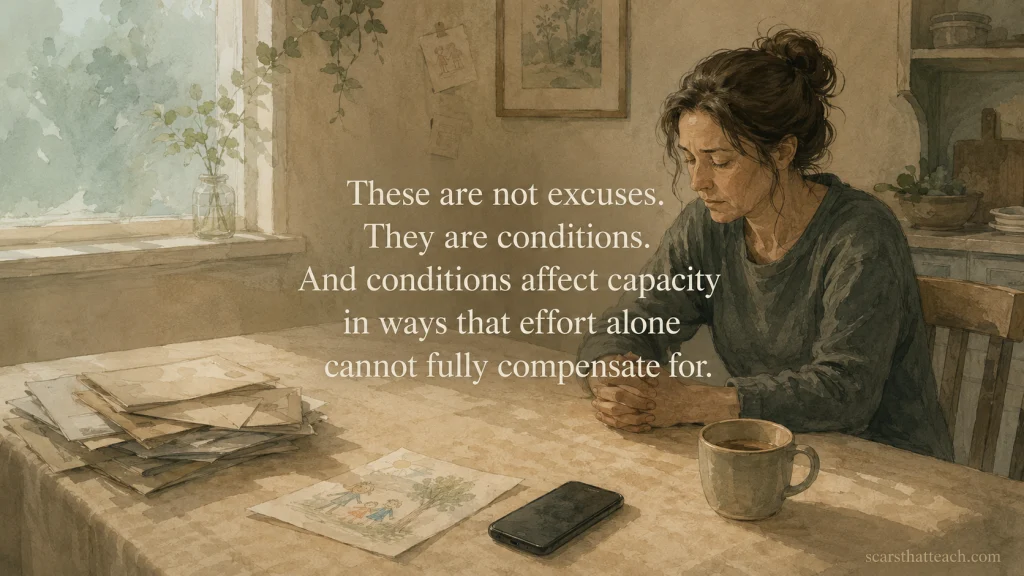
This is not a diagnosis, and I want to be careful about how it is framed. It is a description of a mechanism that research has identified as one plausible explanation for why chronic low discipline often appears in people who are also carrying significant ongoing stress. Not all of it is visible. Financial instability that is being managed quietly. A relationship that requires constant emotional navigation. A living situation that does not allow real rest. A caregiving responsibility that absorbs whatever is left at the end of each day. These are not excuses. They are conditions. And conditions affect capacity in ways that effort alone cannot fully compensate for.
I am not the right person to assess whether this mechanism is what is happening in your specific situation. What I can say is that across twenty years of sitting with people in their hardest moments, the version of low self-discipline that traced back to genuine character was rarer than anyone expected. The version that traced back to a person trying to regulate themselves under sustained pressure they had never named clearly was far more common.
What People Almost Always Get Wrong When Trying to Fix It
The most predictable mistake is reaching for more effort. If the explanation for low discipline is insufficient willpower, the obvious response is to try harder to exert it. Set more alarms. Make more commitments. Add accountability. Create higher stakes. This can produce short-term improvement, and sometimes it does, which is enough to sustain the belief that more effort is the answer. Then the stress increases, or the sleep deteriorates, or something else places additional load on an already strained system, and the improvement collapses. The person concludes, again, that they lack what it takes.
The more useful question, and the one that rarely appears in the advice, is what is currently making regulation harder than it should be. Not as an excuse, but as a diagnostic. If the system responsible for self-control is operating under conditions that impair it, adding effort to the top of that stack is unlikely to produce durable change. Reducing the load on the system, or changing the conditions that are straining it, addresses the problem at a level that effort alone cannot reach.
This is harder to do than following a list of tips. It requires an honest look at what is actually present in your life, not just what you have decided you should be able to handle. Most people have already decided. What they have not done is questioned the decision.
Why the Character Explanation Persists Even When It Does Not Help
The character explanation for low discipline survives partly because it is easy to apply. It requires no assessment of conditions or circumstances. It provides a clear verdict and, implicitly, a clear solution: try harder, want it more, be better. This is satisfying in a way that more complicated explanations are not. It puts everything inside the person, which means the person, in theory, can fix it by deciding to.
It also survives because it is partially true in a narrow set of cases. Some people who experience low discipline are primarily dealing with a values or motivation problem, a genuine mismatch between what they say they want and what they are actually willing to prioritize. For those people, the character framing can function as a productive challenge. The problem is that the framing gets applied universally, to every case of chronic low discipline, regardless of what is actually driving it. And for the larger group of people who are genuinely trying, under conditions that make regulation harder than it looks from the outside, the character verdict is not productive. It is one more load placed on a system that is already strained.
The people I sat with who had spent years under that verdict did not become more disciplined because they had internalized it. They became more ashamed. Shame is not a particularly effective engine for behavioral change. What it is effective at is making people less likely to look honestly at their situation, because looking honestly requires acknowledging that the situation is hard, and they had already been told that acknowledging the difficulty was itself a form of weakness.
“The people who most needed a clearer picture of why regulation was difficult for them were usually the ones who had been told, most often, that the explanation was obvious. They had already received a verdict. What they had not received was an accurate account.”
The Question Worth Asking Instead
The stress-regulatory framework suggests a shift in what question is worth asking. Not how do I find more willpower, but what is currently making regulation harder than it otherwise would be. This is a different kind of inquiry. It requires actually looking at the conditions present in your life rather than at the quality of your resolve.
- Sleep is among the strongest predictors of prefrontal functioning. Not occasionally poor sleep, but chronic sleep debt that has been normalized to the point where it no longer registers as a variable.
- Sustained low-level stress, the kind that does not feel acute because it is always present, degrades regulatory capacity without producing the obvious signs of crisis that would signal a problem worth addressing.
- Emotional load that has no outlet accumulates in ways that are not always visible. Managing difficult relationships, suppressing ongoing frustration, navigating situations that require constant self-monitoring, all of these consume regulatory resources before a person reaches the moment where discipline is supposed to appear.
- Physical conditions, including chronic pain, certain medications, and nutritional states, affect prefrontal function in ways that are outside the scope of what I can speak to responsibly. If any of these apply, a conversation with a doctor is a more useful starting point than a conversation with a discipline framework.
None of these are the only relevant factors, and I am not suggesting that identifying them is sufficient to solve the problem. What they represent is a starting point that is more accurate than the character explanation, and one that leads to questions with practical answers rather than to a verdict that cannot be appealed.
The broader picture of why self-discipline is harder than the advice suggests, and what the research says about how it actually develops, is something I explore in more depth in the writing I have collected on what makes lasting self-discipline possible and what typically gets in the way. This piece covers the explanatory layer. What to actually do differently, practically and without relying on willpower as a lever, belongs to a separate treatment.
Final Thoughts: What a More Accurate Explanation Is Worth
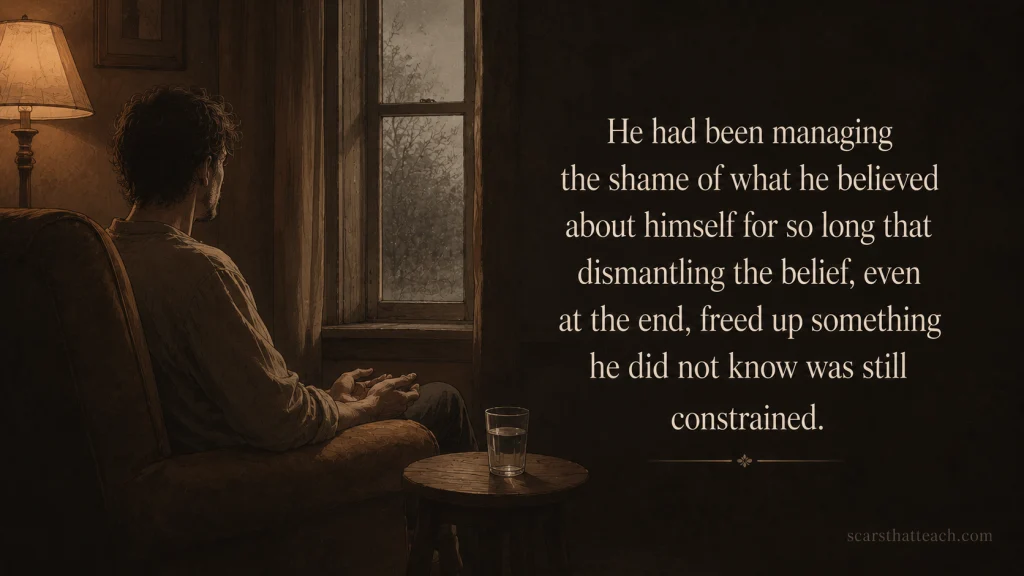
The man I mentioned at the beginning did not change his behavior after his doctor told him that his chronic low discipline reflected strain rather than defect. He was too close to the end for that. What he said it gave him was something smaller and, in his telling, more valuable: the ability to stop spending energy on a verdict he had never examined. He had been managing the shame of what he believed about himself for so long that dismantling the belief, even at the end, freed up something he did not know was still constrained.
That is not a universal outcome. Some people examine the explanation, find it useful, and still struggle with the same patterns. What a clearer picture can do is change the frame around the effort. A person trying to build regulation under conditions that genuinely make it harder is not in the same situation as a person who has simply not tried hard enough. They may need different things. They are almost certainly asking themselves the wrong question if the question is still some version of what is wrong with me.
Nothing may be wrong with you. The conditions you are operating under may be harder than you have given yourself credit for. That is worth knowing, even if knowing it is only the beginning. If you are looking for how people have articulated what it means to build something durable out of discipline, rather than to perform it temporarily, some of the clearest thinking I have encountered is collected in the words others have used to describe what discipline actually requires. Not as inspiration. As evidence of what people who have thought carefully about this already understood.
FAQs
🤔 Why do I have no self-discipline even when I really want to change?
Wanting to change is not the same as having the regulatory capacity to act on it consistently. If the system responsible for self-control is under sustained strain, effort and motivation run into a ceiling that intention alone cannot raise. The question worth asking is not how to want it more, but what is currently making regulation harder than it should be.
😔 Is lack of self-discipline a character flaw?
In most cases, no. Chronic low discipline most often reflects conditions that are impairing the system responsible for self-regulation, not a fixed trait that reveals something permanent about who you are. The character explanation is common and feels intuitive, but it is less accurate than the research suggests and less useful than it sounds.
🧠 What does stress have to do with self-discipline?
The prefrontal cortex, which handles impulse control and deliberate self-regulation, is sensitive to sustained stress. Elevated stress hormones impair its functioning, which means the capacity for discipline drops not because a person has used up their willpower but because the underlying regulatory system is operating at reduced capacity. This is one of the more consistent findings in the research, even if popular accounts rarely lead with it.
📖 Is the ego depletion theory still valid?
It is contested. A 2014 review by Evan Carter found that the underlying studies showed signs of publication bias, which weakens confidence in how consistent the effect actually is. The willpower-as-finite-resource model is still influential, but treating it as settled science overstates where the research currently stands.
💬 Why does my self-discipline collapse when I’m stressed?
Because stress impairs the regulatory systems that discipline depends on. This is not a personal failing. It is a predictable response to elevated load on a system that has limits. The useful response is not to try harder during stressed periods but to examine what is generating the stress and whether any of it can be reduced or redistributed.
🌱 Where do I start if I want to actually build self-discipline?
Start with an honest look at current conditions rather than at your level of effort. Sleep, sustained background stress, and ongoing emotional load are among the strongest predictors of regulatory capacity. Addressing those is a more durable starting point than adding more accountability or higher stakes to a system that is already strained.