
People who maintain strong self-discipline under normal conditions can watch it collapse almost entirely when a stressful period arrives, and the most common interpretation of that collapse is that their discipline was never real to begin with. That interpretation is almost certainly wrong. What the research on stress and self-regulation shows is that the capacity self-discipline depends on is a genuine resource that sustained stress depletes, which means the collapse is predictable and situational, not evidence of character. This piece covers what actually happens to self-control under stress, why the standard advice to push through tends to make things worse rather than better, and what the more useful question is when discipline fails specifically during a hard season.
The People Who Fell Apart Quietly
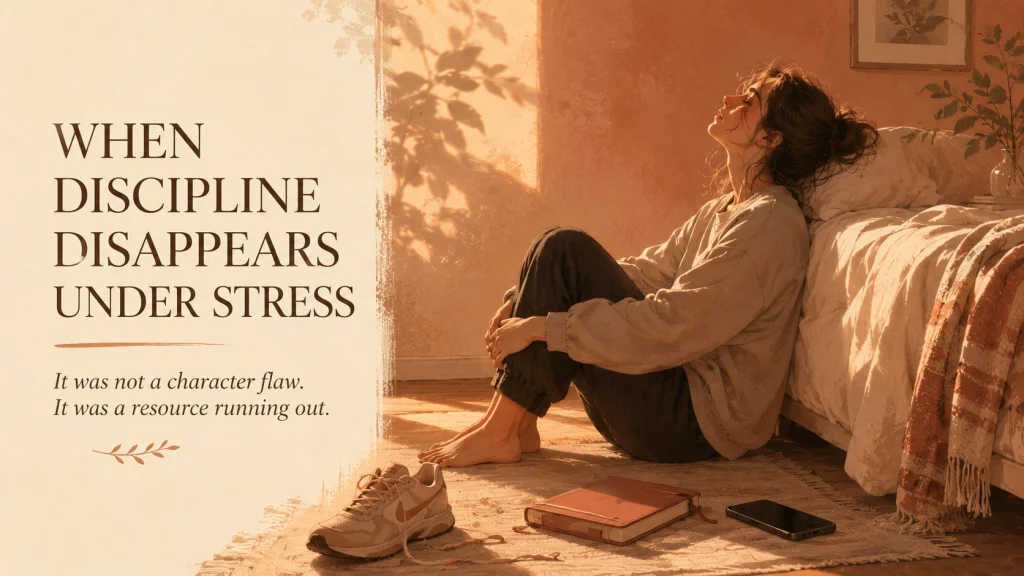
One thing I came to recognize, over more than twenty years as a hospice chaplain, was the specific look of someone whose self-discipline had disappeared under stress. Not someone who had always struggled with discipline generally, but someone who had always pointed to their habits and their consistency as a source of private pride, and who was now watching those habits dissolve in a season of sustained difficulty they had not predicted would cost them this particular thing.
Some of the people I sat with had carried enormous professional and personal responsibility for years without visible strain. Then something arrived, something private and sometimes something they had not yet named to anyone, and within days the routines they had maintained for years were gone. The early mornings. The exercise. The careful attention to what they ate and how they slept. All of it had receded, and what they were left with was not just the stressor itself but the additional weight of believing that the collapse had revealed something true about who they really were. That the discipline had always been fragile. That they had been performing competence rather than possessing it.
The research on what stress does to self-regulation suggests a different explanation, and one that is considerably more accurate.
What Stress Actually Does to Self-Control
Self-discipline is not simply a matter of motivation or character. It depends on a set of cognitive and emotional capacities, including the ability to regulate attention, delay gratification, and override impulse in favor of longer-term goals, and these capacities are not unlimited. They function more like a resource than a fixed trait: they can be depleted, and when they are depleted they are not available in the same way they were before the depletion. Sustained stress, whether it arises from a specific crisis, from accumulated pressure over an extended period, or from the particular combination of both, places an ongoing demand on exactly these capacities.
What this means in practice is that a person who is genuinely disciplined under normal conditions can find that discipline unavailable under sustained cognitive and emotional load, not because they have changed as a person, but because the system that supports self-regulation is already heavily committed to managing the stress itself. The prefrontal functioning that enables planning, impulse control, and consistent behavior is also the functioning being taxed by an unresolved stressor sitting in the background of every day. The capacity that looks unlimited during a stable period turns out to have been operating with significant reserve. The stress consumes the reserve. What is left is less than what was there before.
This is not a clinical diagnosis and it does not require one. It is simply what the documented relationship between stress and self-regulation describes: a predictable pattern, not a character flaw. The piece on self-discipline covers the broader picture of what self-control actually involves, but the stress-specific pattern is distinct enough to be worth examining on its own terms.
Why Pushing Through Is Usually the Wrong Frame
The dominant advice for discipline that has collapsed under stress is some version of the same instruction: push harder. Recommit. Treat the collapse as a test and pass it. This advice treats the stress as an obstacle the person needs to overcome through greater effort, and it implicitly frames any failure to do so as a motivational problem, as insufficient willpower or insufficient commitment.
The problem with this frame is that it misidentifies what the person is actually dealing with. If the issue were motivational, pushing harder would make sense. But if the regulatory capacity is genuinely depleted, pushing harder is asking a system that is already under significant load to take on additional load. That is not a recovery strategy. It is an additional demand on a system that is already failing to meet its current demands. In many cases, the push-through attempt produces a second collapse, which then gets interpreted as further evidence of weakness, which generates the shame that makes recovery harder.
There is also something worth naming about the relationship between the push-through frame and the emotional experience of a stress-triggered collapse. Most people who are otherwise disciplined do not interpret their collapse as a resource problem. They interpret it as a revelation: that the discipline was always shallower than they thought, that they have less character than they believed, that a stressful period has shown them something they would rather not have known. That interpretation is understandable and it is almost always wrong. But the push-through frame reinforces it, because it treats discipline under stress as a test of character rather than a test of capacity, and any failure of the test reflects on who the person is rather than what they are carrying.
The More Useful Question
The question that most naturally follows a collapse of discipline under stress is “why am I suddenly so weak?” That question assumes the problem is personal. It looks for the answer in character, in motivation, in some fundamental deficiency that the stressful season has exposed. It is a question that tends to produce shame and self-criticism, both of which are additional loads on the same system that is already overwhelmed.
The more useful question is “what load am I currently carrying that I have not been explicitly accounting for?” That question treats the collapse as information about the situation rather than evidence about the person. It shifts the frame from “what is wrong with me” to “what is the actual demand on me right now, and how does it compare to the demand I was managing when the discipline held?”
That shift is not a way of excusing the collapse. It is a more accurate description of what is happening. Discipline that held for years under normal conditions and then failed under sustained stress is not evidence of weakness. It is evidence of a load that exceeded what the system could carry while also maintaining its usual outputs. Understanding it that way does not resolve the stressor, but it does change what an appropriate response looks like. It stops making the discipline itself the problem and starts making the load the problem, which is where the actual leverage tends to be.
- The stressor that is unnamed. Stress that has not been explicitly identified or acknowledged tends to have the same effect on regulatory capacity as stress that has been named, but without the possibility of being addressed directly. A private difficulty that the person has not yet spoken about carries the same cognitive and emotional cost as one they have processed openly.
- Accumulated smaller stressors. The collapse of discipline sometimes happens during a period that does not contain an obvious single cause. The load in these cases is often cumulative: a number of smaller stressors that have been absorbed individually but whose combined weight has exceeded the reserve.
- Duration more than intensity. Sustained stress of moderate intensity tends to deplete regulatory capacity more thoroughly than acute high-intensity stress that resolves quickly. A difficult period that has been going on for months without resolution often produces more visible discipline collapse than a single crisis, even when the crisis felt more severe in the moment.
What Actually Helps During a Hard Season
If the problem is depleted capacity rather than insufficient character, the responses that help are the ones that either reduce the load or reduce the scope of what discipline is being asked to maintain. Neither of those is the same as giving up. They are adjustments to what is actually possible given what is actually present.
Reducing scope means identifying the smallest set of behaviors that, if maintained, will prevent the situation from becoming significantly worse, and treating those as the only non-negotiable items during the stressed period. Not the full routine. Not the full set of standards. The minimum viable version that holds the most important things in place while releasing the expectation that everything can function at its normal level. This is not lowering the bar permanently. It is an honest accounting of what is available under current conditions.
Naming the load explicitly also helps, though this is something many people resist. The act of acknowledging that a stressor is real, and that it is taking something from the reserve that would otherwise support discipline, does not make the stress worse. It makes the relationship between the stress and the behavior collapse more legible, which reduces the amount of additional interpretive work the person has to do on top of everything else.
What does not tend to help is the addition of new demands in the name of recovery: new habits to build, new structures to implement, new commitments to track. That impulse is understandable, but it adds load to a system that is already at capacity. The season that breaks discipline is not usually the right season to begin building more of it. It is more often the season to protect what is most essential and wait for conditions to change.
Final Thoughts: Capacity Is Not Character
The title of this piece is the point I most want to land. The discipline that disappears under stress was real. The capacity that sustained it is a genuine resource, and resources have limits that character does not. Interpreting a stress-triggered collapse as a character revelation is a misreading of what actually happened, and it tends to be a costly one, because it makes recovery harder and the shame that follows it heavier than either the situation or the evidence warrants.
What the people I sat with who had gone through periods like this eventually came to understand, sometimes much later than was useful, was that the collapse had not revealed something permanent about them. It had revealed something about the load they had been carrying without fully accounting for it. That is a different kind of information, and it points toward a different kind of response.
The broader question of why self-discipline feels absent even during stable periods, rather than specifically under stress, is covered in the piece on why some people feel they have no self-discipline. If what is most present right now is the shame that follows a collapse rather than the collapse itself, the piece on why lack of self-discipline feels like a personal failure addresses that directly. What others have recognized about discipline and its limits is collected in the discipline quotes section, for whatever that context is worth.
FAQs
😔 Why does my self-discipline disappear when I am stressed?
Because self-discipline depends on regulatory capacities, including attention, impulse control, and long-term orientation, that sustained stress depletes. These capacities are not unlimited. Stress places an ongoing demand on exactly the same system that supports self-discipline, which means that under sufficient load, even someone who is genuinely disciplined under normal conditions will find that capacity reduced or unavailable.
💭 Does losing discipline under stress mean it was never real?
No. Discipline that holds reliably during stable periods and collapses specifically under sustained stress is evidence of a capacity that has been exceeded, not evidence that the capacity was illusory. The pattern is predictable and well-documented: regulatory capacity is a resource with limits, and stress consumes it. The collapse reflects what the person is carrying, not who they fundamentally are.
💪 Should I just push through and rebuild discipline while stressed?
In most cases, no. Pushing harder when regulatory capacity is depleted adds additional demand to a system that is already failing to meet its current demands. It tends to produce a second collapse, which generates additional shame and makes recovery harder. The more useful approach during a stressed period is usually to reduce scope to the minimum essential behaviors rather than to attempt to rebuild full discipline on top of an already-overloaded system.
🔍 How do I know if stress is what is causing my discipline to collapse?
The most reliable indicator is the pattern: did discipline hold reliably during stable periods and collapse specifically when a stressor arrived or accumulated? If so, the stress-triggered pattern is the more likely explanation than a general or chronic absence of discipline. The distinction matters because the appropriate response is different in each case.
📉 Why does a period of moderate sustained stress sometimes feel worse than a single big crisis?
Because duration tends to deplete regulatory capacity more thoroughly than acute intensity. A single high-intensity crisis that resolves quickly allows for recovery afterward. A sustained stressor of moderate intensity that persists without resolution keeps drawing on the regulatory reserve without allowing it to replenish, which tends to produce a more visible collapse of discipline over time than a crisis that felt more severe but ended.
🔁 How do I rebuild discipline after a hard season passes?
Gradually, and with less urgency than the impulse to recover tends to generate. When the stressor has eased, the capacity begins to return, and the habits that were disrupted tend to be easier to restart than they were to build the first time. The useful move is to reintroduce them incrementally rather than to attempt a full restoration all at once, which risks recreating the same overload that contributed to the collapse.