
Most people who abandon a self-discipline effort do not quit on the day they lapse. They quit the day after, once they have quietly decided what that single miss says about them. This is about the specific moment between the lapse and the choice to resume, why one broken day carries so much weight, and what it actually takes to rebuild self-discipline after failure without needing to recover the unbroken streak first. The streak was evidence. The day after it ends is the actual test.

What the Missed Day Told You About Yourself
I have sat with enough people in their final weeks to know that the regrets they carry are rarely about the bold choices. The ones that cost them something, the ones still running when nothing else was, were usually about the quieter decisions. The moments when they decided that one failure had told the truth about who they really were, and let that verdict stand without questioning it.
That same pattern showed up in a different shape more times than I can count. A woman I sat with once had maintained a consistent morning practice for close to two years. Exercise, then writing, then twenty minutes of something she kept just for herself. She missed a week during a family illness. When the illness cleared, she did not go back. She did not frame it as a scheduling problem when we talked about it. She said she had realized it was not really her. Two years of evidence, dismissed by seven missed days. The streak did not end her practice. The conclusion she drew from the streak ending did.
That is the specific mechanism that makes rebuilding self-discipline after failure so much harder than the surface advice suggests. The missed day is rarely the problem. The problem is what the missed day gets attached to. For most people, a discipline streak is not just a behavior. It carries an identity claim. While the streak holds, it feels like proof of who you are. When it breaks, it can feel like proof of who you actually are. Rebuilding starts with understanding which of those readings you are acting on, because only one of them is accurate.

Why One Missed Day Does More Damage Than It Should
There is a pattern that appears consistently in habit and productivity research, often called the what-the-hell effect. The shape of it is this: after a single lapse, people are significantly more likely to abandon the entire effort than to treat the miss as a one-time event and continue. The missed day causes almost no real damage to the progress already made. But the mental shift that follows it can undo everything. One skipped workout does not reverse weeks of training. One skipped workout followed by the thought “well, I already broke it” can end the whole effort by Friday.
I want to be clear about how I am using this framing. The what-the-hell effect is a behavioral pattern that shows up across productivity and habit-tracking writing. I am drawing on it because it matches what I observed across two decades of sitting with people in serious conversations about how they had lived, not because I am citing a specific study. The pattern feels like recognition, not research. And what it recognizes is that the all-or-nothing response to a single lapse is both common and disproportionate to what actually happened.
Consider a simpler version of how this plays out. Someone keeps a food log for 47 consecutive days. On day 48 they eat badly and skip the entry. On day 49 they open the app and feel something close to embarrassment. Not at the meal. At the number. It now reads zero days. The question they are sitting with is not whether to log that day. The question is whether logging that day means the same thing it meant at day 47. For a lot of people, the honest answer in that moment is no. And because the answer is no, they close the app.
The what-the-hell effect matters here because it transforms a single missed day into an all-or-nothing verdict about the whole effort. While the streak was intact, any given tomorrow was still open. Once the streak breaks, the question stops being “do I continue?” and becomes “was this ever going to work for someone like me?” That is a much heavier question, and most standard advice about restarting does not get near it.
Why “Just Start Again” Is True but Not Enough
Most writing on broken-streak recovery lands on the same correct point: restart immediately. Do not wait for Monday, for the first of the month, for a version of yourself that feels ready. Get back to the practice tomorrow. This advice is right. The problem is that it answers the behavioral question while leaving the identity question completely alone.
The behavioral question is simple. When should I restart? Tomorrow. That part is not complicated. The identity question is the harder one: does restarting count, now that the unbroken streak is gone? That is what stops people. You can know intellectually that resuming is the correct move, and still find yourself genuinely unsure whether it matters, because what felt significant about the streak was the unbroken number. Once that number resets, the effort can feel like a diminished version of what it was. You are not continuing something. You are starting something with a smaller reason to believe in it.
This is the gap in the “just restart” advice. It tells people what to do. It does not help them with what the restart means once the streak they had been building no longer exists. The person who needs to hear “restart immediately” already knows it. What they do not know is how to make that restart feel like it counts. And if you have ever tried to push yourself back into a discipline from that specific psychological position, the one where you know you should but cannot quite make it feel real, then you already understand why the behavioral instruction alone is not enough. Understanding why a discipline lapse can feel like evidence of a character flaw is part of what makes the restart feel possible again.

The Day After the Lapse Is the Actual Test
If you want to know where discipline lives, it is not in the streak. It is in what you do the morning after the streak ends. The streak is evidence of consistency. The day after the streak breaks is a test of whether the consistency was real or whether it depended on the number to keep going. These are different things, and the confusion between them is a large part of why broken-streak discipline is so hard to recover from.
Maintaining a practice when everything is working, when you are rested, when the habit has its own momentum, takes real effort. Showing up the day after you broke it, with no unbroken run to point to and no feeling of earned progress behind you, takes a different kind of effort. It requires making the choice without the reward of the streak. That is not a lesser version of discipline. It is the version that holds when conditions are not ideal, which is most of the time. The decision to start again after failing at a discipline is, in that specific way, more demanding than any single day of the original effort ever was.
The most common mistake I have watched people make in this moment is not quitting. It is waiting. They tell themselves they will restart when the shame has cleared, when they have analyzed why they missed, when they have a better system in place. The waiting feels responsible. It is not. It is a way of giving the missed day more authority than it deserves, and that authority tends to compound the longer the gap grows.
- Waiting to feel ready before restarting usually means waiting until the effort no longer feels worth attempting.
- The gap between the lapse and the restart grows heavier with time, not because the task has changed, but because the story around it has accumulated.
- A restart that happens without a full explanation for why the miss occurred is not reckless. It is honest about what you actually control.
- Day one of a restart after a lapse carries more psychological weight than the original day one ever did. Knowing this does not make it easier, but it makes the resistance feel less like evidence that you are not cut out for this.
The first two points describe what waiting looks like from the inside. The last two describe what the restart actually asks of you. Neither is comfortable. Only one of them moves anything forward. The restart does not need to feel significant. It does not need to feel meaningful. It just needs to happen before the waiting becomes its own habit.
Restarting as Data, Not as Redemption
One reframe I have found consistently useful for this specific moment is treating the restart as information rather than as a second chance. A second chance implies you are trying to recover something lost. Information implies you are continuing to learn something that the missed day also contributed to. These are different mental positions, and the second one is easier to act from, because it does not require the restart to feel like vindication.
When the restart is data, the missed day becomes part of the record rather than an erasure of it. What was happening in the hours before the lapse? Was it fatigue, schedule pressure, a disrupted routine that broke the trigger you had been relying on? None of that needs a full analysis before you resume. But holding a frame of inquiry instead of judgment changes the texture of the restart. You are not proving something to yourself. You are finding out something about how this particular discipline works for you under imperfect conditions.
The Two-Day Rule, popularized by filmmaker Matt D’Avella, lands differently once you understand the identity problem underneath the broken streak. The rule itself is simple: never miss twice in a row. Missing once is a lapse. Missing twice is the beginning of a new pattern, and patterns carry their own momentum. The value of the rule is not that it preserves a number. It is that it interrupts the what-the-hell effect before the story of who you are when it comes to this discipline has time to calcify. One missed day tells you almost nothing. What you do the next day tells you considerably more.
For anyone working through the broader landscape of self-discipline, what builds it, what quietly erodes it, and what it actually looks like to sustain it through real conditions, the surrounding questions get more room at self-discipline and what actually sustains it.
Final Thoughts: The Streak Was Never the Point
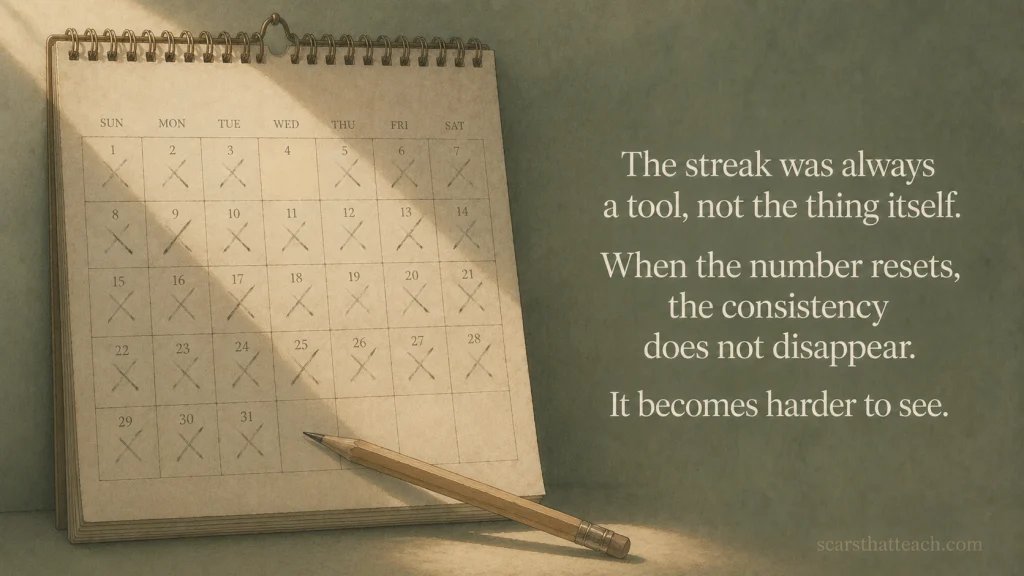
The honest thing to say about broken streak discipline is that the streak was always a tool, not the thing itself. It was a visible record of consistency, and that visibility is genuinely useful. But the consistency was the point. The unbroken number was the evidence. When the number resets, the consistency does not disappear. It becomes harder to see. That is the real loss when a streak breaks, and it is also a temporary one, though it rarely feels that way on the morning it happens.
What I have observed over the years is that people who rebuild discipline after a lapse, without waiting for ideal conditions, tend to stop treating the streak as the thing that makes the effort meaningful. They have missed before and returned. They have evidence now that the whole effort does not depend on a perfect run. That is a more durable foundation than an unbroken number, even if it took losing the number to build it.
The day after you break the streak is not the day you discover whether you are a disciplined person. It is the day you find out what kind of relationship you have with starting again. That is worth knowing, regardless of what it turns out to be. And on the question of what discipline asks of us when the conditions are difficult rather than clean, some of the most useful words on discipline are the ones written for exactly that moment.
FAQs
🔄 How do you rebuild self-discipline after you have already broken a streak?
Start the next day, without waiting for the missed day to feel resolved. The restart does not need to feel meaningful or earned. What stops most people is not confusion about what to do next but the belief that restarting counts for less now that the streak is gone. It does not count for less. It counts differently, and that difference, doing it without the momentum behind you, is harder and worth more than most people give it credit for.
💭 Why do I completely give up on discipline after one bad day?
Because the missed day gets attached to a story about who you are, not just what you did on a particular day. This is sometimes called the what-the-hell effect: one lapse disproportionately predicts full abandonment, not because of the damage the miss caused, but because of the conclusion it triggers. The lapse itself is rarely the problem. The verdict that follows it is.
📅 What is the Two-Day Rule and does it actually help?
The Two-Day Rule, popularized by Matt D’Avella, is straightforward: never miss the same practice two days in a row. Missing once is a human lapse. Missing twice is the start of a new pattern. The rule works not because it saves a number but because it interrupts the all-or-nothing thinking that turns a single missed day into permission to walk away entirely.
⏳ How long does it take to get discipline back after you fall off?
The behavior can resume the next day. The feeling that the restart matters as much as the original streak took longer for most people, and it almost never arrived before the behavior did. Waiting for the feeling to show up first is one of the main reasons people end up waiting for weeks. The feeling tends to follow the action. It rarely arrives to announce it.
🧠 Is it normal to feel like a failure after breaking a habit streak?
Yes, and it is worth understanding why. Discipline streaks carry identity weight, not just behavioral weight. When the streak ends, it can feel like evidence about who you fundamentally are rather than information about what happened on a specific day. That feeling is common. It is also not an accurate reading of what a single missed day actually means about you or about the effort.