
Struggling with self-discipline is common. Experiencing that struggle as proof of something fundamentally wrong with you is also common, and it is worth separating from the practical problem of inconsistency itself. The shame that follows repeated discipline failures is not just an unpleasant side effect. It actively interferes with the thing it claims to be motivating. Understanding why discipline failure lands as a character verdict, rather than as a circumstantial or biological difficulty, is part of understanding why that shame is so persistent and so hard to reason your way out of.

The Man Who Apologized for Never Becoming Disciplined
I sat with a man once who was near the end of his life. He had grandchildren who loved him. He had stayed married for decades to someone he still called the best thing that ever happened to him. By any ordinary measure, the life he had built was one worth having. But over several visits, he returned to the same thing: the exercise routine he had never maintained, the reading habits he had started and abandoned more times than he could count, the version of himself he had always intended to become. He apologized for it more than once, as though the failure to become that person outweighed what he had actually done. As though the gap between the man he was and the man he thought he should have disciplined himself into being was the most important fact about his life.
I have thought about those conversations many times since. Not because his regret was unusual. The opposite. What he was carrying, the sense that lack of self-discipline is not just an inconvenience but evidence of a personal failing that runs deeper than behavior, was one of the most consistent things I encountered across years of that kind of work. People would talk about it with a specific quality of shame that they did not use for other struggles. It felt different to them than grief, than regret about choices, than the ordinary weight of a life not fully lived. It felt like an indictment.

Why Lack of Self-Discipline Feels Like a Personal Failure
Part of why this lands less like a practical problem and more like a verdict on who you are is the way the culture has framed self-control. It is not treated as a skill that varies across people and circumstances, or as something that emerges from a mix of biology, environment, and habit. It is treated as a marker of character. The disciplined person is the responsible person, the trustworthy person, the person who has their life in order. The undisciplined person is the one who has not done the work on themselves, who lacks willpower, who keeps making excuses. That framing is so pervasive it becomes invisible. People absorb it and then apply it to themselves without recognizing it as a framing at all.
What makes this particularly difficult to untangle is that it operates at a level below argument. You can know, intellectually, that self-control is affected by genetics, upbringing, stress levels, sleep, and a dozen other factors outside of pure moral resolve, and still feel, viscerally, that your own inconsistency with discipline is a sign of weakness. Knowing something is not always enough to change how it lands. The shame does not respond to being told it is unreasonable. It responds to something else, which is why understanding where it comes from matters more than simply trying to talk yourself out of it.
Where the Feeling Actually Comes From
Researchers across psychology, sociology, and public health have spent decades treating self-control as close to a master key for a good life. Children who show it early are tracked toward better mental health, steadier finances, fewer brushes with the law. Adults who lack it get cast, quietly, as a burden on themselves and everyone around them. That framing is worth naming out loud, because once it’s inside you, missing a workout or leaving a task unfinished stops being small. It starts to feel like failing a test the culture has already told you measures your worth as a person.
There is also a biological dimension that the character-based framing tends to obscure. Research into the genetics of self-control has found that inherited factors account for a meaningful portion of how much natural capacity for it any given person has. Add to that the role of early environment: the households people grew up in, whether they had models of consistent discipline around them, whether their nervous systems were shaped by stability or stress. None of this is an excuse or an escape from responsibility. It is simply context. And the absence of that context from the way most people talk about discipline failure, including the way most people talk to themselves about it, is part of what makes the shame so difficult to locate accurately. You are measuring yourself against a standard that assumes everyone started from the same place. Most people didn’t.
For a wider look at how other people across time have understood discipline and what it actually demands of a person, the words others have left behind about what discipline really asks of us offer some perspective on how varied and complicated the honest accounts tend to be, even among people known for their self-command.
The Trap No One Names
There is a specific pattern in how shame about discipline tends to operate, and it rarely gets described clearly. It goes something like this: you notice that you are inconsistent in some area of your life. You form a judgment about yourself because of it. That judgment feels bad, so you find ways to avoid sitting with it, which usually means avoiding the behavior that triggers it. The avoidance confirms the self-image. The self-image produces more judgment. The cycle repeats. What looks from the outside like a motivation problem is often, at its core, a shame loop that the person has been cycling through without ever identifying it as a loop at all.
The piece of this that most advice never reaches is that shame consumes exactly the mental and emotional resource required to exercise self-discipline. Regulating behavior, resisting distraction, following through on commitments, all of these draw on the same limited capacity that self-criticism drains. The person who spends significant energy berating themselves for being undisciplined is not building toward greater discipline. They are depleting the thing they need in order to have it. This is not a trivial point. It is the reason why using shame as a motivational tool, which is what most people are doing when they call themselves weak or lazy, tends not to produce lasting change and often makes the situation harder to address over time.
What I observed, across many years and many different people, is that the ones who carried the most intense shame about their discipline failures were rarely the most inconsistent. They were often people who had tried, repeatedly and in good faith, and found that trying harder through self-criticism did not work. The exhaustion was not about willpower. It was about what it takes to keep pushing yourself with a method that does not actually move you forward.
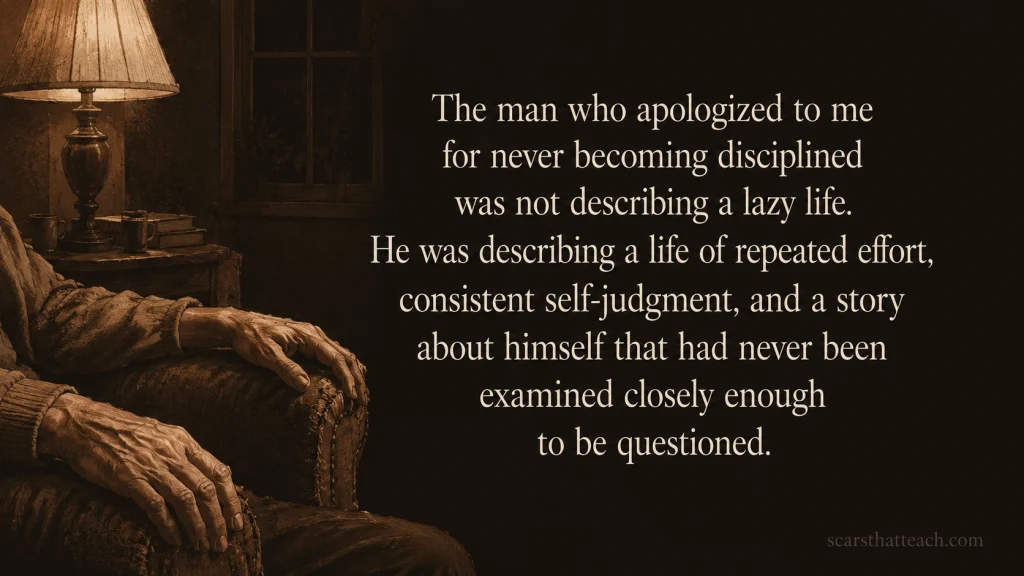
The man who apologized to me for never becoming disciplined was not describing a lazy life. He was describing a life of repeated effort, consistent self-judgment, and a story about himself that had never been examined closely enough to be questioned.
What the Shame Is Actually Protecting
One question worth sitting with, if you recognize yourself in any of this, is what the self-criticism is doing for you. Shame about discipline failure often carries the implicit logic that if you just judged yourself harshly enough, eventually you would be forced to change. That logic feels protective. It is the motivational tool you reach for because it seems like the only one available that takes the problem seriously. The alternative, being less harsh with yourself, can feel like giving up or making excuses, which is the last thing someone who genuinely wants to be more consistent wants to do.
What tends to be true, though, is that the harshness is not taking the problem seriously. It is taking the story about the problem seriously, the story that says you are fundamentally undisciplined, that you have always been this way, that this is simply who you are. That story is not the same thing as the actual pattern of behavior you are dealing with. Behaviors can change. The conditions that make them easier or harder can shift. But a self-concept, once established, is much harder to move, and the shame that reinforces it tends to do exactly that: reinforce it, not disrupt it.
The signs that shame about discipline is operating this way, rather than as a useful motivator, are usually recognizable:
- The self-criticism feels urgent but does not produce sustained action. You start something, fall off, feel bad, start again, fall off again.
- The failure generalizes. Missing one thing becomes evidence of a character pattern rather than staying as an observation about that specific thing.
- The language shifts from “I didn’t do that” to “I am someone who doesn’t do that.” The behavior becomes an identity.
- Thinking about the area where discipline fails produces a feeling of heaviness or avoidance rather than practical engagement with what might actually help.
- You find it easier to maintain discipline in areas where others are watching than in areas where no one would know.
None of these are evidence of weakness. They are recognizable features of how shame shapes behavior. Naming them for what they are is not the same as excusing the underlying inconsistency, but it is a more accurate starting point than the one most people carry into this question.

Final Thoughts: The Difference Between the Problem and the Story About It
The man I sat with near the end of his life was not wrong to want to have been more consistent. Discipline matters, and the gap between the person we intend to be and the person we actually manage to be is real, and it is worth taking seriously. What he had never managed to do, and what most people in the same position haven’t, was to separate that gap from the verdict about his character that he had layered on top of it. Those are two different things. One is addressable. The other is a story that has been running so long it feels like fact.
If you find yourself using self-discipline failure as evidence of something fundamentally wrong with you, the most useful question is not how to become more disciplined. It is whether the story you are telling yourself about your inconsistency is accurate, or whether it is a layer of interpretation that has calcified around what is, underneath it, a more ordinary and more workable problem. Shame makes things feel larger and more fixed than they usually are. That is worth knowing, even if it does not immediately change anything.
There is a wider range of what people have found and said about discipline across the full terrain of this topic at other angles on what self-discipline is and isn’t, if that context is useful alongside what this piece covers.
FAQs
😔 Why do I feel so ashamed about my lack of discipline?
Because the culture has framed self-control as a marker of character rather than a skill that varies across people for biological and circumstantial reasons. When you fail at discipline repeatedly, you are not just missing habits. You are, inside that framing, failing a test of who you are as a person. That is a heavier thing to carry than the practical problem deserves, and it is worth recognizing the framing for what it is.
🔁 Why does feeling bad about my discipline make it even harder to improve?
Because self-criticism draws on the same mental and emotional resource that self-regulation requires. When a significant amount of that energy is going into judging yourself, less of it is available for the actual work of changing behavior. Shame tends to function as a brake, not a motivator, even though it is often used as if it were the only tool available for taking the problem seriously.
🤔 Is lack of self-discipline really a character flaw?
No, though it is commonly treated as one. Research into self-control finds that inherited factors and early environment both play a significant role in how much natural capacity for discipline any person has. That does not eliminate personal responsibility, but it does mean that people are not starting from the same place, and measuring yourself against a standard that assumes they are will produce a distorted picture.
💭 How do I stop seeing my discipline failures as evidence of who I am?
Start by separating what happened from what you have concluded about yourself because of it. “I didn’t follow through on that” is an observation about a behavior. “I am someone who never follows through” is a story about identity. Those are different things, and only one of them is actually supported by the evidence. The story tends to feel like a fact because it has been repeated so often. It is still a story.
⚖️ Does wanting to be more disciplined mean I’m not accepting myself?
No. Wanting to be more consistent in areas that matter to you is not the same as self-rejection. The difference lies in whether you are trying to address a specific behavior pattern or trying to prove you are a different kind of person. The first is workable. The second tends to generate the shame cycle that makes change harder.
🌱 Is the shame about discipline failure something that can actually change?
Yes, though it usually changes more through examination than through willpower. The shame tends to be held in place by a story about what the discipline failure means. When that story gets questioned carefully, the emotional weight often shifts before any behavior changes at all. That shift matters because it removes the thing that was interfering with change in the first place.