Self-confidence is not a fixed trait you either have or lack. It is situational, domain-specific, and far more variable than most advice about building it acknowledges. The confusion tends to come from treating it as a single global thing, when the evidence from watching people actually live with it, and reckon with it late in life, suggests otherwise. What follows is a clear-eyed look at what confidence is, how it differs from self-esteem, why it tends to shift by context, and what actually produces something more durable than a motivational push.

The Room You Walk Into Without Thinking Twice
Something I noticed repeatedly across twenty years at the bedside: almost everyone who said that self-confidence was something they had never really had could name at least one room in their lives where they walked in without thinking twice. A kitchen. A workshop. A particular kind of conversation with a particular kind of person. And almost none of them had ever considered that fact significant.
They had filed it away as the exception that proved the rule. The rule being: I am not a confident person. The exception being: except there. What struck me, sitting with enough of those conversations to see the pattern, was how often that exception contained the more accurate truth, and how rarely it was the thing being examined. The generic version of this problem tends to produce generic solutions. Affirmations, comfort zone challenges, visualization exercises. Most of it addresses a version of confidence that does not quite match what the people across from me were actually describing.
What they were describing was something more specific, more variable, and more connected to particular situations than any single motivational frame could reach. Understanding why that is turns out to matter more than most confidence advice suggests.

Self-Confidence and Self-Esteem Are Not the Same Problem
One distinction worth making clearly before anything else: self-confidence and self-esteem are related but distinct. Self-confidence refers to your belief in your ability to handle specific situations. Self-esteem is something broader, a more foundational sense of your own worth and value as a person. The two can move independently of each other, and they often do.
A person can be highly competent in their field, perform well under pressure, and carry real confidence in professional contexts while quietly believing, underneath all of it, that they are not particularly worth knowing. That combination is more common than it sounds. The confidence is real. So is the low self-esteem. They coexist, and the first one does not fix the second.
The reason this distinction matters is practical. A lot of well-meaning advice about building confidence is actually trying to address self-esteem, or vice versa. Someone who doubts their ability to handle specific situations needs something different from someone whose underlying sense of worth has been steadily eroded by years of criticism or comparison. Treating both as the same low confidence and offering the same remedy tends to lead nowhere useful for either person.
When Performance Becomes the Foundation
There is a version of confidence that gets built primarily on performance. You feel capable when things go well, when you succeed, when people respond positively. That structure can look solid from the outside for years. The problem is what happens when performance dips, which it does for everyone eventually.
When confidence is built mainly on competence, and competence runs into something genuinely difficult, the whole structure becomes fragile in a way the person rarely saw coming. This is one reason that people who are objectively skilled at what they do can still experience deep uncertainty about themselves when circumstances change. The skill is real. But skill is not the same as a stable sense of worth, and no amount of external achievement resolves a belief about your own value that was formed somewhere earlier and somewhere else entirely. Two decades of watching people take stock of their lives near the end of them made that particular pattern impossible to miss.
Why Confidence Tends to Be Situational Rather Than Global
The most important thing most advice about building self confidence gets wrong is the assumption that confidence is a single, transferable trait. If you build enough of it in one area, the thinking goes, it eventually spreads. Do enough hard things and you become someone who is simply not afraid of hard things.
That is not quite how it works. Confidence tends to be domain-specific, meaning a person can carry substantial confidence in one context and very little in another, without one situation undermining the other. A surgeon can be entirely composed in an operating room and genuinely uncertain at a dinner party. A teacher who manages thirty restless students without hesitation can feel out of their depth in a one-on-one conversation about their own feelings. Neither version is more real. Both are true at the same time, and neither one cancels out the other.
What this means practically is that building confidence through general inspiration rarely transfers to the specific area where a person most needs it. Reading a book about becoming more confident does not automatically make someone more comfortable in the actual situations that give them trouble. That gap, between the general advice and the specific situation, is where most of the frustration tends to live.
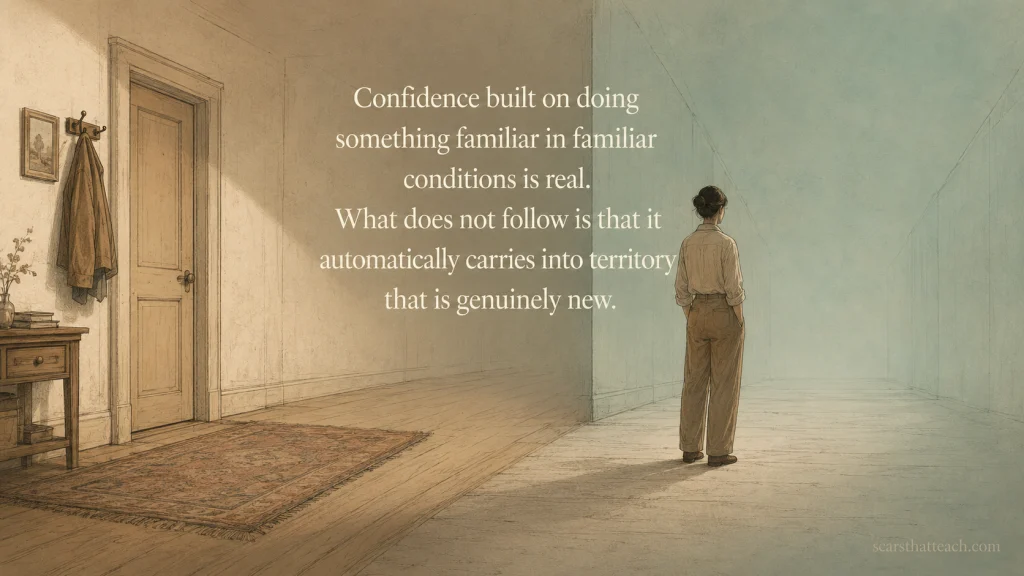
“Confidence built on doing something familiar in familiar conditions is real. What does not follow is that it automatically carries into territory that is genuinely new.”
I watched this play out in a pattern too consistent to ignore. People who had built real capability over decades in one area of their lives found themselves entirely at sea when life placed them in a different kind of room: retirement, loss, a role they had never held before. The confidence was not gone. It simply did not belong to the new situation yet. That is a very different problem from not having confidence at all, and it calls for a different response.
Understanding that confidence is domain-specific is also what explains why self-confidence comes and goes even for people who seem to have built something stable. It is not a sign that the confidence was never real. It is the natural consequence of moving between situations where your accumulated experience applies and situations where it does not yet.
What Actually Builds Confidence That Lasts
If confidence is situational, then building it requires working with specific situations rather than with general motivation. This is slower and less satisfying to read about than most confidence advice tends to be. It is also more accurate.
There are a few conditions that tend to produce something more durable than a single motivational push. They share a common quality: they are all specific rather than general, and none of them require feeling confident before starting.
- Repeated low-stakes exposure in the specific area. Confidence in a situation grows through direct familiarity with that situation. Not one big leap, but enough smaller encounters that the situation becomes less unfamiliar over time. The first few will be the hardest. That part does not disappear entirely, but it does shrink.
- Accurate feedback over a long enough window. One person’s reaction on one occasion tells you very little. A pattern accumulated across different people and different contexts, over time, tells you something you can actually use. Most people either over-weight a single bad experience or dismiss a consistent pattern. Neither is productive.
- Separating worth from performance. This is the slower and harder work, and it usually requires more than a chapter or a conversation. But the people who build something stable tend to have found some way to hold onto a sense of their own value even when the performance fails. Which it always eventually does.
- Acting in the specific situation before feeling ready. Confidence often follows action rather than preceding it. Waiting until you feel confident before attempting something tends to produce a very long wait. Moving forward in the absence of confidence, in a context with low enough stakes to survive a failure, builds the kind of experience that eventually produces something more solid.
None of that is quick. Most of what actually produces lasting confidence is quiet, cumulative, and happens over a longer stretch than most people want to hear about. That is not a reason to avoid it. It is just an honest description of what it takes. Strategies that produce real results tend to be specific to the domain where the confidence is missing. The more targeted the approach, the more likely it is to transfer. Broad strategies applied without that specificity tend to produce broad, temporary results.
Final Thoughts: What Stable Confidence Actually Looks Like
The people I sat with who carried real self-confidence, the kind that did not dissolve under pressure, almost universally had one thing in common. They had stopped expecting it to feel different on the inside than it actually did. They still had doubts. They still hesitated in certain rooms. They had simply stopped treating hesitation as evidence that they were fundamentally different from people who appeared not to hesitate.
That is a quieter version of confidence than most descriptions offer, and a more honest one. It does not feel like certainty. It feels more like a willingness to proceed without it.
The questions this subject raises are more specific than any overview can reach on its own. If you already know which version of this problem you are dealing with, the more targeted writing will be more useful than a general frame. For the fuller picture of what self-worth requires alongside confidence, the writing on self-love and what it actually involves covers ground this page does not.
Where to Go From Here
Self-confidence breaks down differently depending on the situation. Each piece below takes on a specific version of that problem, drawn from the particular places it tends to show up and the particular questions it tends to generate.
| The Question | What It Covers |
|---|---|
| What is low self-confidence | How to recognize it in your own patterns, separate from self-esteem and social anxiety. |
| Imposter syndrome | Why competent people doubt their own competence, and what that pattern tends to protect. |
| How to build self-confidence | What actually produces it in the specific situations where it is missing, not in general. |
| Why self-confidence comes and goes | Why it fluctuates rather than stays fixed, and what that means for building something more stable. |
| How to stop doubting yourself | What self-doubt is actually protecting, and how to work with it rather than around it. |
| Self-confidence vs self-esteem | Why confusing the two leads to addressing the wrong problem with the wrong tools. |
| Confidence and arrogance | The actual difference, and why genuine confidence does not require performing certainty you do not have. |
FAQs
🪞 What is low self-confidence?
Low self-confidence is a persistent doubt in your ability to handle specific situations, not a general character flaw. It tends to be situational, meaning it often shows up in particular areas while leaving others untouched. Most people carry more confidence in some corners of their life than they realize, and recognizing that is usually the more useful starting point.
🔄 Why does my confidence come and go?
Because confidence is situational rather than fixed. It is shaped by familiarity, recent experience, and whether you have encountered failure in that particular area lately. The fluctuation is not a sign that your confidence was never real. It is what happens when situations change faster than accumulated experience can follow.
🧱 What is the difference between self-confidence and self-esteem?
Self-confidence is your belief in your ability to handle specific situations. Self-esteem is a more foundational sense of your own worth as a person. You can have high confidence and low self-esteem at the same time, which is why addressing one does not automatically resolve the other.
🎭 Can you be confident and still feel like a fraud?
Yes, and more commonly than most people admit. That pattern tends to appear in people who built their confidence primarily on performance rather than on a stable underlying sense of worth. The competence is real. So is the doubt. They coexist because they are drawing on different foundations.
🛠️ How do you build self-confidence that actually lasts?
By accumulating direct experience in the specific situation where confidence is missing, not by applying general motivation to the problem. Repeated exposure, accurate feedback over time, and separating your sense of worth from performance outcomes are the conditions that tend to produce something more durable than a single push.
⚖️ Does confidence mean not feeling afraid?
No. Most people with genuine, stable confidence still feel uncertainty in new or high-stakes situations. The difference is that they have stopped treating that feeling as evidence they are not capable of handling what is in front of them. The feeling is still there. The meaning they give it has changed.