
The version of you who skips the workout, opens the third bag of chips, or scrolls past midnight instead of sleeping is not weaker than the version of you who held it together all day. Something measurable changes by evening that makes the same decision feel different than it did that morning. This piece looks at why self-discipline gets harder at night specifically, what decision fatigue actually has to do with it, and why the more useful fix isn’t trying harder to resist, but understanding that the deal you’re negotiating with yourself after dark isn’t the same deal you were negotiating at nine in the morning.

The Bargains Nobody Sees You Make
Most of the regrets I heard about in years of sitting with people near the end of their lives were rarely born in dramatic moments. They were born in small evening bargains, made after a long day, when no one, including the person making them, was watching closely anymore. That pattern is worth taking seriously, because it points directly at why self-discipline gets harder at night rather than staying steady the way most people assume it should across a single day.
If you hold it together fine at work, at the gym, in conversations that require patience, and then watch the same discipline fall apart by nine or ten at night, the problem usually isn’t a character flaw that only shows up after dark. It’s that the negotiation itself has changed. By evening, you’re not making the same decision you’d have made that morning. You’re making a related but different one, with a tireder brain doing the math.
Why Decision Fatigue Hits Hardest in the Evening
Researchers have a name for part of what’s happening: decision fatigue, the gradual decline in the quality of decisions after a long stretch of decision-making. One of the better known demonstrations of this came from psychologist Roy Baumeister’s research on what he called ego depletion, including an experiment where people who’d had to resist a plate of fresh cookies in favor of radishes gave up far sooner on an unrelated frustrating task afterward than people who hadn’t had to resist anything. Self-control, in other words, behaved like something that could be spent down over the course of a day, not like a fixed trait that stayed constant from morning to night.
Journalist John Tierney’s reporting on this pattern for the New York Times helped popularize the idea that judges, shoppers, and everyone else make measurably worse decisions the longer they go without a break, regardless of how disciplined they consider themselves in general. By the time evening arrives, you’ve already spent a full day’s worth of small decisions: what to say, what not to say, what to prioritize, what to let go. That’s most of what decision fatigue in the evening actually comes down to: the same depletion pattern from earlier in the day, finally showing up at the hour when the accumulated cost outweighs whatever activation energy is left, which is also the simplest explanation for why willpower tends to feel worse at night than it did that morning.
It’s Not a Willpower Problem, It’s a Different Bargain
Most advice on this treats the evening collapse as a willpower problem to push through with more discipline, more reminders, more resolve. I think that framing misses what’s actually going on. The deal you’re negotiating with yourself at night isn’t a weaker version of the morning deal. It’s a different deal entirely, because a tired brain discounts tomorrow’s consequences more heavily than a rested one does.
At nine in the morning, skipping the workout or opening your phone for two hours feels expensive, because tomorrow still feels close and consequential. By ten at night, after the accumulated cost of the day’s decisions, the same tomorrow feels further away and easier to discount, even though nothing about tomorrow itself has actually changed. You’re not weighing the same trade-off twice. You’re weighing a trade-off where the future has gotten quietly cheaper in your own evaluation, without you ever consciously deciding that it should.
This matters because it changes what actually helps. Trying to summon more resolve at the exact moment your evaluation of the future has already shifted is fighting the wrong battle. The more useful move is recognizing discipline at night for what it usually is: a math problem with a discounted future built in, not a referendum on your character.
What the Evening Bargain Usually Looks Like
A few patterns showed up often enough in what people described to me that they’re worth naming directly, since recognizing the shape of the bargain is most of what makes it possible to interrupt:
- The same plan that felt completely reasonable in the morning starts to feel negotiable by evening, with no new information actually changing.
- The justification shifts from “this matters” in the morning to “just this once” by night, even though the stakes haven’t moved.
- Small decisions earlier in the day, what to wear, what to eat, what to say in a hard conversation, quietly use up the same capacity that discipline draws from later.
- The collapse tends to happen at a fairly consistent hour for a given person, which is a sign of accumulated depletion rather than a random lapse.
- The next morning’s version of you usually disagrees with the bargain the night version made, which is itself evidence that something temporary shifted, not something permanent about who you are.
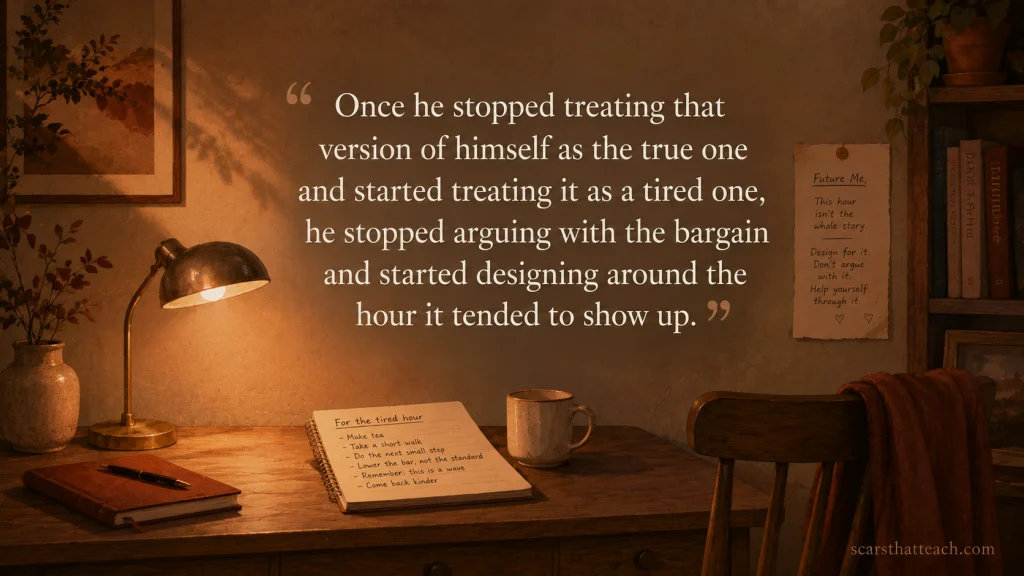
I sat with a man once, a composite drawn from a number of conversations rather than any single person, who described his nights as a kind of negotiation with someone he didn’t fully trust: himself, at ten p.m., after a day that had already asked enough of him. Once he stopped treating that version of himself as the true one and started treating it as a tired one, he stopped arguing with the bargain and started designing around the hour it tended to show up.
Final Thoughts: What This Isn’t Saying
I want to be clear about the limits of this. This isn’t a sleep problem, and I’m not going to give you advice about insomnia or sleep hygiene, since that’s a different territory than what’s happening here. It also isn’t a character problem, and treating it like one tends to make the next evening’s bargain harder, not easier, because shame is its own kind of depletion. What actually helps is understanding the hour you’re vulnerable in and planning around it rather than relitigating your character every night at ten o’clock.
If you want to reduce how much of this depends on willpower in the first place, it’s worth looking at building self-discipline without relying on willpower, since most of what helps at night actually gets decided earlier in the day. And if the harder question for you is less about the hour and more about why you can’t get yourself to start at all, the difference between self-discipline and motivation covers that distinction directly. For the wider set of questions this one belongs to, there’s more under how people actually build self-discipline that holds up, and if you want it in someone else’s words for a while, there’s also a collected set of discipline quotes that hold up under real pressure.
FAQs
🌙 Why does self-discipline get harder at night?
Mostly because of decision fatigue. After a full day of smaller decisions, a tired brain discounts tomorrow’s consequences more heavily than a rested one, which makes the same choice feel less urgent at night than it did that morning.
🍪 What is decision fatigue, exactly?
It’s the gradual decline in decision quality that follows a long stretch of decision-making. Research on self-control has found that resisting temptation or making repeated choices earlier in the day leaves less capacity for the next difficult decision later on.
😮💨 Is losing discipline at night a sign of weak willpower?
Not really. It tends to reflect accumulated tiredness and a shifted evaluation of future consequences more than it reflects character. The same person who loses discipline at ten p.m. is often the same person who held firm all day before that point.
🛏️ Is this the same thing as a sleep problem?
No, and it’s worth keeping those separate. This is about decision-making capacity declining over the course of a day, not about insomnia or sleep quality, which is its own territory and deserves its own kind of attention.
🔧 What actually helps with discipline at night?
Planning around the hour you tend to be vulnerable usually works better than trying to summon more resolve in the moment. Reducing the number of decisions you have to make late in the day, by deciding things earlier, tends to matter more than willpower itself.