People-pleasing is a pattern most people recognize in themselves long before they understand why it keeps happening. It is not simply being nice, and it is not always rooted in trauma. It sits on a spectrum, from a conscious social choice to an automatic, driven behavior that has quietly stopped feeling like a choice at all. This page covers how that pattern forms, why it persists even when you can see what it costs you, how it differs from genuine kindness, and where to look if you want to understand your own version of it.

The Most Exhausted People I Sat With Were Not the Ones Who Had Worked the Hardest
In over twenty years of hospice chaplaincy, I noticed something that took me a while to name clearly. The people who seemed most depleted (not physically, but in some deeper way) were rarely the ones who had made the most sacrifices. They were the ones who had given endlessly and quietly to people who had never asked for it, in ways they had never said out loud, hoping the giving itself would produce something: gratitude, closeness, peace, safety. It almost never did.
What they had done, in many cases, was spend years reading the room and adjusting themselves to it. Saying yes when they meant no. Absorbing someone else’s discomfort so there would not be a scene. Going along because disagreement felt dangerous, even when it wasn’t. And they had done it so long and so automatically that when I asked them about it, some of them genuinely could not identify the moment when it had stopped feeling like a choice.
That is the thing about people-pleasing that the straightforward advice, “just set a boundary,” “just say no,” tends to miss. It is not a behavior problem. It is a pattern with roots. And the roots are not always where people expect them to be.

What People-Pleasing Actually Describes
People-pleasing, broadly, describes a pattern of prioritizing others’ approval, comfort, and needs over your own, often including difficulty saying no, a tendency to avoid conflict even when conflict would be appropriate, and a habit of suppressing genuine reactions in favor of whatever reaction seems safest or most welcome. Most people who recognize the pattern in themselves are not surprised by that definition. What surprises them is how persistent it is, even once they’ve named it.
The reason it persists is that it works, at least in the short term. Saying yes when you mean no tends to prevent immediate friction. Softening your opinion to match the room keeps the atmosphere comfortable. Doing things for people before they ask produces a version of closeness, or at least keeps a certain kind of distance from forming. The pattern is reinforced constantly by the small, real social rewards it generates. That is part of why identifying it intellectually does almost nothing to stop it.
A Spectrum, Not a Type
One thing worth saying directly: people-pleasing exists on a spectrum. At one end, it is a conscious social strategy: something you choose when the situation calls for it, and can put down when it doesn’t. Most people operate somewhere in this range some of the time, and there is nothing wrong with it. Adjusting your behavior to be considerate of others is a skill, not a flaw.
At the other end, it becomes an automatic, fear-driven pattern that operates without much conscious input at all. You find yourself agreeing before you’ve had time to think about whether you agree. You feel a spike of anxiety at the thought of someone being disappointed in you, even someone you don’t particularly respect. The accommodation is no longer something you choose. It chooses you. That distinction matters, because the two ends of the spectrum call for very different responses.
Some practitioners draw a sharper line between what they call “warmth-based accommodation,” adjusting to others from a genuine desire to connect, and fear-based, automatic people-pleasing, where the underlying driver is anxiety about what happens if you don’t. The difference is not always visible from the outside. From the inside, it is usually felt as the difference between giving freely and giving because you cannot identify a safe alternative.
Where the Pattern Comes From
The most common explanation people reach for is trauma, and sometimes that is accurate. A pattern of appeasement that developed in a household where conflict was genuinely dangerous, or where love was conditional on compliance, can harden into something automatic over years. Some practitioners describe this in terms of a fawn response, a survival orientation in which accommodating others becomes the strategy for staying safe. That framing, first developed by therapist Pete Walker, is useful for some people in understanding why their people-pleasing feels involuntary rather than chosen. It is worth knowing, though, that it is a practitioner concept rather than an established clinical category, and not all people-pleasing fits the model.
Because the pattern can also come from temperament. Some people are wired from early on to be highly attuned to others’ emotional states, sensitive to shifts in atmosphere, quick to notice when someone is uncomfortable, and naturally inclined to smooth things over. That is not trauma. It is a disposition, and in many environments it gets heavily reinforced. A child who is praised for being “so easy” and “never any trouble” learns quickly which version of themselves is welcome, and adjusts accordingly.
Culture and family role are also significant. In cultures or family systems where harmony is a core value, learning to suppress individual preferences in favor of group comfort is not dysfunction. It is normal socialization. The same pattern that reads as pathological in one context reads as basic respect in another. This does not mean it cannot cost something. It means the cost is harder to name, because the pattern was never framed as a problem.
And sometimes the roots are simply habit: a strategy that worked in one context, repeated in enough other contexts that it became a default. No single formative experience, no identifiable moment of fear. Just repetition over a long enough period that the behavior stopped feeling like a choice and started feeling like personality.
The Difference Between Being Kind and People-Pleasing
This is the one that people resist most, because it requires sitting with the possibility that some of what they thought was generosity was something else. Genuine kindness is given freely. It does not depend on how the other person receives it, and it does not produce resentment when it goes unacknowledged. People-pleasing tends to do both. The giving is conditional in a way that is often invisible to the giver, conditional on the other person approving, on the relationship staying intact, on no conflict emerging. When those conditions aren’t met, resentment follows. That resentment is, in many cases, the clearest signal that what felt like generosity had something else underneath it.
A pattern I saw often enough in my years of chaplaincy to stop calling it a coincidence: people who had spent years managing someone else’s comfort, always being the one to back down, to soften, to absorb, often described their relationships in terms of debt. They had done so much. Nobody appreciated it. Nobody saw how hard they worked. What they rarely saw, until much later, was that the giving had never been entirely free. It had been a bid: for safety, for approval, for love. The other person had never agreed to the terms of the transaction, because the terms had never been stated. The resentment was real. But so was the way it had been built.
None of that makes the person who people-pleases bad. It makes them human and usually pretty understandable. But it is worth being honest about, because conflating people-pleasing with kindness makes the pattern harder to see and harder to change.
- Kindness tends to feel complete after the act. People-pleasing tends to feel unresolved, waiting for a response that validates the effort.
- Kindness can be given to someone who disappoints you. People-pleasing tends to collapse when the other person fails to meet the unspoken return.
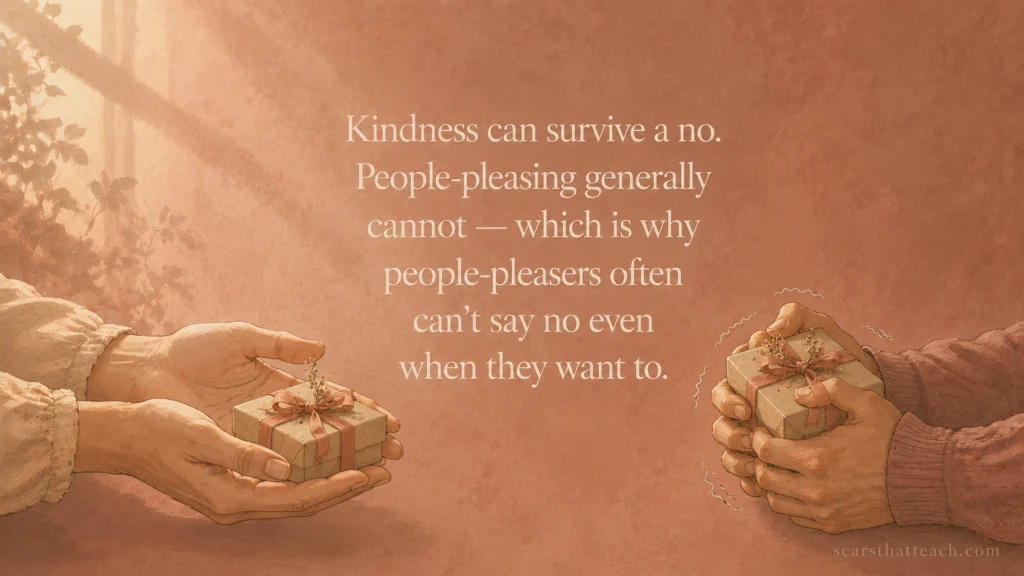
- Kindness can survive a no. People-pleasing generally cannot, which is why people-pleasers often can’t say no even when they want to.
- Kindness asks nothing in return and knows it. People-pleasing asks for something in return and usually cannot say what it is.
Those are not absolute rules. They are patterns, and they are imprecise. But if any of them land, they are worth sitting with.
What the Pattern Costs
The costs of people-pleasing tend to accumulate slowly, which is part of why they go unnoticed for so long. Nobody wakes up one morning and decides they have lost track of their own preferences. It happens through years of small adjustments, small surrenders, small moments of prioritizing someone else’s reaction over their own honest response. By the time the cost becomes visible, it has usually been building for a long time.
The most common costs people name are exhaustion, resentment, and a creeping sense that they don’t quite know what they actually want anymore. That last one is worth taking seriously. When you spend long enough automatically adjusting your preferences to match the room, you can lose reliable access to what your actual preferences are. People who have been people-pleasing for decades sometimes describe asking themselves what they want for dinner and genuinely not knowing, because the neural pathway from “what do I want?” to a clear internal answer has been routed around for so long it has gone quiet.
There is also the paradox that people-pleasing often fails on its own terms. The goal, usually, is to be liked, to secure warmth, closeness, or at least safety. But chronic deference tends to produce the opposite: people who feel close to someone are, in part, people who believe they know who that person is. When someone is always agreeable, always accommodating, always fine, they become in some ways invisible. why people-pleasing doesn’t make people like you more is one of the more counterintuitive realizations that tends to land hardest, and one that is worth looking at in detail.
Where to Go from Here
People-pleasing is not a single problem. It is a cluster of overlapping questions, and different people are stuck at different points. The seven clusters below go into each of those specific questions in depth. If you recognize the pattern in yourself, the most useful starting point is usually the question that feels most uncomfortably accurate, not the one that sounds most manageable.
| Topic | What it covers |
|---|---|
| Why you always say yes when you mean no | Why the word no can feel physically impossible even when you know you want to say it, and what is actually happening in that moment. |
| Why people-pleasing doesn’t make people like you more | The counterintuitive mechanism by which chronic accommodation tends to produce distance instead of closeness. |
| How to stop people-pleasing | What actually changes the pattern: not the advice to “just say no,” but what needs to happen before that becomes possible. |
| Why people-pleasing makes you resent the people you help | Where the resentment comes from, why it feels unjust, and what it tends to indicate about what was underneath the giving. |
| The difference between being kind and people-pleasing | A closer look at the line between genuine generosity and accommodation driven by something else, and how to tell which one you’re doing. |
| Why you feel guilty when you put yourself first | Why prioritizing your own needs can feel like a moral failure even when you know it is not, and where that guilt tends to come from. |
| Why you need everyone to like you | The specific anxiety underneath approval-seeking, and why reassurance tends to make it worse rather than better. |
If none of those feel like the right entry point, the broader context for this pattern, including self-worth, confidence, and how people come to measure their value against others’ opinions, is covered in the self-love and self-worth section of this site.
Final Thoughts: What Naming It Actually Does
Recognizing the pattern is not the same as changing it. I want to be honest about that, because a lot of content in this space implies that clarity is the same as a solution, that once you understand why you people-please, the behavior will naturally ease. In my experience, it does not work quite that way. What naming it does is give you a reference point. A moment where you can notice what is happening rather than just living it automatically. That is not nothing. But it is also not the work itself.
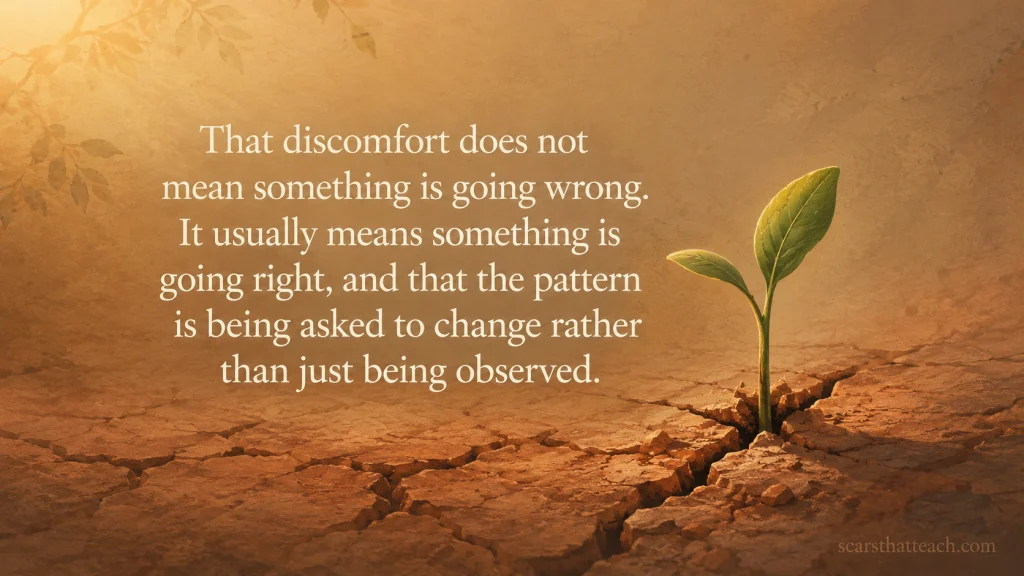
The work, for most people, takes longer and looks different than a realization. It involves friction, small experiments, and a lot of discomfort at the moments where the old pattern would normally kick in. That discomfort does not mean something is going wrong. It usually means something is going right, and that the pattern is being asked to change rather than just being observed.
What I can offer here is a clearer frame for what you are carrying. The clusters above go deeper on the specific questions. The rest is yours to work through, in your own time, at whatever pace makes sense for the life you are actually in.
FAQs
🤔 Why do I keep people-pleasing even though I know it’s hurting me?
Because knowing something intellectually and having the pattern actually change are two different things. People-pleasing is usually reinforced by real short-term rewards: fewer conflicts, warmer responses, a sense of safety. The fact that it costs you in the long run doesn’t cancel those immediate signals. Naming the pattern is the beginning, not the solution.
😓 Is people-pleasing always caused by trauma?
No. It can come from trauma, but it can also come from temperament, culture, family role, or simple repetition over time. Assuming trauma as the root cause when it isn’t can make the pattern harder to understand, not easier. The question worth asking is where yours started, which may not be where you first assume.
😔 What is the difference between being a people-pleaser and just being a kind person?
The clearest marker is what happens when the giving goes unacknowledged. Kindness tends to feel complete without a particular response. People-pleasing tends to feel unresolved, waiting for something in return that was never explicitly asked for. The resentment that builds when that return doesn’t come is usually the most honest signal.
😤 Why does saying no feel so hard even to small requests?
Because for many people-pleasers, saying no is not experienced as a neutral social act. It is experienced as a threat to the relationship, or as proof of being selfish, uncaring, or difficult. The difficulty is not about the word. It is about what saying it seems to mean. That belief, not the word itself, is what is worth examining.
😩 Can people-pleasing make people like you less?
It can, yes. People who are always agreeable, always accommodating, always fine tend to become somewhat invisible over time. Closeness requires a sense of who someone actually is, including where they push back. Chronic deference can make that genuinely hard to know.
🧩 Is people-pleasing the same as the fawn response?
Not exactly. The fawn response is a specific practitioner framing, developed by therapist Pete Walker, that describes an appeasement-based survival strategy formed in response to threat or abuse. People-pleasing is a broader term that includes patterns with very different origins. Some people-pleasing fits the fawn framing; a lot of it doesn’t. It is a useful concept for some people, but not a clinical diagnosis.
🔄 How do you actually stop people-pleasing?
Not by deciding to. The pattern tends to run faster than decision-making. What actually changes it is getting specific about what you’re afraid will happen when you don’t accommodate, and then testing whether that fear is accurate, one small situation at a time. That is slower and more uncomfortable than it sounds. It is also more likely to work than an insight alone.