
Why am I jealous of other people’s success is a question most advice answers with a command: stop comparing, be happy for them, use it as motivation. None of that explains what the jealousy is actually pointing at. Envy often carries real information, a desire you have not named yet, a disappointment you never let yourself grieve, or a comparison that was never quite fair to begin with. This piece looks at how to read that signal instead of just trying to silence it.

What Envy Sounds Like, and What Is Usually Underneath It
When people named their envy to me directly, it often came out sounding harsh, even cruel, the kind of thing they were ashamed to say out loud about someone they otherwise liked. Underneath that harshness, almost every time, was something quieter and sadder. Not malice toward the other person, but a private fear that their open door proved your own had already closed.
If someone else’s success makes you feel smaller, behind, or resentful, even when part of you genuinely wants good things for them, that contradiction is not a character flaw. It is two things happening at once: real goodwill toward another person, and a private grief about your own situation that has nothing to do with them.

Why Some Upward Comparison Motivates and Some Just Deflates
Research on social comparison draws a useful distinction here. Seeing someone ahead of you can work two different ways. Sometimes it motivates, giving you a clearer sense of what is possible and a model to work toward. Other times it deflates, landing as evidence that you are behind in a race you did not realize you were running. The difference usually comes down to how the comparison gets interpreted: as independent information about someone else’s path, or as a verdict on your own worth and timeline.
Envy tends to show up specifically in that second interpretation. It is what happens when another person’s success stops being just information about them and starts feeling like a statement about you, your pace, your choices, whether you are still in the running for the life you wanted. The broader reason upward comparison tends to wear people down covers that mechanism in more general terms, beyond envy specifically.

The Information Hiding Inside the Jealousy
Most advice on this topic stops at telling you to stop feeling jealous, or to redirect the feeling into motivation. Both responses skip past something more useful: envy frequently contains real information, separate from the self-attack that usually follows it. It can point to a desire you have not fully acknowledged, something you want but have not let yourself admit wanting out loud. It can point to a disappointment you never properly grieved, a door you assumed was still open until someone else’s success made clear, painfully, that it had quietly closed. Sometimes it points to a comparison that was never structurally fair in the first place, two people starting from different resources, different timelines, different obstacles, being measured against each other as if none of that mattered.
What I noticed, listening to people work through this, was that the envy usually settled once they separated the signal from the attack. The signal might be I actually want that for myself too, or I am still grieving that this did not happen for me the way I expected. The attack is the part that turns around and says something is wrong with you for feeling any of it. Those are not the same thing, even though they tend to arrive together.
Envy rarely lies about what you want. It just hands you the truth wrapped in shame, and most people throw away the truth along with the wrapping.
What People Commonly Get Wrong About Feeling Jealous
The most common mistake is treating the jealousy itself as proof of a bad character, which tends to add a layer of shame on top of an already uncomfortable feeling, without ever addressing what caused it. Feeling envious of someone’s success does not make you a worse person than someone who never feels it. It usually just means the comparison landed somewhere tender, the same tenderness a steadier sense of your own worth tends to soften over time.
The second mistake is assuming the only honest response is to either suppress the feeling entirely or weaponize it as motivation. Sometimes motivation is exactly the right use of it, and situations where comparison genuinely works in your favor are worth knowing about. Other times the more honest response is simply naming the disappointment underneath the envy and letting it be grieved rather than converted into fuel.
- You feel guilty for not being purely happy for someone, even when you genuinely care about them.
- The jealousy points to a specific area, career, relationships, money, rather than showing up everywhere equally.
- You notice the envy is sharper when the comparison feels unfair given different starting points.
- Part of the feeling includes grief about a timeline or door you assumed was still open.
- You have never let yourself name, plainly, what you actually want underneath the jealousy.
Final Thoughts: The Feeling Is Not the Verdict on Your Character
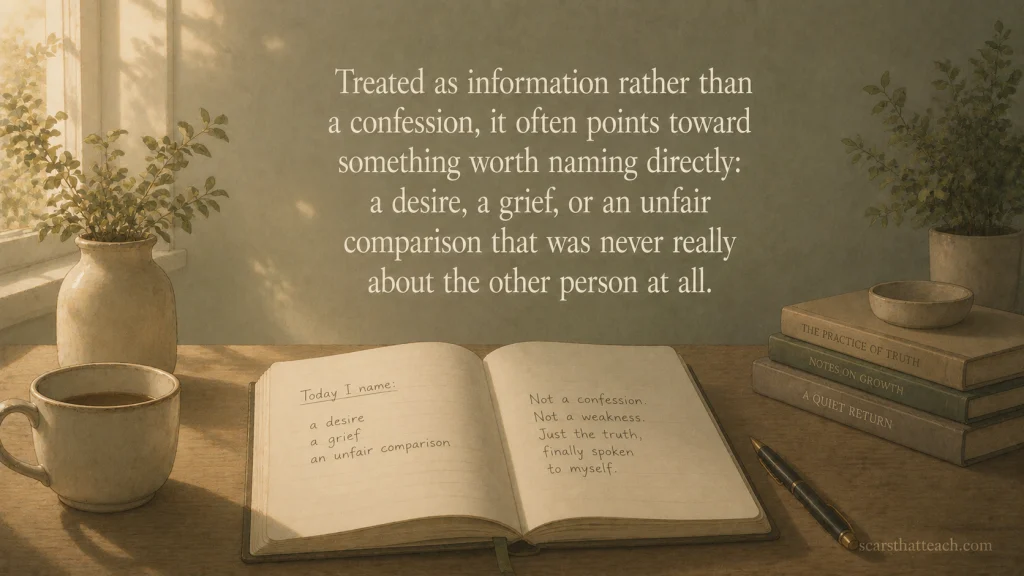
Jealousy over someone else’s success is common enough that it deserves more than a command to stop feeling it. Treated as information rather than a confession, it often points toward something worth naming directly: a desire, a grief, or an unfair comparison that was never really about the other person at all. A wider look at how comparison shapes self-worth covers related ground beyond envy specifically.
FAQs
😔 Does feeling jealous of someone’s success make me a bad person?
No. Envy is a common response when a comparison feels personal rather than informational. It reflects what the comparison touched in you, not a defect in your character.
🔍 What is jealousy actually trying to tell me?
It often points to an unacknowledged desire, an ungrieved disappointment, or a comparison that was never quite fair to begin with. The feeling itself is information worth separating from any self-criticism around it.
💭 Why do I feel jealous even when I genuinely want good things for that person?
Both can be true at once. Genuine goodwill toward someone and private grief about your own situation are separate feelings that often arrive together without contradicting each other.
🚫 Should I just try to suppress the jealousy?
Suppressing it tends to leave the underlying signal unaddressed. It is often more useful to name what the feeling is pointing toward, rather than pushing it away or forcing yourself to feel only happiness.
📱 Is this the same as comparing myself to people on social media?
Related, but not identical. Comparison through social media specifically has its own dynamics, separate from envy triggered by someone’s success in everyday life.