
Self-forgiveness for past mistakes is not a decision you make once, and it is not a moment of resolution that, once reached, holds. It is closer to a practice: the repeated choice not to resume the habit of self-condemnation when a memory of what you did surfaces again. What it requires is specific — acknowledgment of what happened, genuine responsibility for it, amends where possible, and then the deliberate end of ongoing self-punishment. The memory may not disappear. The regret may persist. What can stop is the self-punishment, and that is what self-forgiveness actually asks of you.

The Narrow Gate
Most people trying to figure out how to forgive themselves for past mistakes come to the question having already tried the obvious things. They have told themselves it was a long time ago. They have reminded themselves that everyone makes mistakes. They have looked for the lesson in it, tried to move forward, made some version of peace with what they cannot change. And still the memory is there, and the feeling around it has not shifted the way they needed it to.
What I observed, across many years of sitting with people in their final months, is that the people who had eventually arrived at something like genuine peace with what they had done shared one characteristic. They had looked directly at what they had done, without flinching and without looking away, and then from that place they had found a way to keep going. Not to make it okay. Not to erase it from what they were. To keep going with it as part of their history.
That passage is narrow because most people, when trying to get past something they have done, want to skip the looking directly at it. The skipping is understandable. But I watched people carry the skip for years, trying to move past something they had never quite faced. What they were trying to get past did not move the way they needed it to. I have written elsewhere about why self-forgiveness is so hard to do, and the answer almost always comes back to this same place.

What Self-Forgiveness Actually Requires
The first thing it requires is honest acknowledgment: not the approximate version of what happened, not the version softened by context or hardened by self-blame, but a clear account of what you did and what it produced. This sounds basic. It is not. Most people who have been carrying guilt about something have rehearsed it many times, but rehearsal is not the same as acknowledgment. Rehearsal loops. It circles the same ground without arriving anywhere. Acknowledgment is the moment the circling stops and you say, plainly, what happened.
Taking genuine responsibility means owning your role in what happened, specifically, without minimizing it through excessive context and without inflating it through excessive self-punishment. Both of these are forms of avoidance. The person who is constantly reviewing how terrible they were is not engaged in responsibility in any useful sense. They are performing a version of contrition that keeps them occupied without requiring them to actually face the specific thing they did. Responsibility is smaller and more precise than that performance. It is just: this is what I did, and this is what it cost.
“What I kept seeing, in the rooms where people were finally making peace with themselves, was that the ones who got there had not stopped feeling the regret. They had stopped doing something with it. The doing was the difference.”
Amends, where they are possible, are not an apology. An apology is a statement of regret. An amends is a change. Where the person you hurt is reachable and willing, where the harm is repairable in some form, this step is not optional if genuine self-forgiveness is the aim. Where it is not possible — the person is gone, the relationship is permanently closed, the harm cannot be undone — the question shifts. It becomes: what would a genuine amends have looked like, and is there any equivalent available now. Sometimes there is. Sometimes there is not, and that is its own weight to carry honestly.
The last component is the hardest to describe because it has an internal logic that makes it feel like the moral thing to do. If I keep suffering for this, I am at least paying for it. The suffering feels like it should count for something. But continued self-punishment does not undo what happened, does not help the person who was harmed, and does not prevent you from making the same mistake again. It keeps you occupied with a penance that never actually clears the debt, because the debt is not the kind that can be paid that way.
Ongoing self-punishment tends to look like recognizable things, once you know what to look for:
- Returning to the same memory repeatedly, each time from the same angle, without arriving anywhere new.
- Refusing to accept acknowledgment of things you have done well, because you do not feel you have earned the right to receive it.
- Treating yourself with considerably less consideration than you would extend to someone else who had made the same mistake.
- Interpreting later difficulties as something you deserve for what you did.
- Remaining in a posture of self-condemnation even when no one else is still requiring it of you.
If more than one of those is familiar, the self-punishment is still running. What forgiving yourself actually involves, at its core, is bringing that to a deliberate stop — not because what you did was acceptable, but because the punishment is no longer serving any purpose beyond punishing you.
The Part Most Explanations Get Wrong
Most of what has been written about self-forgiveness frames it as a decision. You decide to forgive yourself. You choose to release the guilt. You reframe the experience as a lesson rather than a failure and then move forward from there. This framing is clean, it sounds actionable, and it does not match how the process actually works for most people. The decision gets made. The memory comes back. The guilt returns. And the person is left wondering what they did wrong, why the decision did not hold.
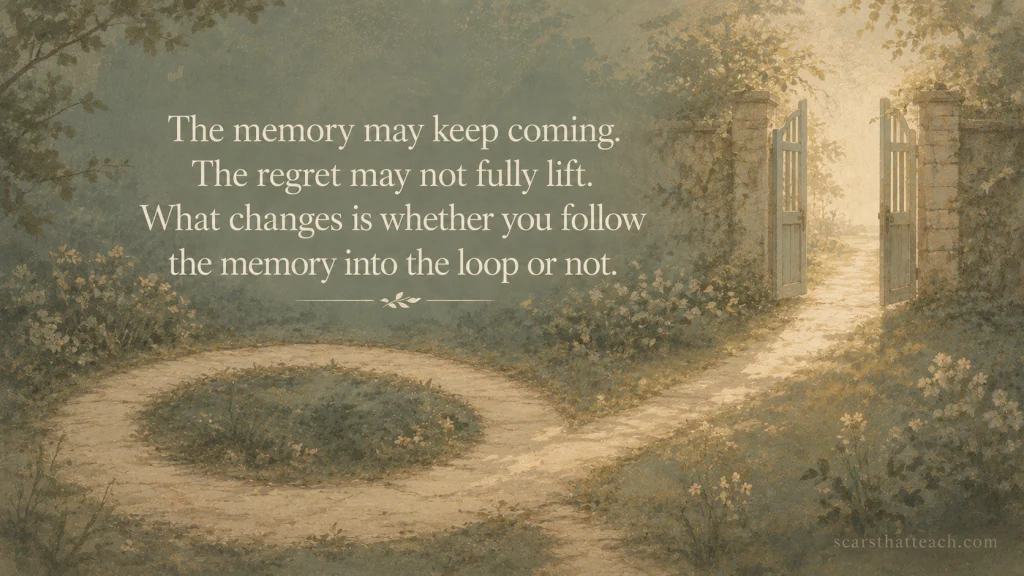
The more accurate framing is that self-forgiveness is an anti-habit. When the memory of the mistake arises, and it will arise again regardless of any resolution you felt you had reached, the question is not whether the memory appears. The question is what you do with it when it does. The person who has not yet forgiven themselves tends to follow the memory into the familiar loop: reviewing what happened, revisiting the regret, running the prosecutorial case again from the beginning. The person who is building self-forgiveness notices the memory, acknowledges it, and does not follow it back into the loop.
This distinction matters practically because it changes what you are trying to accomplish. You are not trying to reach a state of peace that, once arrived at, will remain in place. You are developing a practice of not reopening the prosecution every time the evidence surfaces. The memory may keep coming. The regret may not fully lift. What changes is whether you follow the memory into the loop or not. Most good guidance on the difference between forgiving yourself and letting yourself off the hook lands here: the forgiveness is not in excusing what happened, but in refusing to keep prosecuting it after you have already faced it honestly.
This also addresses the question that most people in this situation are actually carrying: if I stop punishing myself, does that mean I am saying what I did was acceptable? It does not. Ending self-punishment is not the same as excusing what happened. You can hold the full weight of what you did and still choose not to keep extracting suffering from yourself as though that suffering is what responsibility looks like.
Final Thoughts: What the Gate Opens To
The distinction worth holding onto, across all of this, is that none of what self-forgiveness requires is a promise that the memory disappears or the regret lifts. A good deal of what gets written on this subject suggests otherwise, usually in the interest of making the process sound more achievable. But I have watched people who had genuinely forgiven themselves for serious things still carry some form of regret. What they were not doing was prosecuting themselves for it any further. The memory was part of them. The penance had stopped.
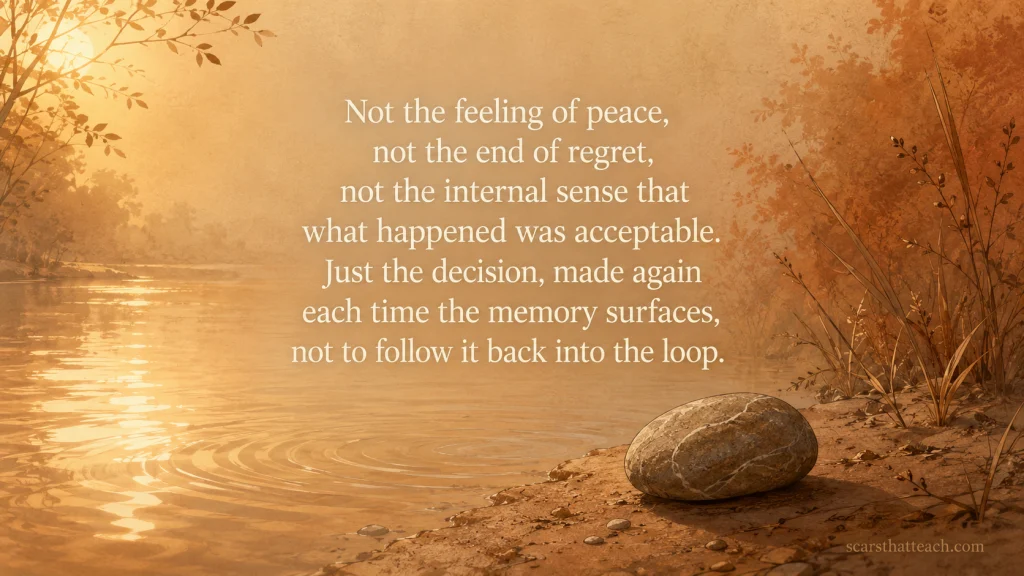
That is the narrow gate. Not the feeling of peace, not the end of regret, not the internal sense that what happened was acceptable. Just the decision, made again each time the memory surfaces, not to follow it back into the loop. Not to keep extracting punishment from yourself for something you have already faced, taken responsibility for, and, where possible, made right. A lot of what people have said honestly about failure points toward the same place: the weight of it does not have to be permanent, but getting lighter requires being willing to set something down deliberately rather than waiting until it drops.
That decision can feel uncomfortably close to letting yourself go. It is not. It is just recognizing that the debt is not the kind that clears through continued payment, and that keeping the payments going is not the same as taking what happened seriously.
FAQs
🔁 Does forgiving yourself mean you have to feel okay about what you did?
No. Self-forgiveness does not require you to decide that what you did was acceptable, or that it did not matter, or that the regret should be gone. What it requires is that you stop adding punishment to something you have already faced honestly. The weight of what happened can remain. The ongoing self-prosecution does not have to.
💭 What if I keep thinking about what I did even when I want to move on?
The memory returning is not a sign that you have not forgiven yourself. It is a sign that the memory is still part of your history, which it will always be. What matters is what you do when the memory appears: whether you follow it back into rumination or let it surface without following it. Self-forgiveness is built in that moment, not in the absence of the memory.
🤝 Do I need to apologize to the person I hurt before I can forgive myself?
Where an amends is possible and the other person is willing, skipping it tends to leave a gap in the process. But an apology alone is not the point. What matters is whether you have genuinely owned what happened and made whatever repair is available to you. Where the other person is not reachable or willing, that step takes a different form.
😶 What if the person I hurt is no longer in my life?
When a direct amends is not possible, the question becomes what a genuine amends would have looked like, and whether any equivalent is available now. Sometimes it is. Sometimes the harm was specific enough that no equivalent exists, and the weight of that is its own thing to carry honestly, separate from the question of continued self-punishment.
⏳ How long does self-forgiveness take?
It varies enough that a timeline would be misleading. What I can say is that the people I saw reach genuine peace with something they had done had usually been in the process longer than they expected, and the pace tended to track how honestly they had faced what they did rather than how much time had passed.
🔒 What is the difference between forgiving myself and letting myself off the hook?
Letting yourself off the hook means excusing or minimizing what happened. Forgiving yourself, in the sense that matters, means you have faced it honestly, taken responsibility for it, and made what repair was available — and then stopped adding to the punishment. The full weight of what you did remains. The ongoing self-prosecution stops.