
People-pleasing produces resentment toward the very people you helped, and most people find this confusing when they first notice it. The mechanism is not complicated once you see it: the person doing the accommodating pays a real cost, but that cost is never disclosed, so no one else knows a transaction occurred. The resentment that follows is not a sign that the other person is ungrateful. It is a sign that an invisible ledger has been running, and only one person was keeping it.

Why the People You Help Become the People You Resent
Understanding why people-pleasing makes you resent the people you help requires looking at what is actually happening beneath the accommodation. Not the surface behavior, which looks generous, but the internal experience, which almost never is. The two are different enough that most people who are caught in this pattern do not recognize it until the resentment is already there, and even then they usually cannot explain it.
Some of the angriest people I sat with near the end of their lives were not angry because they had lived selfishly, or because no one had ever needed anything from them. They had spent decades giving. What they had not done, in most cases, was give freely. They had helped because not helping felt too costly: a conflict they were not ready for, a disappointment they could not stand to cause, a version of themselves they could not afford to be seen as. The help was real. The choice behind it was not. And somewhere along the way, the people they had accommodated became the people they could not stop feeling quietly furious at, even when those people had done nothing wrong.
That particular kind of anger, quiet, confusing, turned inward and then outward at the wrong target, is what this piece is about.
When Helping Is Not Freely Given
The resentment that comes from people-pleasing develops specifically because the accommodating behavior is not freely chosen. It is driven by something else: fear of conflict, fear of disapproval, fear of being seen as difficult or selfish or cold. The person doing the accommodating is not thinking about what they want to give. They are thinking about what will happen if they do not. That is a real distinction, and it matters for everything that follows.
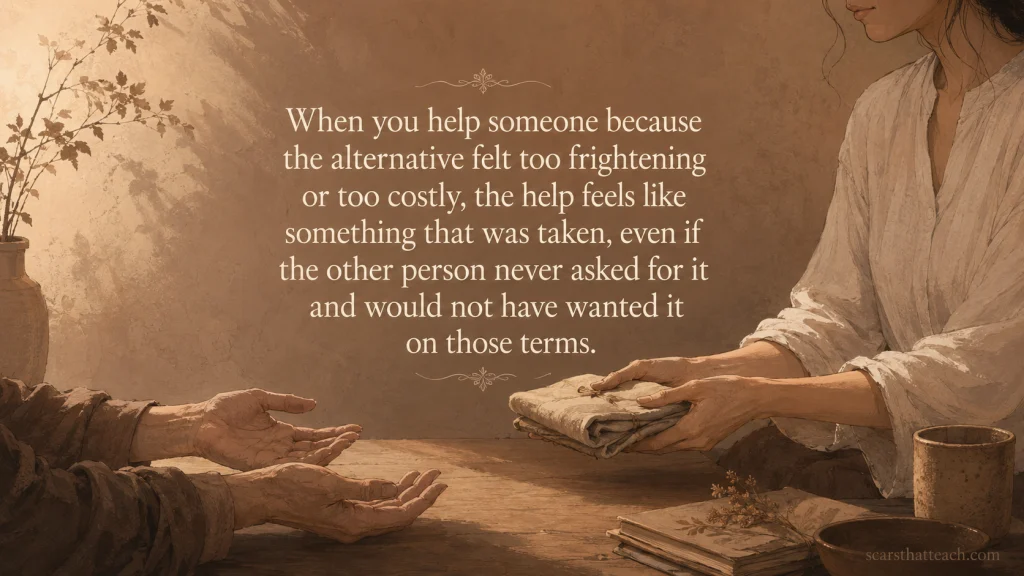
When you help someone from a place of genuine choice, the help feels like something you gave. When you help someone because the alternative felt too frightening or too costly, the help feels like something that was taken, even if the other person never asked for it and would not have wanted it on those terms. They experienced a favor. You experienced a compromise. Neither of you is wrong about what happened. You are simply describing two different events.
Research into people-pleasing and what is sometimes called the fawn response describes this pattern consistently: the accommodating person suppresses their own needs and preferences to avoid anticipated conflict or rejection, and the emotional cost of that suppression accumulates over time, often without the person naming it clearly even to themselves. The broader patterns of people-pleasing behavior are more varied than this single mechanism, but this one, the undisclosed cost, tends to be where resentment begins.

The Transaction No One Else Knows About
Here is the part that most explanations of this dynamic skip over. They name resentment as a consequence of people-pleasing without explaining why it lands specifically on the person who was helped, rather than on the situation, or on the fear that produced the behavior in the first place. The answer has to do with how transactions work when only one party knows they are in one.
When someone accepts your help, they are responding to what they can see: a person offering something. They have no access to the calculation that happened before the offer, the discomfort you swallowed, the thing you did not say, the preference you set aside. They receive generosity because that is what it looks like from where they are standing. They feel no particular need to acknowledge a cost, because they were never shown one. And because they never acknowledged the cost, the cost never gets discharged. It sits. And what it sits next to, in most cases, is the person who was present when it was paid.
This is counterintuitive enough that it is worth saying plainly: the person you helped is not the cause of your resentment in the way that someone who wronged you would be. They did not take anything you were not offering. They simply did not know the offering was costing you something. The resentment points at them because they were the recipient, not because they are responsible. Most of what gets written on self-worth and learning to value your own needs circles around this same problem from a different angle: when you do not name what you are giving, no one else can honor it.
“The cost that goes unspoken does not disappear. It accumulates, and eventually it has to go somewhere.”
The resentment, when it arrives, usually feels disproportionate. The person who triggers it may have done something small, or nothing at all. That is because the resentment is not really about the most recent incident. It is about every incident before it where the cost was paid and not acknowledged, added up to something the latest interaction simply tipped over.
What This Looks Like From the Inside
The confusing part of this pattern is that it does not feel like a structural problem while it is happening. It feels personal. The resentment feels like something the other person did, even when, on examination, they did not do much. Recognizing the mechanism requires being able to look at your own behavior first, which is uncomfortable, because it means acknowledging that the cost you are angry about is one you kept agreeing to pay.
A few versions of this I have seen often enough to describe:
- The friend who never asks but always needs. You rearrange your schedule, your energy, your plans. They accept each accommodation easily because you offer it easily. The resentment builds not because they are demanding, but because you are not telling them what each yes actually costs you.
- The family member you can never disappoint. You show up at every event, take every call, absorb every complaint. They experience a devoted relative. You experience a person who cannot say no, and somewhere underneath that, you experience anger at them for needing so much, even though you have never once told them what needing so much costs you.
- The colleague you always cover for. You take on the extra work, smooth over the gaps, absorb the inconvenience without comment. They may not even know you are doing it. When the resentment arrives, it can look like contempt for their competence, but the source is the accumulated cost of covering that was never named or reciprocated.
- The partner you agree with too easily. You defer on decisions, preferences, plans. They take the lead because you offer it. Over time, the deference produces a quiet fury that neither of you can quite locate, because it has no single cause. It has a pattern.
What people most commonly get wrong when they notice this resentment is assuming it is evidence that the relationship is bad, or that the other person is taking advantage of them. That reading is possible. It is also possible that the other person is simply unaware, because they were never given the information they would have needed to behave differently. Those are two very different situations, and treating them as the same tends to produce the wrong response.
Why people-pleasing rarely builds the closeness it aims for is worth reading alongside this. The invisibility of the cost is also part of why the help does not produce the connection the giver hoped for, which is often the thing that quietly makes the resentment worse.
Final Thoughts: The Ledger Only You Can See
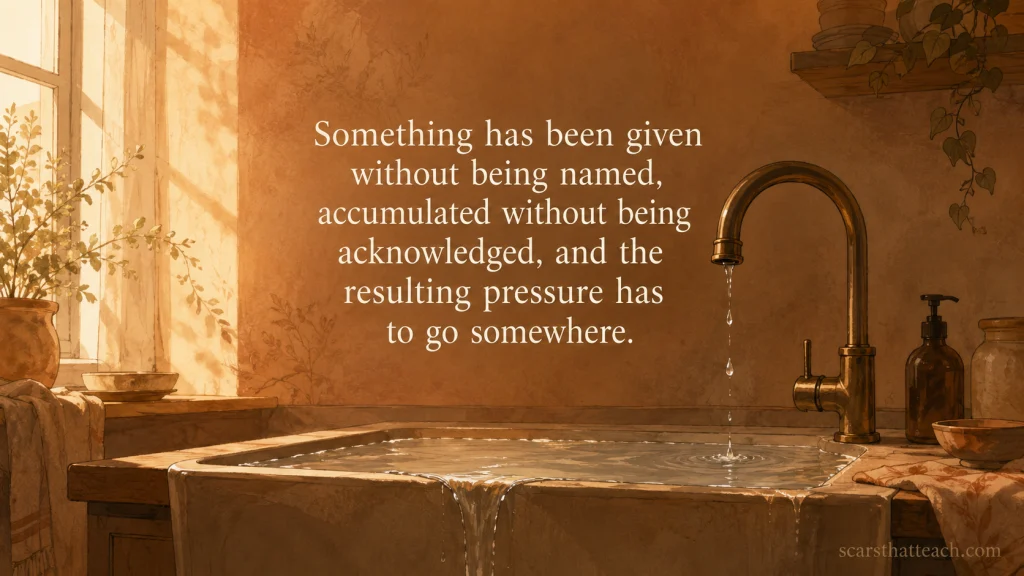
All of that adds up to something worth naming clearly before moving on. The resentment that comes from people-pleasing is not a character flaw in you, and it is not, in most cases, a verdict on the person you are resenting. It is feedback from a system that has been running without disclosure. Something has been given without being named, accumulated without being acknowledged, and the resulting pressure has to go somewhere.
What that feedback is pointing at is not the other person. It is the pattern of giving without being able to say what the giving costs you, which is an older problem than any particular relationship. Most people who find themselves in this dynamic did not develop it with the person they are currently resentful of. They brought it with them, shaped by relationships earlier in their lives where naming a need felt too risky, or where accommodation was the only available currency. That does not make the current resentment less real. It does mean the current relationship is probably not the source of it.
I am not going to tell you what to do with that. It depends on the relationship, the history, and what you are actually willing to name and to whom. If the guilt of drawing a line is its own obstacle, why putting yourself first feels like a betrayal may be the more immediate question. What I can say is that the ledger does not stop running on its own. At some point it has to be seen, even if only by you.
FAQs
😤 Why do I resent people I help even when they didn’t do anything wrong?
Because the cost of helping them was real, but you never disclosed it. The person you helped experienced your generosity. You experienced a compromise driven by fear of conflict or disapproval. They had no information about what it cost you, so they could not acknowledge it. Resentment tends to accumulate where a cost was paid and never recognized, and the person who received the help is simply the one who was there.
🔄 Is people-pleasing resentment always about the other person?
Rarely. The resentment points at the person who benefited, but the source is usually a pattern of undisclosed giving that predates any single relationship. The other person is not usually the cause. They are the location where the cost landed without being named.
💬 Why does the resentment feel so disproportionate to what the person actually did?
Because it is not really about the most recent incident. It is about every prior incident where the cost was paid and not acknowledged, accumulated until something small tips it over. The trigger is just the latest entry in a ledger that has been running for a while.
🤔 Does feeling resentment mean the relationship is toxic?
Not necessarily. It can mean the dynamic is imbalanced in a way that has gone unnamed. That is a problem worth addressing, but it is a different problem from being in a relationship with someone who is intentionally taking advantage of you. The distinction matters, because the two situations call for different responses.
🧠 What is the connection between people-pleasing and resentment?
People-pleasing produces resentment because the accommodating behavior is fear-driven rather than freely chosen. When you help from a place of genuine choice, the giving feels complete. When you help to avoid conflict or disapproval, the cost stays with you. Over time, that cost builds, and it tends to build in the direction of the person who accepted the help without knowing what accepting it was costing you.