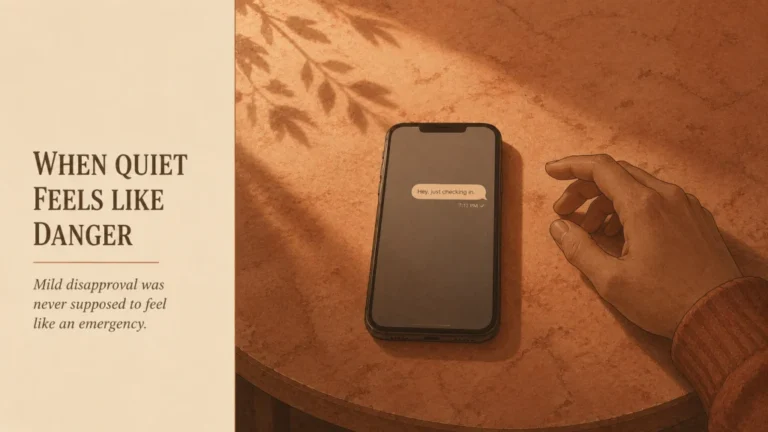
The question of why you always say yes when you mean no usually gets answered with advice about practicing better responses. That answer skips the more important question underneath: why does saying no feel so disproportionately threatening in the first place? The mechanism behind automatic agreement is not a communication deficit. It is a protection response, and understanding what it is protecting you from matters more than being told to simply start declining things.

The Woman Who Had Never Said No Without Paying for It
I remember a woman I sat with in the final months of her life who told me something she had carried for decades without naming it. She said she had never, in her adult life, said no to a direct request without spending the rest of the day certain she had permanently damaged the relationship. Not uneasy. Certain. She described it the way someone describes a fact they have long since made peace with. But the way she said it told me she had not. What she had done was accommodate the certainty for so long that it had become indistinguishable from her, the way a compensatory limp eventually starts to feel like the natural gait.
That is where the question “why do I always say yes when I mean no” tends to live, not in a lack of vocabulary or a failure of nerve, but in a deeply embedded conviction that the cost of no is something the relationship cannot survive. The people who live with this pattern rarely think of themselves as someone who cannot say no. They think of themselves as someone for whom saying no would cause real damage. That distinction is where the explanation actually starts.
Why Saying Yes Happens Before You Can Think About It
Automatic agreement is not a bad habit that formed through inattention. For many people, it is a response that bypasses deliberate thought entirely, because it developed in conditions where deliberating about whether to agree was not safe. Psychologists have described this as part of a cluster of protective responses alongside fight, flight, and freeze: a pattern of appeasement and accommodation that the nervous system uses when conflict or disapproval registers as genuinely threatening. Not threatening as a figure of speech. Threatening at the level of physical response, with all the tightening and bracing that accompanies any perceived danger.
This is why people who say yes when they mean no often report that the yes is out before they have consciously chosen it. The word forms, the smile follows, and only afterward does the internal voice register that they did not actually want to agree. The sequence is not a failure of willpower. It is the body running a protection protocol that operates faster than the part of the mind that would like to make a different choice.
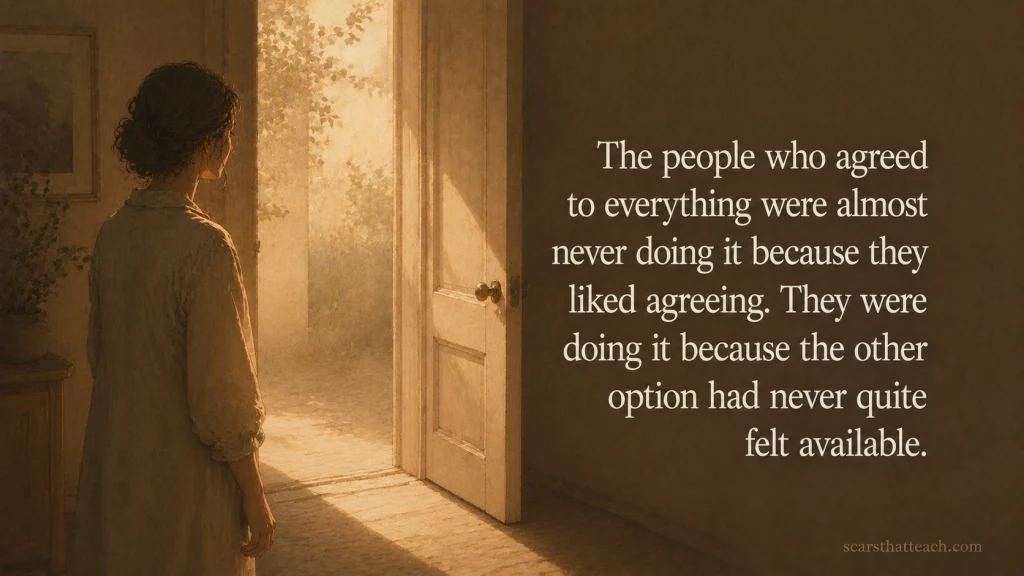
“What I noticed, across enough of these conversations, is that the people who agreed to everything were almost never doing it because they liked agreeing. They were doing it because the other option had never quite felt available.”
Understanding why you always agree, or why saying no seems to produce something close to panic before anything has actually happened, starts with taking seriously that the response is doing something. It is not irrational. It has a logic, and that logic is protective.
What the Threatened Consequence Actually Is
The threat is different for different people, but it tends to organize around a few recognizable forms. Getting clear on which one is driving the pattern is more useful than treating them all as the same thing.
- The other person’s anger. Not that it will be uncomfortable but that it will be unmanageable, or that it will be turned entirely on you in a way that feels impossible to survive.
- Loss of the relationship. Not as a logical prediction but as a felt certainty: if I say no, this person will leave, withdraw, or decide I am not someone they want around.
- Being seen as selfish or difficult. Less about consequences and more about identity, the fear that saying no reveals something about you that you would prefer not to have confirmed.
- Responsibility for the other person’s disappointment. A felt obligation to protect them from any negative experience, including the ordinary experience of being told no by someone who cares about them.
- A disruption to the sense of safety in the relationship itself. Not any specific outcome but the general feeling that saying no destabilizes something that has been carefully maintained.
What these share is that they are all relational. The anticipated cost of saying no is not embarrassment or conflict in the abstract. It is specifically the loss of connection, safety, or standing within a relationship that matters. That is why the advice to simply practice declining things misses the actual problem. The person who cannot say no is not failing to practice a skill. They are managing what feels like a survival-level risk every time the question arises.
Why the Supposed Fix Feels So Dangerous to Attempt
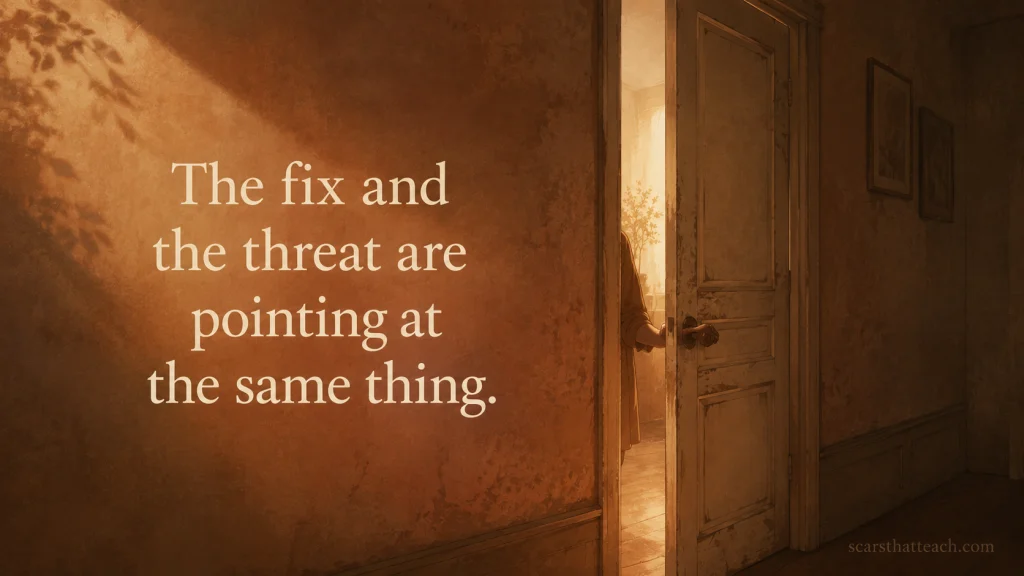
Most of what exists on this topic offers the same answer: learn to say no. Start small. Practice with low-stakes requests. Build up. This framing treats the pattern as a skill deficit, which means the solution is practice. The difficulty is that for many people, attempting the solution is precisely what the protection response is designed to prevent. The fix and the threat are pointing at the same thing.
The reason saying no feels dangerous is not that the person lacks courage or has not thought clearly about their own needs. It is that, somewhere in their history, the consequences of saying no or of creating conflict were significant enough that the body formed a conclusion: agreement is safer. That conclusion may have been formed in a household where a parent’s anger changed the temperature of everything, in a relationship where conflict reliably produced withdrawal, in a family role where keeping the peace was the unspoken condition for belonging. The pattern made sense in that context. The problem is that it learned to generalize.
Researchers who write about this pattern from a therapeutic perspective note that the anticipated consequence of saying no is often not proportional to the actual relationship. The person is calculating the cost using data from an earlier environment, applied to a current one where the stakes may be entirely different. But the body does not automatically update its threat assessments. It applies the old conclusion until something interrupts it, which is why the instruction to just start saying no tends to produce not gradual confidence but something closer to genuine dread.
If the practical question, what to actually do with this pattern, is what you are trying to work toward, the writing on how to approach stopping people-pleasing covers that territory more directly. What matters here is understanding the mechanism well enough that the difficulty of attempting to change it stops feeling like evidence of weakness.
Where the Pattern Comes From, and Why It Does Not Always Require a Dramatic Origin
One thing worth saying clearly: the pattern of saying yes when you mean no does not require a severe or clinical history to explain. The protection response develops when agreement has been reliably safer than the alternative, and that condition can be met through a wide range of experiences that never rise to the level of trauma in any clinical sense.
It can come from a family role. The child who was the peacekeeper, the one who read the room and adjusted to keep things stable, develops the capacity for automatic agreement through sustained practice. It can come from temperament. Someone who is highly attuned to other people’s emotional states may have found early that agreement dampened distress in others, and repeated that strategy until it became the default. It can come from specific social environments, workplaces, friend groups, or cultural contexts where expressing disagreement carried consistent costs. Or it can simply come from a long enough run of experiences where saying yes worked and saying no did not.
The specific origin matters less than the recognition that the pattern exists for reasons, and that those reasons made sense in the context that produced them. What is worth examining is not where it came from but whether the context has changed and whether the strategy still serves anything useful in the life you are actually living now. For many people, it has not served anything useful for years. What it has done is become invisible because it is so consistent.
The question of whether what you are doing is genuine care or a protection response running on old instructions connects to a broader distinction, one that is worth sitting with: the difference between being kind and people-pleasing is not always obvious from the inside, and being clear on it changes what the pattern actually costs.
Final Thoughts: What the Pattern Is Trying to Protect
The woman I described at the beginning of this had not, as far as I could tell, ever said no to anyone who mattered to her without afterward running the full calculation of what it had cost. She was not a passive person. She was not someone who lacked opinions or preferences. She was someone who had learned, early enough that she could not point to when, that her belonging in relationships was conditional on her accommodation. She had been practicing that lesson for so long that she had stopped noticing she was practicing it.
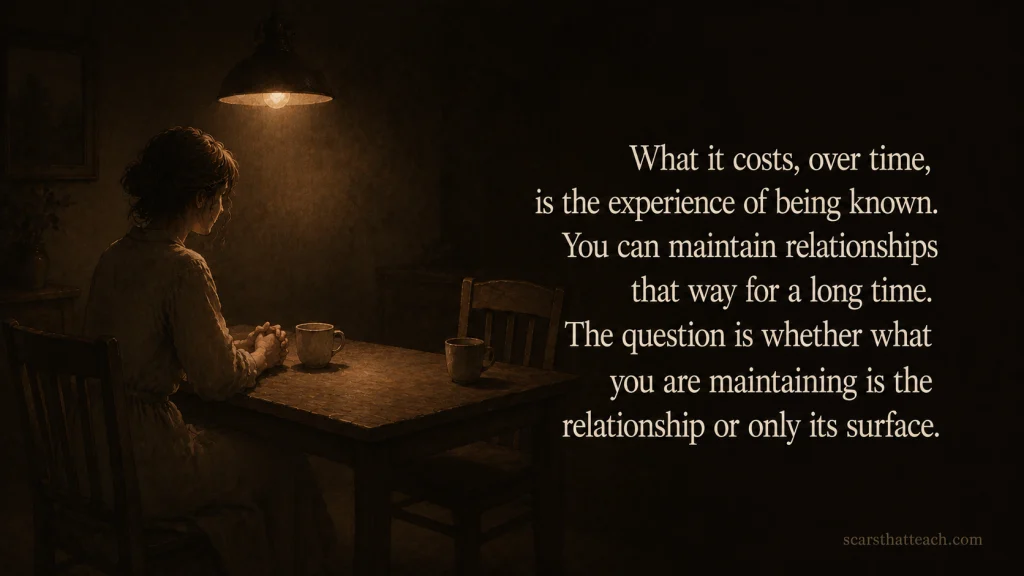
That is what the pattern of always saying yes when you mean no is usually protecting: the sense that being in the relationship at all requires constant management of the other person’s experience of you. It is not irrational, given where it started. What it costs, over time, is the experience of being known. You can maintain relationships that way for a long time. The question is whether what you are maintaining is the relationship or only its surface.
The larger territory this question sits in, including the other patterns that tend to accompany automatic agreement, is worth exploring if this has been a long-standing way of moving through the world. That is what the writing collected around people-pleasing and what sustains it is there for. And some of what people have said, after they have lived through the cost of not knowing themselves, is gathered in what people said about finally being on their own side.
FAQs
🔄 Is always saying yes a personality trait or something that can change?
It is not a fixed personality trait, even if it feels like one. It is a learned pattern of response, which means it developed under specific conditions and can be understood and worked with. What makes it feel fixed is that it operates below the level of deliberate choice most of the time. Change tends to start with being able to notice the pattern in real time rather than only in retrospect.
😰 Why does the thought of saying no feel like something terrible will happen?
Because the protection response is running a cost calculation based on past experience, not the current situation. If saying no or creating conflict has historically produced something painful, the body applies that conclusion broadly. The feeling of dread is not irrational given the data it is working with. It is just often working with outdated data.
🤝 Is this the same as the fawn response?
The pattern overlaps significantly with what therapists call the fawn response, a protective accommodation strategy that sits alongside fight, flight, and freeze. Whether it qualifies as a clinical pattern depends on severity and history. Most people who recognize themselves in automatic agreement are not in clinical territory; they are simply running a learned strategy that developed for understandable reasons and has outlasted the conditions that made it necessary.
💬 Does always saying yes mean I do not know what I actually want?
Not necessarily. Many people with this pattern have clear internal preferences and know exactly what they would prefer. What they have learned is to override that knowledge automatically when the social stakes are present. The preference is there. What is absent is the felt sense that expressing it is safe.
🧩 Can this pattern develop without a traumatic history?
Yes. While the pattern can develop in environments with significant relational difficulty, it also develops through temperament, family role, long-term social conditioning, and sustained experience in environments where agreement simply worked better than the alternative. No dramatic origin is required to explain it, and attributing it to trauma when that framing does not fit can make the pattern harder to examine clearly.