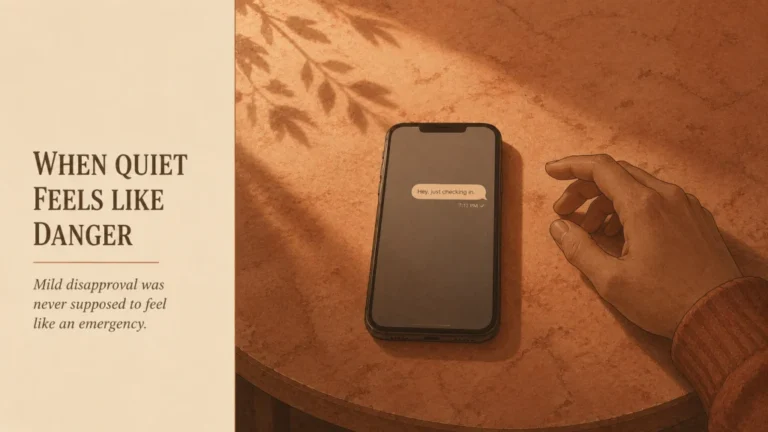
People-pleasing tends to feel like a strategy for being liked, and in the short run, it often works. What it produces over time is something different: a pattern that others sense before they can name it, a closeness that never quite arrives, and a quiet accumulation of cost that the people-pleaser carries alone while everyone around them assumes things are fine. The counterintuitive finding is not that kindness pushes people away. It is that consistently hiding yourself in order to keep others comfortable tends to prevent the kind of mutual knowing that real closeness is built on.

What the Dying Rarely Said About the People-Pleasers in Their Lives
A hospice chaplain once described a pattern she had noticed after years of sitting with people near the end of their lives, listening to them talk, without anything left to perform, about who had actually mattered to them and why. She had expected the usual answers. What she kept noticing, about who came up and how, did not line up with what most relational advice about being liked would lead anyone to predict.
The people named with the most feeling, the ones missed with something close to physical ache, were rarely the ones who had worked hardest to be agreeable. They were, more often, the ones who had said something true at the wrong moment, held a position when holding it cost them something, or simply refused to pretend when pretending would have been easier. The people who had spent years making themselves frictionless came up in those conversations with warmth. But a particular kind of warmth. The kind you feel toward someone who made things comfortable, not the kind you feel toward someone who actually knew you.
That distinction is worth sitting with. Being liked and being loved are not the same relational outcome. And the strategy most people use to try to secure one tends, over time, to quietly undermine the other.

Why It Tends to Work at First
People-pleasing is not irrational. That is worth saying plainly before anything else. The person who agrees readily, accommodates without complaint, and never introduces friction into a social situation is, in the short term, genuinely pleasant company. People do like spending time with them. Gatherings go more smoothly. Conflicts do not start. The people-pleaser often gets invited back, spoken well of, and treated with a kind of easy warmth that can be easy to mistake for something deeper.
What the short term conceals is what the long term eventually reveals. Pleasantness is not the same as closeness. Being easy to be around is not the same as being known. In the early stages of a relationship, the surface is most of what either person has access to, so a person who makes the surface comfortable can seem like exactly what the situation calls for. The confusion between surface comfort and genuine connection can persist for years. By the time the difference becomes clear, a great deal of effort has usually gone into maintaining an approach that was never going to produce the outcome the people-pleaser had in mind.
For most people-pleasers, the habit of agreeing when they mean no started long before the relationships they are currently in. Understanding saying yes when you mean no and where that reflex actually comes from is worth working through separately, because the origin of the pattern and what it does to your relationships over time are two different problems, and they call for different kinds of attention.
What Others Sense Before They Can Name It
When someone consistently accommodates in ways that require suppressing what they actually think or feel, the people around them tend to notice something, even when they cannot say exactly what it is. The interaction feels slightly off-center. There is a version of the person you are getting, but something has been edited out of it. You can be perfectly comfortable with someone and still carry a faint sense that you are not quite meeting the real one.
When someone consistently subordinates their own reactions and preferences to maintain approval or avoid conflict, the relationship tends to drift toward something one-sided in ways that neither person consciously chose. The person receiving all that accommodation does not always experience it as generosity. They experience it as a flat surface with no real texture: someone who is easy to be around but does not require much genuine investment in return. Over time, the people-pleaser becomes, in the minds of others, something close to peripheral. Present, pleasant, but not particularly necessary.
There is a pattern that surfaces often enough to stop calling it a coincidence. The person who had spent years agreeing with everyone, never asserting a preference, never naming what actually bothered them, would often describe feeling invisible in relationships where they had been present and accommodating every single day. The people around them were not cruel. They had simply stopped expecting to find much of anything real on the other side of the agreement. Invisible is exactly the right word for what that kind of relentless accommodation tends to produce.
The Closeness That Cannot Form Without Real Knowing
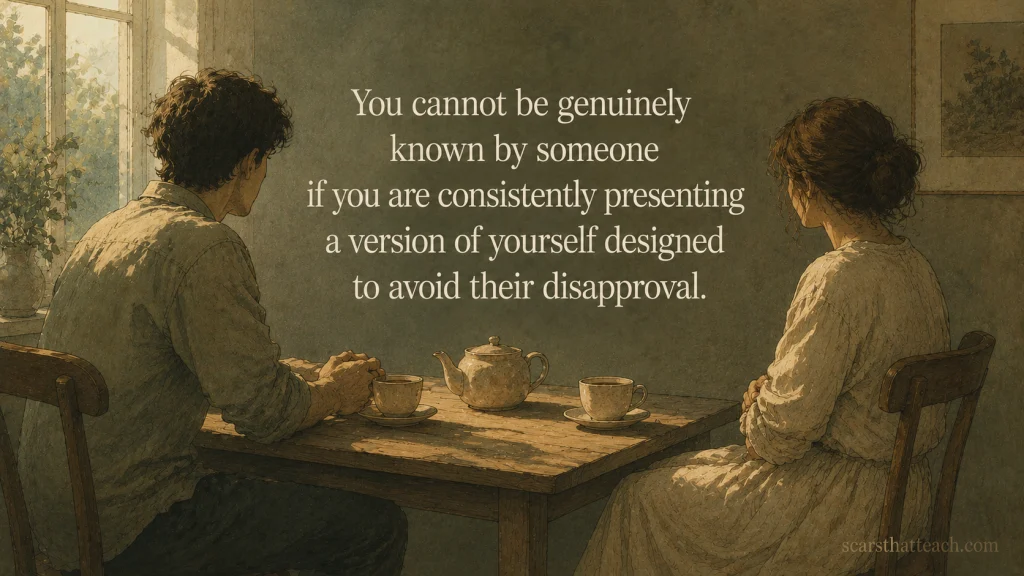
Closeness requires mutual knowing. You cannot be genuinely known by someone if you are consistently presenting a version of yourself designed to avoid their disapproval. And you cannot genuinely know someone if the entire texture of your interactions with them is organized around not unsettling them. Both sides of the exchange lose something. The person doing the accommodating tends to feel the loss more acutely, because they are the one doing all the work of staying hidden.
What this produces is a relationship that can run for years without ever getting real. The conversations are pleasant. The time spent together is comfortable. But there is no record of either person having actually seen the other clearly in a difficult moment, disagreed and stayed anyway, or said something hard and been met with something honest in return. Those are the exchanges that build the kind of trust that outlasts circumstance. Without them, the relationship stays at a level where both people feel fine but neither feels close. Fine is not what the people-pleaser was working toward. They were working toward something that felt like being genuinely wanted. The two are not the same thing.
This is one of the less-discussed reasons why people-pleasing backfires as a relational strategy. It is not only that others eventually sense the inauthenticity. It is that the people-pleaser, by consistently concealing their actual responses, prevents the relationship from reaching the depth they were hoping for all along. The strategy was supposed to produce closeness. What it tends to produce instead is a kind of pleasant distance.
The Resentment That Builds While Everything Looks Fine
There is another layer to this, and it belongs to the people-pleaser alone. Emotional exhaustion and a slow accumulation of resentment are among the most consistent long-term consequences of a pattern that looks, from the outside, like generosity. The person doing the accommodating carries the cost. No one else usually sees it, because no one else was told it was there.
The resentment does not show up the way anger at someone who has directly wronged you tends to show up. It is more diffuse than that, and more disorienting. It tends to surface as a background sense that something is not fair, that all this effort is not being seen or returned, that the relationship is costing more than it is giving back. The problem is that the people-pleaser has never told anyone what the effort actually was. They presented the accommodation as natural and effortless, which means no one around them knows to register it as something that cost anything. So the resentment compounds in a vacuum, invisible to everyone, including sometimes the person carrying it.
That gap between the person the people-pleaser has performed and the person they actually are is often what eventually erodes the relationship. Not a single confrontation. Just a slow accumulation of unacknowledged cost until the person doing all the accommodating has nothing left to give and no clear language for why. The signs that this dynamic has taken hold tend to follow a recognizable shape:
- Feeling drained after spending time with people you are supposed to care about, without being able to explain it.
- A persistent sense that the effort you are putting into a relationship is not what the other person sees or values.
- Noticing that your actual opinions, preferences, and frustrations have not come up in conversation in longer than you can clearly remember.
- Finding yourself rehearsing how to say something neutral before the other person has even said anything.
- A settled, low-level feeling that the people in your life know a version of you, but not quite the real one.
These are not necessarily signs that the relationship is past saving. But they are signs that it is not currently giving either person much of what relationships are actually for. If this particular layer of the pattern feels familiar, there is more on what it builds into over time in what people-pleasing does to the people you help.

Final Thoughts: What the Strategy Was Never Going to Produce
The people-pleaser is not doing something wrong in any simple sense. The instinct to reduce friction, to keep others comfortable, to make yourself easy to be around, comes from somewhere real. The problem is not the instinct itself. The problem is what the instinct costs over time, and the particular irony that the strategy designed to secure closeness tends to systematically prevent it.
What threads through that pattern is that the people who managed to be genuinely loved, not just liked, were the ones who had let themselves be known. Imperfectly, sometimes uncomfortably, but actually known. That required saying things that were true, holding preferences that others did not always share, and staying in the room after a moment of honest friction rather than immediately smoothing it over. None of that is easy, and timing is rarely in our control. But it is what the relationship was waiting for. The people who skipped that part, who tried to secure closeness by never requiring anything real from anyone, often ended up with many comfortable relationships and very few close ones.
If you want to understand the full shape of this pattern, where it tends to show up across different relationships and what shifts when someone starts seeing it clearly, other questions about people-pleasing are worth working through. And if the piece underneath it, the part about how you regard yourself when you are not managing anyone else’s reactions, is where you actually need to start, thoughts on self-worth and self-regard offer a different kind of entry point.
FAQs
💬 Does being nice actually make people like you more?
In the short term, often yes. But being nice in the specific way that requires hiding what you actually think or feel tends to produce comfort rather than closeness. People may like spending time with you while never quite knowing you. That is a different outcome than the one most people-pleasers are working toward.
🤔 Why do people-pleasers end up resenting the people they help?
Because the help is being given at a real cost that was never named or acknowledged. When someone consistently accommodates without saying what the effort actually is, the effort becomes invisible. Resentment is almost always the result of an imbalance that stays unacknowledged long enough to compound.
👁️ Can people tell when someone is being inauthentic, even if they cannot explain why?
Yes, reliably. Most people cannot name exactly what feels off, but they notice. The interaction feels slightly flat, a little too smooth. Over time, the people-pleaser registers to others as someone pleasant but not someone who requires much genuine investment in return.
🔄 Does people-pleasing backfire in every relationship?
Not always immediately and not always in the same way. But the consistent pattern over time is that the closeness the people-pleaser is working toward does not form the way they hoped. The relationship stays pleasant. The depth does not follow.
💡 How do you stop people-pleasing without pushing people away?
The fear that honesty will cost you the relationship is usually the same fear that produced the pattern in the first place. What tends to happen in practice is that most relationships can hold considerably more of the real you than you have been allowing. Some cannot. Those are usually not the ones worth organizing your entire personality around.
🧩 What is the difference between being kind and being a people-pleaser?
Kindness is something you extend from a stable sense of what you actually think and feel. People-pleasing is what happens when you organize your behavior around managing how others perceive you, at the cost of showing anything true about yourself. One is generosity. The other is a form of self-erasure that tends to leave both people worse off over time.