The difference between being kind and people-pleasing is not the action itself, it is where the action comes from. A kind act can be given freely and withheld freely without much cost to the giver, while a people-pleasing act carries a quiet dread at the thought of not doing it. I spent two decades watching people who believed those two things were the same wall, with no room to be both caring and free. They are not the same wall. This piece walks through what actually separates kindness from people-pleasing, and why letting go of one does not require letting go of the other.

The Difference Between Being Kind and People-Pleasing
A woman told me once that she was afraid to stop people-pleasing because she thought it would make her selfish. She described it the way you might describe standing in front of a wall, certain there was nothing on the other side of it. Kindness on one side, selfishness on the other, and nothing in between for her to stand on. What struck me was that she had never once considered the wall might not be there at all. She had spent so many years inside the pattern that she could no longer see where her caring ended and her fear began.
That confusion is more common than most people admit, and it keeps a lot of caring people stuck in patterns that exhaust them, because they believe any change to those patterns means becoming someone harder, colder, someone they do not want to be. The actual difference between being kind and people-pleasing has very little to do with what you do for someone. It has everything to do with what happens inside you when you do it, and whether you could have said no without paying for it.
What Genuine Kindness Actually Looks Like
Genuine kindness involves real care for another person’s well-being, and it is fully compatible with saying no, disagreeing, or holding a boundary. A kind person can decline to help with something and remain just as kind as they were before they declined. The kindness was never contingent on the yes. It was a separate thing entirely, something that lived in the person regardless of which answer they gave on a given day.
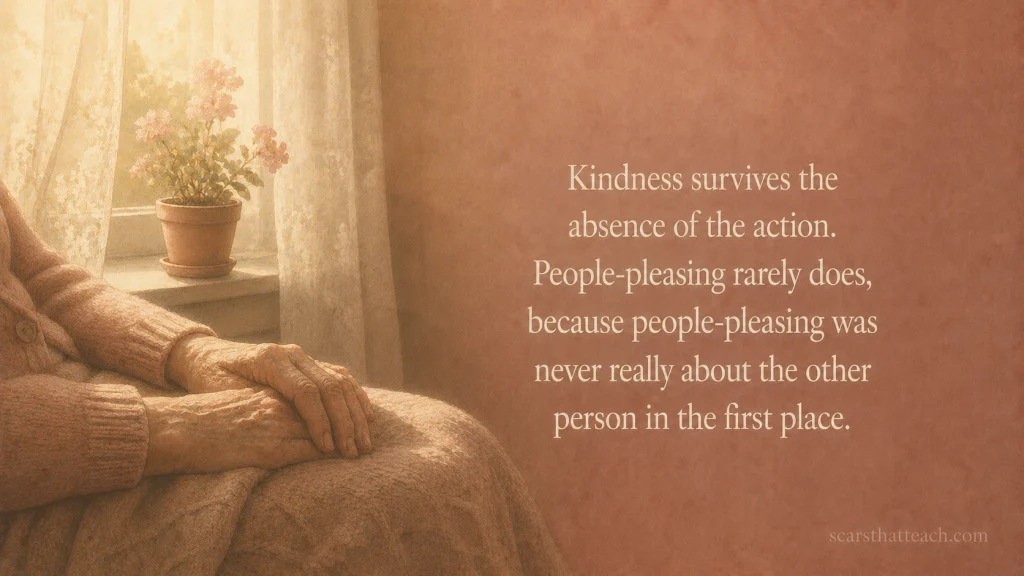
I watched this distinction play out most clearly in the people who were dying. The ones who had spent a lifetime being genuinely kind did not panic when they could no longer do the things that used to make them feel useful. They had cared about people, not about being seen as someone who helps. When the helping stopped, because their bodies simply would not let them help anymore, the kindness stayed intact. It had never depended on the doing. That is one of the clearest tests I know: kindness survives the absence of the action. People-pleasing rarely does, because people-pleasing was never really about the other person in the first place. It was about what happened to the giver if they did not perform.
What People-Pleasing Actually Costs the Giver
People-pleasing looks like kindness from the outside and almost never feels like it on the inside. The practical test is not the action, it is the source. An action driven by genuine care tends to feel different to the giver than an action driven by the fear of what happens if they do not perform it. The first can be done freely and withheld freely. The second cannot be withheld without a cost that shows up almost immediately, usually as guilt, dread, or a tight feeling in the chest before the words “I can’t help with that” even leave the mouth.
I sat with people who could tell you, in detail, every favor they had ever done for someone who never said thank you, and who still could not bring themselves to stop doing those favors. That is not generosity running its natural course. That is a transaction the giver feels obligated to keep making, even when nothing is coming back, because the alternative, the version where they say no and the relationship survives it, has never felt available to them. Some researchers and clinicians describe this as the difference between warmth-based accommodation, which is chosen, and fear-based fawning, which feels compulsory. The accommodation can be set down. The fawning cannot, not without the giver bracing for what they believe will happen next.
The Real Test: Choice Versus Compulsion
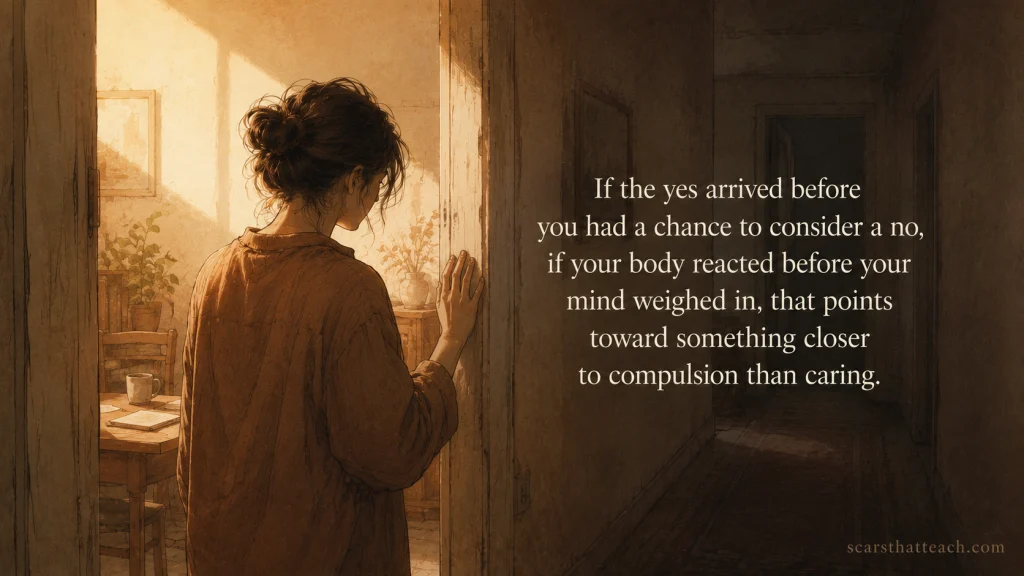
If you want a way to tell the two apart in your own life, the clearest signal is not what you did. It is whether choice was available to you when you did it. If you deliberated, even briefly, and decided to help because it seemed reasonable and you wanted to, that points toward kindness. If the yes arrived before you had a chance to consider a no, if your body reacted before your mind weighed in, that points toward something closer to compulsion than caring.
A few honest questions tend to separate the two faster than anything else. Some point toward kindness, some point toward the fear underneath people-pleasing, and most people recognize both lists in themselves to some degree.
- Kindness sounds like: you can say no to a request and the relationship does not feel threatened by it.
- People-pleasing sounds like: you notice a flicker of dread or panic at the thought of disappointing someone, even over something small.
- Kindness sounds like: you feel lighter after helping, not drained, even when the help cost you time or energy.
- People-pleasing sounds like: you replay conversations afterward, checking for signs that someone might be upset with you.
- Kindness sounds like: you can disagree with someone you care about without feeling like the relationship is now at risk.
None of this means every uncomfortable moment of helping someone is automatically people-pleasing. Discomfort and compulsion are not the same thing. Kindness can be inconvenient and still be kindness. What matters is whether you had room to choose, and whether the cost of saying no would have been proportionate to the actual situation, rather than the much larger cost your fear was telling you it would be.
Why This Fear Runs So Deep
The fear that letting go of people-pleasing means becoming selfish is not irrational, even when it is inaccurate. For a lot of people, the pattern formed early, in homes or relationships where being agreeable was the safest way to stay connected to someone whose moods could not be predicted. In that environment, kindness and compliance got fused together so thoroughly that the person never had a chance to find out where one ended and the other began. Asking them to simply “stop people-pleasing” without first showing them that their actual kindness will survive it is asking them to risk something that, to their nervous system, feels like abandonment.
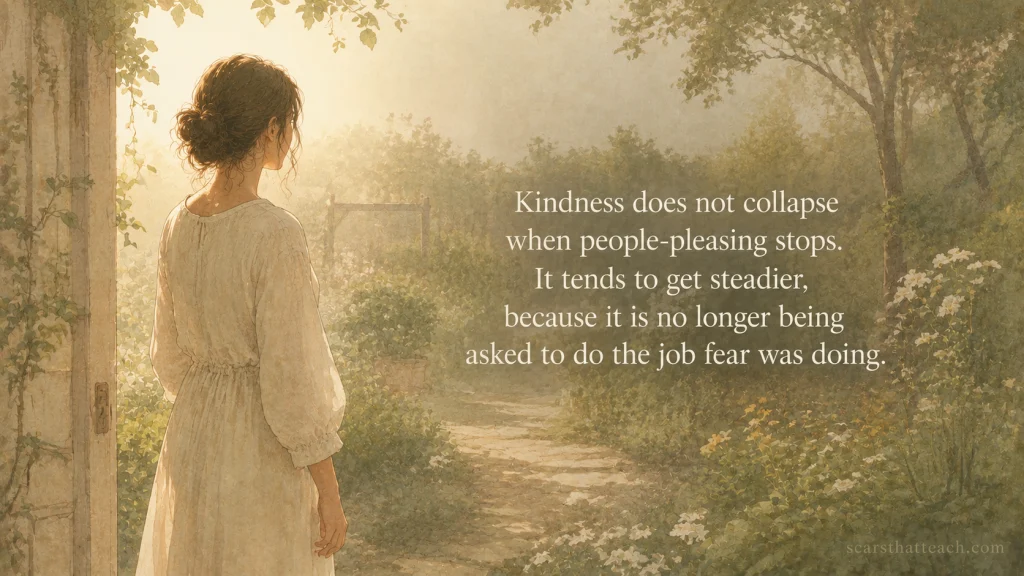
This is not territory I try to diagnose for anyone, and it is not mine to resolve in a single conversation, let alone a single piece of writing. What I can say, from two decades of watching people work through it, is that the fear softens once someone sees, clearly, that the wall they were standing in front of was never load-bearing. Kindness does not collapse when people-pleasing stops. It tends to get steadier, because it is no longer being asked to do the job fear was doing.
Final Thoughts: You Do Not Have to Choose Between Kind and Free
If you recognize yourself in any of this, the thing worth sitting with is not whether you are a good person. You almost certainly already know that you are. The thing worth sitting with is whether the giving you do comes from choice or from fear, and what it might feel like to test that, in one small situation, without assuming the whole structure of your relationships depends on you never finding out.
What I told the woman standing in front of that wall, eventually, was that she did not need to tear it down all at once. She only needed to walk close enough to it once to see that it was not as solid as she had believed. Kindness was on both sides the whole time. It always is.
For more on the specific patterns that keep people stuck in this fear, my piece on why people-pleasing forms and what keeps it going goes further into where this comes from. And if you are ready to look at what change might actually involve, the broader collection on self-love and the harder parts of valuing yourself covers ground this piece only touches on.
FAQs
🤝 What is the difference between being kind and people-pleasing?
Kindness comes from genuine care and can be given or withheld freely. People-pleasing comes from fear of what happens if you say no, and withholding it carries a real cost to the giver.
❓ How do I know if I am kind or just a people pleaser?
Notice what happens in you right before you say yes. If you briefly considered saying no and chose to help anyway, that is kindness. If the yes felt automatic and a no felt unsafe, that points toward people-pleasing.
😟 Will I become selfish if I stop people-pleasing?
No. Genuine kindness does not depend on the fear-driven behavior of people-pleasing, so letting go of one does not remove the other. Most people find their real kindness gets clearer once the fear quiets down.
💭 Can being nice ever be a form of people-pleasing?
Yes. The same action, helping someone, can come from either place. The behavior alone does not tell you which one it is. The feeling underneath it usually does.
🫶 Is it possible to be kind and still set boundaries?
Yes, and that is one of the clearest signs of genuine kindness. A kind person can hold a boundary and remain just as caring as they were before they held it.