
The standard advice about regret offers two options: suppress it, or let it drive you to immediate action. Neither captures what regret is actually for. Research on the subject suggests regret carries two pieces of information worth reading: a signal about what you value highly enough to feel its absence, and a cue about what might still be reachable. This piece looks at how to read that signal clearly, and how to convert backward-looking regret into a more useful question about what is still in front of you.
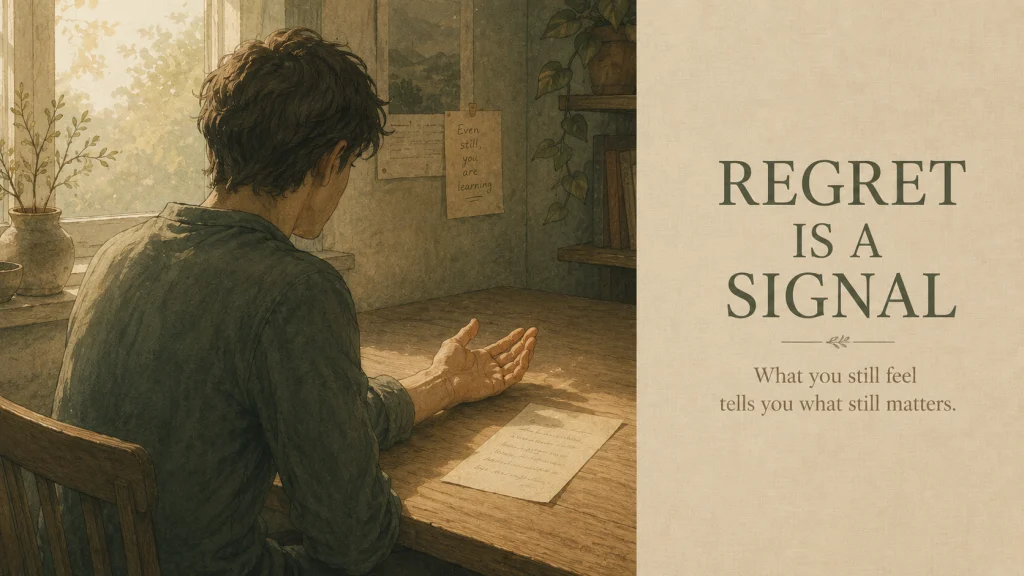
The Difference Between Regret That Informs and Regret That Consumes
After more than two decades sitting with people in the last chapter of their lives, one of the things I noticed is that the people who were still engaged and purposeful near the end were not the ones who had stopped regretting. Most of them had substantial regrets. What was different about them was that they had found a way to make the regret say something useful, not just something painful. They had given it somewhere to point.
The people who were most stuck were the ones whose regret had never been given anything to do. It had nowhere to go except in circles. What they were carrying, often without quite having the language for it, was an unprocessed signal that had long since turned into noise. The difference between regret that informs and regret that consumes is not the size of the original loss. It is whether the regret ever got asked the right question.
That question is what this piece is built around. Not how to stop regretting, but how to use regret productively, as a form of clarity about what still matters, before it settles into something you carry without meaning to for longer than it needed to stay.
What Most Advice on Regret Skips Over
Most of what people are told about dealing with regret healthily falls into one of two categories. The first is suppression: let it go, stop looking back, choose to move forward. The second is immediate action: use the pain as fuel to do the thing you have been putting off. Both have their uses. Neither tends to engage with the middle part, which is the most useful part.
Suppression fails because it does not ask what the regret is communicating. When you route around a regret rather than reading it, you lose the information it carries. You also tend to find that it returns at the edges of other moments, precisely because it was never resolved, only postponed. A regret that has not been asked what it means keeps finding new occasions to raise the question.
The push to immediate action fails in a different way. It treats the regret as a prompt without first understanding what you are being prompted toward. A person who regrets not living more adventurously does not necessarily need to book a trip. They may need to understand what adventure means to them specifically, and where in their current life that thing is conspicuously absent. Acting on the surface of a regret without reading what is underneath it can leave the signal still active even after the action.
What the research suggests instead is a two-step approach: first, read the regret as a statement about values, and second, use that reading to ask a more useful question about the present. Both steps matter. The order matters too.
Regret as a Signal About What You Value
Regret is an emotion with information inside it. Jelena Kecmanovic, a clinical psychologist and the founding director of the Arlington/DC Behavior Therapy Institute, writing for Psyche, makes this point directly: the content of what you regret most consistently can reveal what matters to you enough that you feel its absence. The things that still surface years later are the things that mattered enough to leave a mark.
A man who regrets not spending more time with his children when they were young is not just carrying sadness about the past. He is carrying a clear signal about what connection and presence mean to him, and about what he has let take precedence over those things for too long. A woman who regrets the career she set aside is not just mourning a path not taken. She is carrying information about what kind of work gave her something the current arrangement does not. The regret is a data point about what the person values highly enough to feel its absence across years, sometimes across decades.
It is worth naming a scope boundary here. This piece covers regret about missed opportunities and unchosen paths, the career not pursued, the relationship not built, the version of yourself you kept waiting to become. That is a different category from regret about harm you caused to another person, which carries its own accountability and belongs in its own conversation. If what you are carrying is closer to the latter, the approach here is not the right starting point.
For the missed-opportunity kind, the question to ask of a long-standing regret is not “why didn’t I do that” but “what does it tell me that I still care about this?” What does the absence of this thing reveal about what you value? The answer is usually more specific than people expect. A vague regret about “not taking more risks” becomes something more workable when you ask exactly which risks, in which areas, and what that says about what you were hoping those risks would produce. The specificity is where the information lives.
It also helps to understand that the path not taken tends to be significantly more attractive in retrospect than it would have been in reality. Research suggests that when people imagine what an unchosen alternative would have been like, they systematically overestimate how good it would have been. Reading the values signal inside a regret does not require believing that the other path would have been better. It requires only noticing what the regret is pointing at, which is not a lost outcome but a present value.
The broader patterns that emerge from this kind of reading show up in what people have observed about failure and what it clarifies: the information in what you carry does not expire just because the original opportunity did.
The Reframe That Most Advice Misses
Once you have read the values signal inside a retrospective regret, there is a shift that research supports and most popular advice on regret does not address. Instead of asking “why didn’t I do that then,” you ask “what will I regret not doing now?”
This is called anticipatory regret, and it is a different and often more motivationally effective orientation than ruminating on what is already gone. Retrospective regret looks backward at a decision that cannot be changed. Anticipatory regret looks forward at choices that are still open. It takes the information from a past regret and uses it to ask a present-tense question, which is the only kind of question that produces an actionable answer.
Jordan Grumet, a hospice physician writing in Psychology Today and drawing on Daniel Pink’s research in The Power of Regret (2022), makes this point about inaction specifically. Pink’s survey of more than four thousand people found that what he called “boldness regrets,” the regret of not acting, not pursuing something, not taking the risk, were the most common category. They were also the ones that tended to persist the longest. And they are the most amenable to the anticipatory reframe: if you know that inaction is what you are most likely to regret, that knowledge can actively change how you make present decisions. For a closer look at why inaction produces more lasting weight than action does, the question of why what you did not do tends to outlast what you did is worth examining on its own terms.
The practical version of the anticipatory reframe is not complicated. When you find yourself holding a long-standing regret, you use it as data. You identify what it tells you about what you value. Then you ask: given that I value this, what am I in a position to do, even partially, that moves toward it? And separately: what will I regret five or ten years from now if I do not act on this now? That second question is anticipatory regret working for you rather than against you.
This is not a guarantee of anything, and it is not a promise that action will dissolve what the retrospective regret raised. Some of what was lost is simply gone, and no present action will recover it. What the reframe offers is a more productive relationship with the feeling, one that routes the energy of regret toward what can still be influenced rather than what cannot.
What tends to get misunderstood about regret as motivation is the direction it runs. Most people try to use regret to motivate themselves by thinking about what they missed. Anticipatory regret runs in the opposite direction: it motivates by making vivid what you stand to miss if you do not act now. That is a more reliable engine because it is still about a choice you have, not one that is gone.

What a Healthier Relationship with Regret Actually Looks Like
The approach is not linear, and it does not produce a resolution. Regret does not resolve; it metabolizes. What changes is the relationship you have with it, not the fact of the original loss. Keeping that expectation realistic is part of what makes the approach workable rather than another thing to feel bad about not executing correctly.
Across many years of watching people carry difficult things, and in the research on productive regret, a few patterns appear consistently in people who have found a way to make their regret informative rather than just painful:
- They let themselves feel the regret rather than route around it. Not indefinitely, and not by dwelling, but without avoiding it long enough to ask what it contains. A regret that gets redirected every time it surfaces never gets read.
- They separate the regret from the self-indictment. The loss was real. But treating the regret as evidence that they are someone who consistently makes bad choices is a different claim, and it does not survive much scrutiny. Most people made the choice they made with the information and circumstances they had. The regret is about an outcome, not about the adequacy of the person who experienced it.
- They ask what the regret is actually pointing at. Not “what if,” but “what does this tell me about what I value?” The more specific the question, the more useful the answer. Vague regret produces vague information. A precise question produces something you can actually do something with.
- They convert the backward-looking feeling into a forward-looking question. Once they have identified what the regret reveals about their values, they ask what it means for present choices. This does not require a dramatic overhaul. Often it is a specific and bounded thing that moves toward what the regret named.
- They accept that some regrets do not lead anywhere immediately actionable. Some things are genuinely gone and the opportunity is not recoverable. In those cases, the value in reading the regret is not finding a next step but understanding yourself more clearly and carrying the regret with slightly less weight because you know what it was.
The common thread across all of these is not optimism. It is engagement. Productive regret is not about finding a silver lining. It is about treating the feeling as something to read rather than something to escape or something to be punished by indefinitely. Part of the reason some lessons only land when they land late is that engagement like this takes time to arrive at.
What I found, more times than I can count, is that the people who were most at peace near the end were not the ones who had fewer regrets. They were the ones who had stayed in a working relationship with the regrets they had, and made something of that relationship.
Final Thoughts: The Regret Is Data
There is a version of dealing with regret that amounts to performing forward momentum: staying busy enough that the feeling never quite catches up. There is another version that amounts to performing self-forgiveness: saying the right words until they feel like they landed. Neither of those is what this piece is describing.
What the research supports, and what I observed across many years of watching people reckon with what they were still carrying, is that regret contains information. It is not noise. It is a signal about what mattered enough to you that you still feel its absence. Reading that signal clearly is the first step, and it is the step most advice skips because it is the slower and less satisfying one. The second step is asking what that signal means for the choices you still have, which is how retrospective regret becomes something closer to regret as motivation in the present.
None of this eliminates the regret. It is not meant to. What it changes is the relationship between you and what you are carrying, which is the most that can honestly be offered. The loss was real. The feeling is real. And the information inside the feeling is also real, if you are willing to stop long enough to read it.
If these questions open onto a broader inquiry about what people tend to realize late and what that makes possible, the patterns people carry from learning things later than they wished is a place to continue.
FAQs
💭 What does it mean to use regret productively?
It means treating regret as a source of information rather than a source of punishment. The contents of what you regret most consistently tend to reveal what you value highly enough to feel its absence. Reading that signal clearly, and asking what it means for present choices, is what distinguishes productive regret from rumination.
🔁 Why does regret keep coming back even when I try to move on?
Usually because it has not been read yet. A regret that gets redirected every time it surfaces never gets to say what it is trying to say. The feeling returns because the underlying signal about what you value has not been acknowledged or addressed. Moving on is easier once the signal has been understood, not before.
⏳ Is it too late to do anything useful with an old regret?
It depends on what “useful” means. If you are looking to recover what was lost, sometimes it is too late. But the values signal inside the regret does not expire just because the original opportunity did. Understanding what a long-standing regret says about what matters to you is still worth doing at any point, because it speaks to what you do with what is still in front of you. The question of whether it is too late to change what you regret is worth looking at directly if that is where you are.
📌 What is anticipatory regret and how does it help?
Anticipatory regret is imagining the regret you would feel in the future if you do not act now. Instead of ruminating on what you missed, you ask what you will regret not doing. Research suggests this forward-looking orientation is more motivationally effective than retrospective regret because it points toward a choice you still have rather than one that is gone.
🧩 How is this different from just forgiving yourself?
Self-forgiveness is about releasing self-blame. Using regret productively is about reading the information the regret carries. The two are not the same and do not require each other. You can understand what a regret is telling you about your values without having to perform forgiveness first, and doing so sometimes makes the self-forgiveness question feel less central than it did.