Grief is not reserved for death, even though almost everything written about it assumes a funeral. You can grieve a relationship that ended without anyone dying, a job that defined you, a future you spent years expecting that will now never happen, or a person who is still alive but no longer reachable. This is about why that kind of grief is real, why it often feels harder to carry precisely because no one around you treats it as legitimate, and why the absence of a ritual for it does not make the loss any smaller.
Grief Without a Funeral
Some of the deepest grief I have ever seen had no funeral attached to it at all. A mother grieving a son who was still alive, still breathing somewhere in the world, but who she had not spoken to in years and had no real hope of reaching again. A man grieving a version of his life that had been close, close enough to plan around, and then simply had not come. People grieving twenty years of expecting one future and now facing a different one entirely, with no service, no casserole, no one showing up at the door because there was nothing anyone could point to and call a loss.
That is where grieving something other than death often begins, with admitting that it is grief, fully, even without a body to mourn. The absence of a funeral does not mean the absence of loss. It usually just means the loss has no clear place to go.
Loss Was Never Only About Death
Grief is a response to significant loss, not a response reserved exclusively for death. Most people already know this in theory, but very few extend it fully to their own situation when the loss they are carrying does not fit the shape everyone expects grief to take. The clinical psychologist and researcher Pauline Boss coined a term for a specific version of this: ambiguous loss, meaning a loss that is incomplete, unacknowledged, or cannot be fully mourned in public because there is no clear ending to point to. A person who is physically present but emotionally or cognitively gone. A person who is alive but permanently out of reach. A future that was real enough to build a life around and then quietly stopped being possible.
What makes ambiguous loss distinct is not that it hurts less than death. In some ways it is harder to carry, because there is no clear point where the loss becomes final. With a death, painful as it is, there is an ending. With an estrangement, a diagnosis that slowly takes someone away while their body stays present, or a future that dissolves without a single defining moment, there is often no ending at all. Just an absence that does not resolve.
What This Grief Can Look Like
This kind of loss does not always look the way people expect grief to look, which is part of why it goes unrecognized so often, including by the person carrying it. A few of the more common forms it takes, though this is far from a complete list:
- Estrangement from a family member who is alive but no longer part of your life, whether by their choice, yours, or something that grew between you neither of you fully chose.
- Watching dementia or a serious illness slowly take someone away while their body is still present, sometimes called losing someone twice.
- The end of a hoped-for future: a pregnancy that did not continue, a career that did not happen, a version of your life that you built real plans around.
- The loss of a role, a job, or an identity that once organized your days and your sense of who you were.
None of these come with a ritual most people recognize. There is no established way to mark them, no clear moment when others expect you to be sad, and often no clear moment when they expect you to be finished being sad either.
Why This Grief Is Often Harder, Not Easier
Most of what gets written about this stops at naming the concept and reassuring people that yes, this counts as grief too. That reassurance matters, but it leaves out the harder truth underneath it. Losses without social permission to be grieved are not simply as difficult as death. The research on ambiguous loss suggests they are often more difficult to process, precisely because no one is treating them as real. People do not bring you meals. No one asks how you are holding up. You do not get bereavement leave for a friendship that quietly ended or a diagnosis that is slowly changing someone you love. The isolation of carrying grief nobody else recognizes tends to compound the original loss rather than soften it.
I would rather be direct about this than gentle in a way that is not useful: if you have been telling yourself your grief is disproportionate because nobody died, that instinct is common and it is wrong. The size of a loss is not measured by whether a body is involved. It is measured by what the loss actually took from you, and only you are in a position to know what that was.

What Actually Helps
None of this comes with a fix, but there are a few things that tend to make this kind of grief more bearable to carry, even without a ritual built for it. None of them make the loss disappear. They just give it somewhere to go.
- Name it as grief, out loud if you can, instead of a smaller word like disappointment or stress that undersells what actually happened.
- Stop measuring it against death grief. It does not need to be as bad as a funeral to count as real.
- Build your own small ritual if none exists. Marking an anniversary, writing something down, or setting aside a day can do work that no official ceremony will do for you.
- Expect the grief to stay ongoing rather than resolve into a single moment of closure, especially if the loss itself is still unresolved.
- Look for one or two people who will witness what you are carrying, rather than waiting for permission from everyone around you before you let yourself feel it.
None of these steps require anyone else to agree that your loss counts. That is most of the point.
Final: This Still Counts
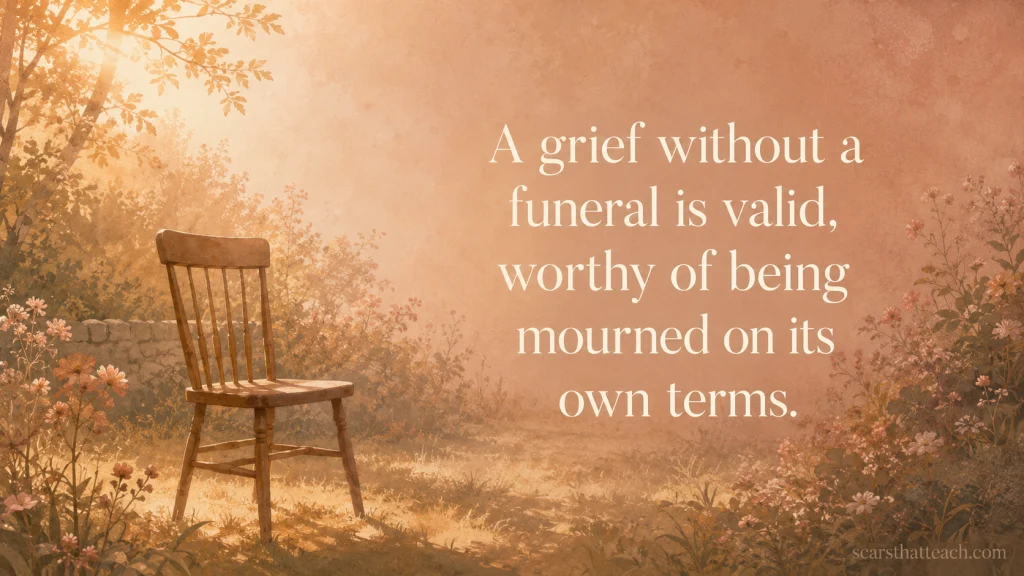
If there is one thing worth taking from this, it is permission you were probably never going to give yourself. A loss without a body is real. A grief without a funeral is valid, worthy of being mourned on its own terms. You do not need anyone else to recognize what this cost you in order for it to be true, though it helps enormously when someone finally does. If you want a fuller sense of what grief actually is underneath all the assumptions people carry about it, there is more in what grief actually is beneath the stereotypes, and if the shape of your own grief has felt confusing or nonlinear, that is covered separately in why grief resists a fixed timeline. The same is true here as it is with any real loss that did not go the way you expected it to: not every setback follows a straight path forward, a pattern explored from a different angle in reflections on failure and starting over. There is more, too, on other forms grief can take, at other honest questions about grief and loss.
FAQs
🕊️ Can you grieve something that isn’t death?
Yes. Grief is a response to significant loss, and not every significant loss is a death. A relationship, a future, a role, or a version of your life can all be grieved just as legitimately.
🌫️ What is ambiguous loss?
It is a term coined by researcher Pauline Boss to describe losses that are incomplete or unacknowledged, where there is no clear ending. Estrangement from a living person and watching someone change through illness are both common examples.
💔 Why does grief over a breakup or job loss feel less legitimate to other people?
Mostly because there is no established ritual for it. Death has funerals and bereavement leave built in. Non-death losses usually do not, so people around you may not realize how significant the loss actually was.
🧭 Is it normal to grieve someone who is still alive?
Yes, and it is more common than most people realize. Estrangement, dementia, and other situations where a person is physically present but no longer reachable can produce grief that is just as real as grief after a death.
🤍 How do you grieve something without a clear ending?
Start by naming it as grief rather than something smaller. Without a clear ending, the loss may need ongoing acknowledgment rather than a single moment of closure, and that is a reasonable way for this kind of grief to work.