The question of whether it is too late to act on a regret is almost always asked too early. The assumption of closure (that the window has passed, that the relationship is over, that the path is gone) tends to arrive well before it has actually been tested. Sometimes the window has closed. Sometimes it has not, and what feels like permanent loss is premature. Telling the difference is the actual work, and it matters more than reassurance in either direction.
Is It Too Late to Change What You Regret? The Assumption That Gets There First
The assumption I encountered most often near the end of a life was not that it was over. It was that it had been over for longer than it actually had been. People who had not spoken to a sibling in years, who had quietly abandoned a version of themselves they once cared about, who had let a relationship they valued settle into silence without ever deciding that silence was what they wanted. The window had not always closed when they assumed it had. But the assumption had closed it anyway, by convincing them there was nothing left worth trying.
This is the question that the phrase “is it too late to change what you regret” is actually asking: not whether time has passed, but whether the specific thing still has an opening, and whether looking for that opening is worth the cost of being wrong. That is a different question than the ones that usually get answered here. Most content on regret either reassures universally, telling the reader that it is never too late, which is not true, or dismisses the question by telling them to move on, which is not always the right call either. The more useful answer lives between those two, and it requires making a genuine distinction between things that are genuinely over and things that are still accessible in some form.
Why “It Is Never Too Late” Is Not the Right Answer
The instinct behind “it is never too late” is generous. It is trying to push against the premature closure that causes real damage, the assumption that the window is shut before anyone has checked. But it overcorrects in a way that creates its own problem. Because some things are genuinely too late. Some relationships cannot be repaired because the other person is gone, or because the harm done was real enough that reconciliation would require something from the other party that is not yours to demand. Some paths close because biology or circumstance made them time-sensitive in ways that are not reversible. Some versions of a life are no longer available because of what was chosen instead, and pretending otherwise is not honest, and it is not kind.
The research on regret is consistent on a relevant point here: what psychologists call the Lost Opportunity Principle suggests that when people conclude an opportunity is genuinely gone, with no future path toward change, the emotional result tends to be grief rather than regret. Grief can settle. Regret without any future-facing component tends to stay active, circling the same ground without a way out. This distinction matters practically, because the right response to grief is different from the right response to actionable regret. Conflating them, by insisting that everything is still possible, keeps a person in the wrong relationship with what they are carrying.
Honest accounting of what is genuinely over is not pessimism. It is the prerequisite for knowing what is not over. You cannot make a useful distinction between closed windows and open ones by insisting all windows are open. That is as useless as insisting they are all closed.
The More Common Problem: Assuming It Is Over Before It Is
What I saw more often than genuine irreversibility was its opposite: people who had assumed the window closed years before anyone had checked. A relationship that had gone quiet but never formally ended, where both people were waiting for the other to open it. A direction not pursued because the person concluded in their thirties that the ship had sailed, and never revisited whether that was actually true. A version of themselves they had quietly filed under “that was for younger people,” without asking what, if anything, of that version was still available in modified form.
Premature closure is a specific kind of error: deciding something is over before it has been tested. It tends to happen for understandable reasons. Reaching out after years of silence is uncomfortable and carries real risk of rejection. Revisiting an abandoned direction requires admitting you stepped away from it. Reconnecting with a version of yourself that got set aside means acknowledging what it cost to set it aside. These are not small things. Premature closure often feels protective, and in the short term it is. The cost shows up later, when the assumption hardens into something the person treats as fact.
Telling the Difference Between Closed and Assumedly Closed
The question “is it too late?” deserves a genuine attempt at an answer rather than a reflexive reassurance. The distinction between something genuinely over and something assumedly over can be tested, and the test is more specific than it usually gets credit for being.
- Is the other person gone, or just distant? A relationship that has gone silent is not the same as one that is formally over. Distance is often bilateral and provisional. Silence does not equal closed. The discomfort of reaching out is not the same as evidence that reaching out would fail.
- Is the path closed, or is a specific version of the path closed? Many regrets about directions not pursued are actually regrets about a particular form of that direction. The form may be gone. The underlying thing, the interest, the relationship, the engagement with something that mattered, often is not. This distinction is easy to miss because the specific lost form is what the regret is pointed at, not the broader territory it sits in.
- Have you actually checked, or are you reasoning from fear of rejection? Premature closure often masquerades as realistic assessment. “They would not want to hear from me” is a plausible-sounding thing to conclude about someone you have not contacted in a decade. It is also a thing that feels safer to believe than to test. These two things are not the same, and it is worth being honest with yourself about which one is operating.
- What would it mean to be wrong? If the window is genuinely closed and you check, you have confirmation. If the window is open and you assume it is closed, you have lost whatever remained. The asymmetry is worth sitting with. The risk of checking is almost always smaller than it feels in advance, and the research on counterfactual regret bears this out: people tend to regret unchosen paths more intensely over time than they regret attempts that did not work.
None of this is a formula. The specific case always matters in ways that no general framework captures completely. What the distinction gives you is a direction to look: toward what is actually knowable, rather than toward what has only been assumed.
When It Is Genuinely Over: What Honest Acceptance Looks Like
Some things are genuinely too late, and saying so clearly is more useful than softening it. A relationship with someone who has died cannot be repaired in the form it would have taken while they were alive. A time-sensitive path that required a particular stage of life, a particular health, a particular window of possibility, may have closed in that specific form. Choices made decades ago that restructured everything else are not reversible in any simple sense, even if their consequences can still be worked with.
What honest acceptance of genuine closure looks like is not the same as despair. The research on grief versus regret points to something useful here: grief tends to move through, because it is a response to something that is recog
nized as actually gone. Regret stays active because it keeps generating the sense that something could still be done. When something is genuinely over and a person treats it as regret rather than grief, they stay in the unresolved loop without a way out of it. Naming what is over, accurately and without minimizing it, is what allows a different relationship to it to develop.
There is a composite pattern I watched play out often enough in my work that it stopped surprising me: a person who had lost someone years before, and who had never made a specific peace with the fact that a particular conversation was no longer possible. Not the loss itself, which they had grieved. But the specific thing they had needed to say, or hear, or repair, which they had kept carrying as if the conversation were still possible if only they could figure out how to have it. The shift that tended to matter was not resolution, exactly, but recognition: this particular path is not available anymore. What remains is how I carry what it meant. That is a different task, and it is one that can actually be done.
For regrets that involve harm done to others, the question of what remains possible looks different, and that territory belongs to a different set of considerations. The question here is specifically about what has not yet been done: directions not pursued, relationships that went quiet, versions of a self that were set aside. The framework for lessons learned late covers the broader landscape of what that kind of reckoning tends to surface.
What “Still Possible in Modified Form” Actually Means
One of the more useful moves when the specific original version of something is gone is asking what the underlying thing actually was, and whether any part of it is still accessible in a different shape. This is not the same as telling yourself everything is still possible. It is a more specific question: what was the thing the regret is actually about, underneath the specific form it is taking?
A regret about not having pursued a certain career is often, on examination, not entirely about that career. It is about some quality of work, or some kind of contribution, or some domain of engagement that the career would have embodied. The career itself may be inaccessible at this point in a person’s life. The quality may not be. This distinction does not dissolve the regret, and it should not be offered as a way to minimize what was lost. But it does open a different question, which is whether the thing underneath the specific lost form can be engaged with in some way that is actually available now.
Research on regret and inaction finds that one constructive response is asking what a small step toward the underlying thing might look like. Not a solution, not a restoration of what was lost, but a genuine engagement with the direction rather than a continuation of the inaction. The step does not have to be large. It has to be real. This connects to the broader question of how to use regret productively, which addresses what to do with what the regret is pointing at once you have gotten clear about whether the window is open or closed.

What Gets in the Way of Checking
The reason people do not check whether the window is still open is almost never that they have actually confirmed it is closed. It is usually some combination of fear of rejection, reluctance to admit that something mattered, and the specific pain of hoping for something and having it not work. These are understandable reasons. They are also worth naming clearly, because they are often the thing that gets dressed up as realistic assessment.
“It would be strange to reach out after this long” is sometimes a factual observation and sometimes a story. “They probably would not want to hear from me” is sometimes an accurate read and sometimes a protection against finding out. “That ship has sailed” can mean the path is genuinely closed or it can mean the prospect of trying and failing is more uncomfortable than the prospect of not trying. Knowing which is which is not always easy, and I do not want to suggest it is. But the distinction is worth pressing on, because the cost of premature closure is not usually obvious until well after the window actually closes.
What tends to clarify it is a question worth sitting with in advance: imagining yourself much later, looking back at this moment, and asking which version of it you would find harder to carry. The version where you tried and it did not work, or the version where you did not try and never found out. Most people, when they actually sit with that question, find that the first version is easier to carry than the second. The research on regret over the long term supports this: inaction regrets are the ones that tend to accumulate and intensify, while action regrets, even ones that did not produce the desired outcome, tend to become easier to live with over time.
The broader question of how to hold failure and missed chances without being held by them is a related but distinct territory. The question of acting versus not acting on an open regret sits differently than the question of how to make peace with what is genuinely over.
Final Thoughts: The Question Beneath the Question
When someone asks whether it is too late to change what they regret, they are usually not asking for a philosophy of time. They are asking about something specific, and the question beneath the question is usually one of two things: either “is there still a way to act on this, and should I try?” or “do I need to accept that this is over and find a way to carry it differently?” These are different questions, and they require different answers.
The most useful thing I can offer, built from two decades of watching people arrive at the end of their lives with different relationships to what they had and had not done: the assumptions about what was still possible were wrong more often in the direction of too early than too late. Not always. Some things were genuinely over, and the people who had made honest peace with that were in better shape than those who had kept carrying the unresolved version. But the premature closures, the windows that got sealed by assumption rather than by reality, those were the ones that showed up again and again, and they were the ones that left the deepest marks.
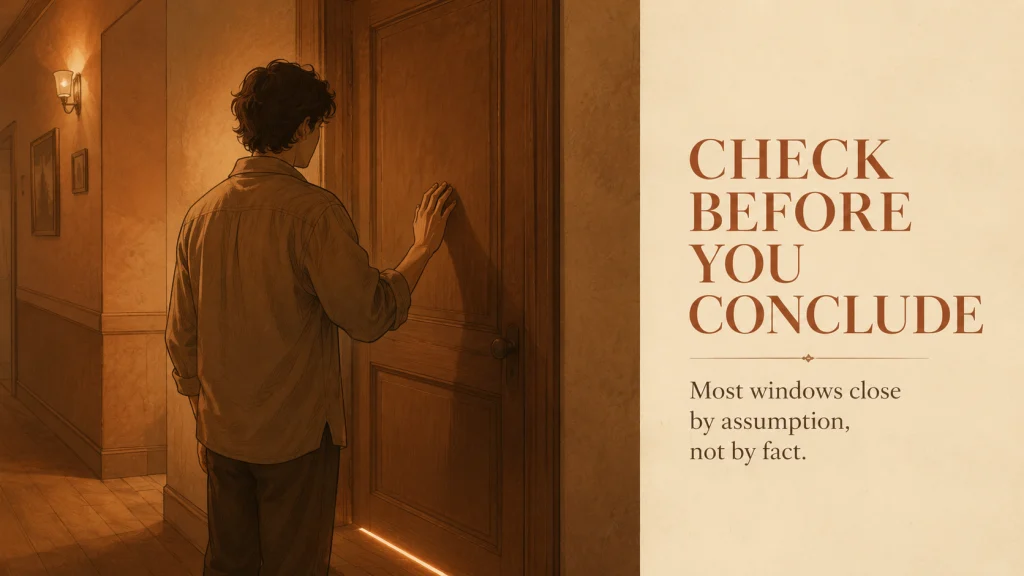
Check before you conclude. The conclusion may be the same. But arriving at it through actual inquiry is different from arriving at it through assumption, and it is a different thing to carry.
FAQs
💬 Is it ever actually too late to change something you regret?
Yes. Some things are genuinely no longer possible: a relationship with someone who has died, a time-sensitive path that required a stage of life that has passed, choices that restructured everything else in ways that are not reversible. Honest accounting of what is genuinely over is not pessimism. It is the prerequisite for knowing what is not over.
🔁 How do I know if I am assuming it is too late when it might not be?
Ask whether you have actually checked or whether you are reasoning from fear of rejection. “They would not want to hear from me” and “reaching out would be uncomfortable” are different claims. Premature closure often masquerades as realistic assessment. The test is whether the conclusion comes from evidence or from the discomfort of finding out.
📌 What does it mean to accept a regret that is genuinely too late to change?
It means shifting from regret, which keeps generating the sense that something could still be done, to grief, which can move through. When something is genuinely over and is still being carried as if it were actionable, the loop stays active without a way out. Naming what is over, accurately, is what allows a different relationship to it to develop.
🕰️ Is it too late to repair a relationship that has been silent for years?
Silence is not the same as closed. Many relationships that have gone quiet are bilateral and provisional, with both people waiting for the other to open the door. The discomfort of reaching out is not the same as evidence that reaching out would fail. The specific outcome cannot be known without trying, and the cost of not trying tends to compound over time in ways the cost of trying does not.
🌱 What if the specific thing I regret is no longer possible but something related might be?
Ask what the underlying thing actually was, beneath the specific form the regret is taking. A regret about a path not taken is often, on examination, about some quality or engagement that path would have provided. The specific path may be closed. The underlying thing may not be. This does not dissolve the regret, but it opens a different question about what is still available.
😔 Why do inaction regrets feel harder to carry than action regrets?
Research on regret over time finds consistently that people tend to regret the things they did not try more than the things they tried and that did not work. Action regrets, even painful ones, tend to become easier to carry over time because they can be processed and learned from. Inaction regrets stay open longer because the unchosen path remains imagined, idealized, and unresolved.