Most people expect grief to end somewhere, a point where the weight lifts and the person they lost stops showing up in ordinary moments. In over twenty years of sitting with the dying and the people they left behind, I never once saw that happen, and I stopped believing it was supposed to. What I learned instead is that grief that never fully ends is not a sign of something broken. Here is why grief never fully ends, and why that might be the most honest thing anyone ever tells you about it.
The Wisest Thing I Ever Heard About Grief Came From a Man in His Eighties
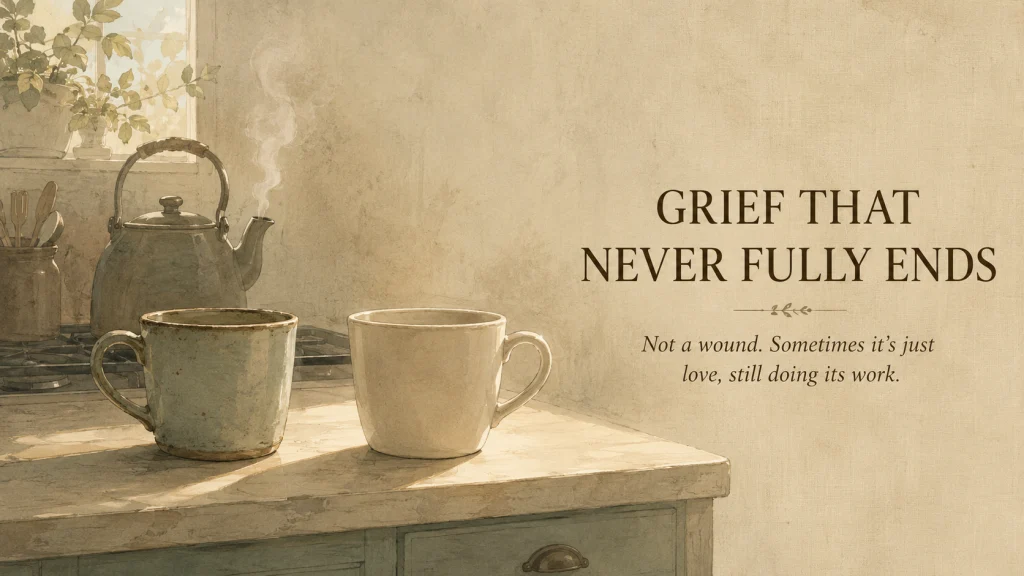
It did not come from a textbook, and it did not come from any of the training I received before I started sitting with dying patients. It came from a man in his eighties, sitting beside his wife’s hospital bed a few days before she died, talking about his own mother, gone more than fifty years by then. He told me that the measure of how much you had loved someone was exactly how much of them stayed with you afterward, and that he had never once wished it were otherwise. Fifty years, and he still set two cups out some mornings before he caught himself. He said it without sadness. He said it like a man reporting a fact he had made peace with a long time ago.
I have thought about that conversation more than almost any other in my career, because it cut against everything the culture around grief tends to teach. We are handed a model early, usually without realizing it, where grief is something you move through and eventually finish, like a project with a completion date. He was not confused about how grief worked. What he understood, sitting there with his mother’s absence still living in him fifty years on, is something most people only arrive at much later, often after years of quietly wondering if something was wrong with them for still missing someone this much. If you want a fuller sense of what grief actually is at its core, that is worth sitting with before you go further here.
The Old Model Told Us to Let Go
For most of the last century, the dominant thinking on grief held that healthy mourning ended in detachment. The work of grieving, according to that model, was to loosen the emotional bond with whoever had died and gradually reinvest that energy into new relationships and new life. Grief that lingered past a certain point, on this view, was treated as a warning sign, something closer to a stalled process than a normal human response. A great deal of the advice people still repeat today, about closure, about moving on, about finally letting go, traces back to that framework, even when nobody using those phrases realizes where they came from.
Researchers Dennis Klass, Phyllis Silverman, and Steven Nickman challenged that model directly in the 1990s, and what they found reshaped how much of the field understands grief today. Rather than framing an ongoing connection to someone who died as a failure to detach, their work described it as common, adaptive, and often a genuinely healthy way of carrying loss forward. People kept talking to the person they lost. Many described sensing their presence at certain moments, or letting that person’s voice weigh in on a decision the way it always had. Others found themselves marking anniversaries in ways that had nothing to do with unfinished business and everything to do with a relationship that had simply changed form rather than ended. This became known as the continuing bonds framework, and it has held up well against decades of further study.
What Most Grief Content Still Gets Wrong
Even with that research widely available, most of what gets written about grief still leans on the old assumption. The underlying message, even when it is never stated directly, is that the goal is to feel better, to reach some point where the loss stops interrupting daily life, to arrive somewhere on the other side of it. I understand why that framing persists. It is comforting to imagine an endpoint. But I watched enough families across enough years to know that the ones who did the best were rarely the ones who stopped feeling the loss. They were the ones who found a way to keep the person they lost present in their life without organizing everything around the absence.
Part of why the moving on narrative sticks is that it is not really built for the person grieving. It is built for the people around them. A friend, a coworker, a sibling watching from the outside wants a timeline they can hold onto, some rough sense of when the person they love will seem like themselves again. Grief that keeps showing up two years, five years, twenty years later is hard to sit with from the outside, so the culture around it reaches for language that promises an ending. I do not think most people push that timeline out of unkindness. They push it because open-ended pain in someone they love is genuinely uncomfortable to witness, and a story with a finish line feels kinder to offer than the truth.
There is also something the continuing bonds framework gets at that rarely makes it into the practical advice: an ongoing connection to someone who died is not only about missing them. It is often part of how a person keeps their own sense of self intact. A daughter who still asks herself what her mother would think of a decision is not stuck in the past. She is drawing on a relationship that shaped who she became, the same way she would draw on any relationship that still mattered to her. Cutting that connection off in the name of moving on does not just remove the grief. It removes a piece of the scaffolding a person has used to understand who they are, and that is a much higher cost than most grief advice accounts for.
One pattern showed up often enough across the families I sat with that I eventually stopped doubting it: someone would come to me a year or two after losing a spouse or a parent, almost apologetic, saying they still cried at certain songs, still reached for the phone to share good news, still felt the person watching over some ordinary moment. They would ask if that meant they had not healed properly. What I told them, and what I still believe, is that grief tends not to disappear so much as settle into a different shape over time. It gets woven into the ordinary business of living rather than sitting on top of it the way it does early on. What lingers is rarely the problem people fear it is. More often it is proof that the relationship still means something, still has a hand in shaping the person carrying it. Regret works in a similar way, and I have written before about carrying the weight of things that went wrong without letting that weight define a person.
Here is where I want to be honest about the limits of what I am telling you, because his words that day do not speak for every kind of grief in every kind of life. If the connection between you and the person you lost was genuinely difficult, complicated, or unresolved, the shape your continuing bond takes may carry more weight in it than his did. Persistence alone does not mean something is wrong, but what it looks like in your case will depend entirely on the relationship, and only you know the particulars of that. It also helps to understand why grief doesn’t follow a set timeline, since that same variability shapes how long a bond like this tends to stay active.
Grief that lasts is not evidence that you failed to heal. Sometimes it is simply what love looks like once it no longer has anywhere else to go.
What a Continuing Bond Actually Looks Like
People carry their continuing bonds differently, and most of them do not recognize the pattern for what it is until someone names it out loud. Over the years, a few forms of it showed up again and again in the families and patients I sat with, enough that I stopped thinking of them as unusual and started thinking of them as ordinary parts of how people carry loss.
- Talking to the person who died, out loud or silently, especially before a hard decision or a big day
- Wanting to share news, a promotion, a grandchild, a small win, with someone who is no longer there to tell
- Feeling a sense of presence at weddings, graduations, or holidays that person would have been at
- Keeping certain objects, a chair, a piece of clothing, a handwriting sample, not out of denial but because they hold something real
- Grief resurfacing sharply on an anniversary or birthday, years after the loss, without warning
None of these are signs that something has gone wrong. They are, more often than not, the ordinary texture of a relationship that is still active, just carried differently than it used to be. Where it starts to look different is when the connection stops making room for anything else, when a person cannot function, cannot work, cannot let themselves experience any joy without guilt, for an extended stretch of time. That distinction matters, and it is worth being honest about it rather than pretending grief never has a difficult edge.
When It Is Worth Talking to Someone
I am not a therapist, and I am careful never to diagnose the grief I see in the families I have sat with, including my own. But two decades of watching this up close taught me to recognize when persistent grief has stopped functioning as a bond and started functioning as a barrier. If someone cannot get through basic parts of daily life for months at a stretch, if the loss feels like it is getting heavier rather than settling into a shape they can carry, or if they find themselves unable to feel anything but the absence, that is worth bringing to a grief counselor or a doctor, not because the grief itself is wrong, but because carrying that much weight alone rarely helps anyone.
For most people, though, what they are experiencing is closer to what that conversation described to me all those years ago. It comes and goes. It shows up uninvited at strange moments and then recedes again. It never fully leaves, and for most people, once they stop expecting it to, that turns out to be the more peaceful place to land.
Final Thoughts: Carrying It Instead of Ending It
I do not think grief is something anyone finishes, and after two decades of sitting with people at the very end of their lives, I have stopped wanting it to be. The people I watched die with the fewest regrets were rarely the ones who had let go of everyone they had lost. They were the ones who had kept those people close, in whatever form that took, right up until the end. If you are still missing someone years later, still setting out that second cup some mornings before you catch yourself, that is not a sign you have failed to move on. It is closer to the opposite. It means some part of you decided, without asking permission, that the relationship was still worth keeping, and went on keeping it. Most people never get anything that certain out of love. Grief that lasts this long is not a wound that will not close. It is loyalty, still doing its work long after there is anyone left to thank it. For more on how grief actually works and what it asks of the people carrying it, you can look through the broader collection of writing on grief and loss on this site.
FAQs
💭 Does grief ever fully go away?
For most people, no, not completely. It tends to change shape over time, becoming less constant and less overwhelming, but it rarely disappears entirely. That persistence is common and does not mean something is wrong with how you are grieving.
🕰️ Why does grief come back years after a loss?
Grief often resurfaces around anniversaries, holidays, or milestones the person would have been part of. This is a normal pattern, not a setback. It usually means the bond you had with that person is still active, not that you have lost ground in some larger healing process.
❓ Is it normal to still talk to someone who died?
Yes. Many people continue talking to a person they lost, out loud or silently, especially before decisions or on hard days. Researchers call this a continuing bond, and it is considered a common and healthy way of maintaining a relationship with someone who has died.
⚖️ How do I know if my grief needs professional support?
If grief is making it hard to function in daily life for months at a stretch, or if it feels like it is getting heavier instead of settling, it is worth talking to a doctor or grief counselor. Persistent grief on its own is not automatically a warning sign, but an inability to function alongside it is worth attention.
🌱 What is the continuing bonds theory of grief?
It is a framework developed by researchers Klass, Silverman, and Nickman that describes maintaining an ongoing connection to someone who died as normal and adaptive, rather than a failure to detach. It shifted much of the field away from the older idea that healthy grief requires letting go completely.
💬 Why do I still miss someone I lost a long time ago?
Missing someone years later is not evidence that you have failed to heal. It usually means the relationship mattered enough that a version of it continues, just in a different form than before. That persistence tends to say more about the love than about anything gone wrong.