Social media does not just add more comparison to your life. It breaks the basic condition that makes comparison useful in the first place. I noticed that the damage people described was rarely jealousy in the ordinary sense. It was closer to being shown a finished version of a life without ever being allowed to see any of the attempts that came before it. This piece looks at the specific structural reason social media amplifies comparison in a way ordinary social life simply does not, and why that distinction matters more than another reminder to limit your screen time.
Shown the Finished Version, Never the Attempts
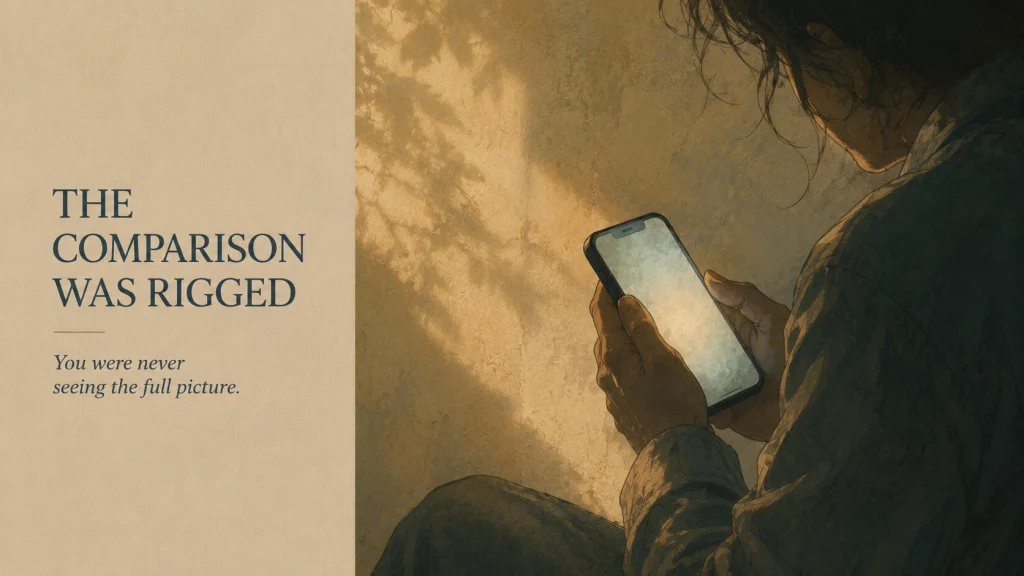
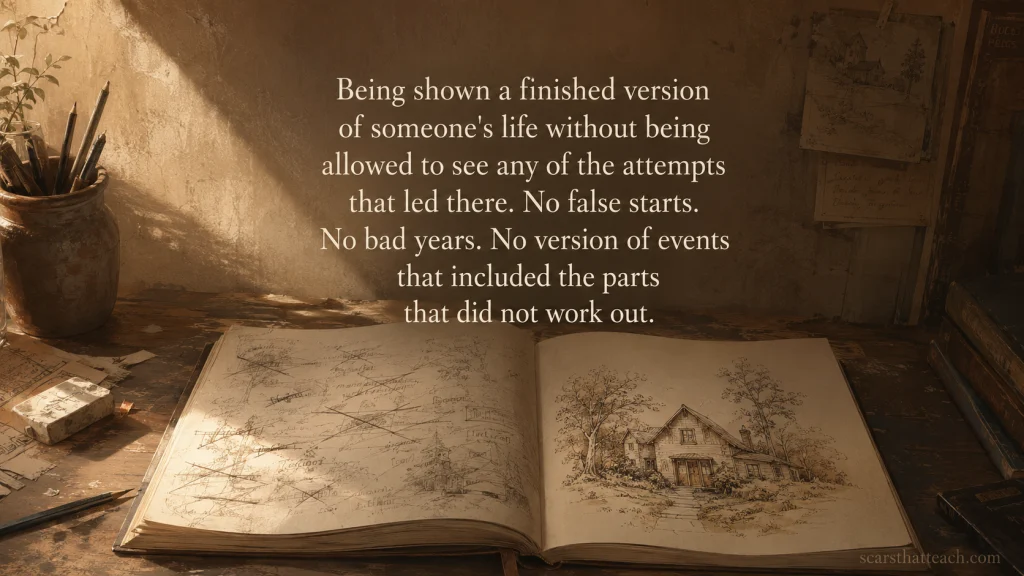
When people described the specific damage social media had done to how they felt about themselves, the word that came up most was not jealousy, at least not in the ordinary sense of wanting what someone else had. It was something quieter and harder to name. The closest description I ever heard was being shown a finished version of someone’s life without being allowed to see any of the attempts that led there. No false starts. No bad years. No version of events that included the parts that did not work out.
That distinction is the entire reason social media comparison feels so different from comparing yourself to people in your ordinary life. It is not that social media introduced comparison into the world. People have always measured themselves against neighbors, classmates, and coworkers. What social media changed is what you are actually allowed to see when you make that comparison, and that change is structural, not incidental.
Why Comparison Used to Need Someone Similar to You
Festinger’s social comparison theory, one of the foundational frameworks in this area of psychology, identifies that people get the most informative self-evaluation by comparing themselves to similar others. These are people whose circumstances, resources, and starting points are close enough to their own that the comparison actually tells you something useful. Comparing your ability to run a mile against an Olympic sprinter tells you very little about your own fitness. Comparing it against someone training under conditions similar to yours tells you a great deal.
Ordinary social life mostly respects this condition without anyone having to think about it. The people you compare yourself to in daily life tend to be people whose actual circumstances you have some context for, a coworker whose work hours you witness, a friend whose recent divorce you watched unfold, a neighbor whose financial stress you have some awareness of even if it is never discussed directly. The comparison might still sting, but it is at least working with real information.
How Social Media Breaks the Comparison Before It Starts
Social media breaks the comparability condition in two ways at once, and most advice on the subject only addresses the symptom rather than either of them directly. The first break is who you are actually comparing yourself to. Followers and connections on social media are not similar others in the sense Festinger’s theory described. They are a mix of close friends, distant acquaintances, public figures, strangers with large followings, and people whose actual life circumstances you may know almost nothing about beyond what they choose to post. The comparison pool itself is no longer made up of people positioned similarly to you, which means the comparison was structurally unreliable before a single post was even viewed.
The second break is what gets shown. Content on social media is curated and selected, not representative of the life it claims to depict. This is not necessarily dishonest in an intentional sense. Most people post the moment that looked good, not the forty minutes before it that did not. But the cumulative effect, viewed across hundreds of posts from hundreds of people, is a feed that systematically overrepresents the polished moment and underrepresents everything that did not make the cut. You are not comparing your full reality to someone else’s full reality. You are comparing your full reality, including the parts you would never post, to a version of life that has already had its difficult, boring, and unflattering moments filtered out by design.
Why This Is a Structural Error, Not Useful Information
Most advice on social media and comparison stops at telling people to limit their screen time, and while that can genuinely help, it treats the problem as a matter of exposure rather than explaining why the exposure is distorted in the first place. Limiting time on a platform reduces how often you encounter a broken comparison. It does not change the fact that the comparison itself, every time it happens, is built on a sample that was never similar to you and content that was never representative to begin with.
Understanding that distinction matters because it changes how you are allowed to interpret the feeling that follows. A bad feeling after comparing yourself to someone on social media is not necessarily meaningful information about how your life measures up. It is more often the predictable output of a comparison that was structurally rigged against you from the start, comparing dissimilar people using unrepresentative content. That reframing does not make the feeling vanish, but it does change what conclusion you are entitled to draw from it. The honest conclusion is rarely my life is lacking. It is closer to this comparison was never built to be fair.
Final Thoughts: The Comparison Was Broken Before You Opened the App
The damage social media does to how people feel about themselves rarely comes from any single post. It comes from a structural condition that quietly breaks the basic requirement comparison needs to mean anything useful: similar people, represented honestly. Once that condition is broken, every comparison made inside it inherits the same distortion, no matter how good or ordinary the actual life on either side of the screen happens to be.
For the general psychology of why people compare themselves to others in the first place, why we compare ourselves to others covers that broader mechanism, and for why upward comparison in general tends to make people feel worse, why comparing yourself to others makes you miserable looks at that pattern directly. For what to actually do once you recognize this pattern in your own life, how to stop comparing yourself to others picks up from here. The wider collection of questions on this subject lives at comparing yourself to others, and for words that speak to how you see your own worth apart from any feed, there is more in self love quotes.
FAQs
📱 Why does social media make comparison feel so much worse than comparing myself to people I know?
Social media breaks the basic condition that makes comparison useful: comparing yourself to similar others. Followers and connections are a mix of close friends, strangers, and public figures whose actual circumstances you often know little about, which makes the comparison structurally unreliable.
🎭 Is it true that people only post the good parts of their lives?
Most people post the moment that looked good rather than the time around it that did not. Across hundreds of posts, this creates a feed that systematically overrepresents polished moments and underrepresents everything that did not make the cut.
⏳ Does limiting my screen time fix the comparison problem?
It can reduce how often you encounter a distorted comparison, but it does not change the fact that the comparison itself is built on an unrepresentative sample. Understanding the structural reason behind the distortion matters as much as reducing exposure to it.
💭 If I feel worse after scrolling, does that mean my life is actually lacking?
Not necessarily. That feeling is often the predictable result of a comparison built on dissimilar people and curated content, rather than accurate information about how your life measures up.