Most of what gets written about regret either turns it into a warning, live without regrets, or tells you to let it go and move on. Neither of those does much with what regret is actually telling you. This piece looks at lessons learned too late as a recognizable pattern in how people experience their own lives, what research on regret has found about which kinds of regret tend to last longest, and why the more useful response isn’t to eliminate regret but to read it for the information it’s actually carrying. It also points toward six more specific questions, depending on which part of this is the one you’re actually sitting with right now.
The Quietest Thing I Ever Heard Someone Say
The most useful thing I ever heard from someone near the end of their life wasn’t a piece of wisdom meant for the rest of us to follow. It was the name of the thing they wished they had allowed themselves to want, said quietly, with neither self-pity nor hope attached to it, just a simple statement of fact. No dramatic delivery. No lesson wrapped around it for my benefit. Just the plain naming of something that had mattered and that they hadn’t let themselves reach for.
That moment has stayed with me longer than almost anything else from those years, and it’s most of why lessons learned too late deserve a closer look than they usually get. Most advice treats regret as something to avoid feeling or something to hurry past. What I watched, over and over, was that most regrets in life weren’t the problem people assumed they were. They were usually pointing at something true, and the person just hadn’t had anyone help them read it that way. Once you stop trying to outrun it, that’s usually the actual life lesson regret has to offer.
What Research on Regret Has Actually Found
Regret is one of the most researched emotions in psychology, partly because almost everyone experiences it and partly because it turns out to be more structured than it feels from the inside. One of the broadest and most consistent findings, going back to research by Neal Roese and others and carried forward in Daniel Pink’s 2022 book on the subject, is that over time, people regret the things they didn’t do far more than the things they did. Missed opportunities. Feelings that went unexpressed. Paths that never got chosen, not because they were tried and failed, but because they were never attempted at all.
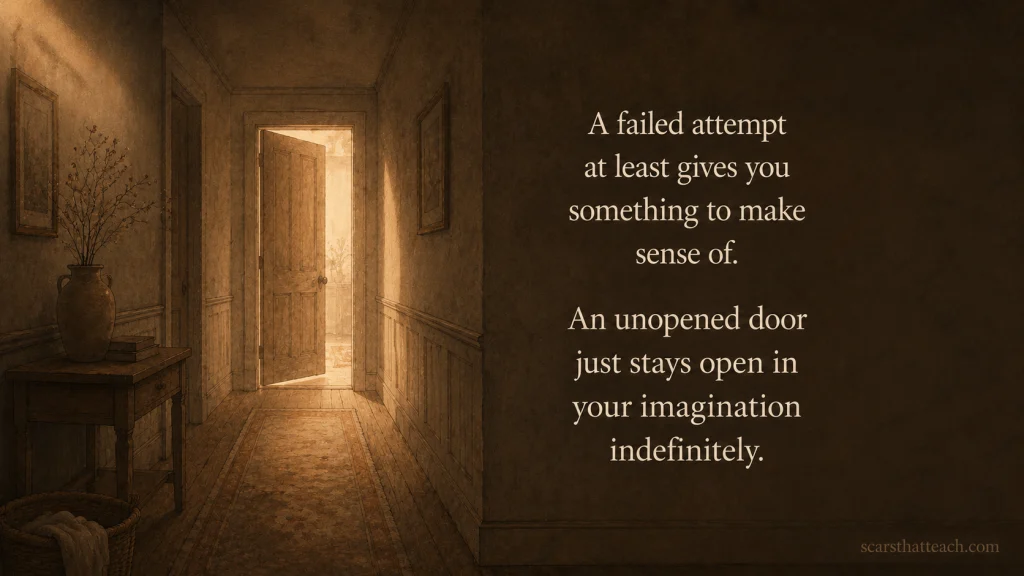
That pattern surprises people the first time they hear it, because most of us assume our biggest regrets will be about mistakes, the wrong decision, the thing that backfired. In practice, decisions that didn’t work out tend to fade faster than the doors that were never opened. A failed attempt at least gives you something to make sense of. An unopened door just stays open in your imagination indefinitely, and that’s largely why what people regret most, years later, turns out to be the things they never tried rather than the things that didn’t go well.
Regret as a Signal, Not a Verdict
Most confirmed advice on regret goes one of two directions. It either moralizes it into a motivational message, live boldly so you won’t end up like this, or it tells you to minimize it, let it go, don’t dwell, move forward. Both of those skip past something more useful that researcher Daniel Pink’s framework names directly: regret functions as a signal that carries real information. It points to something the person valued highly enough that its absence still registers, sometimes years or decades later.
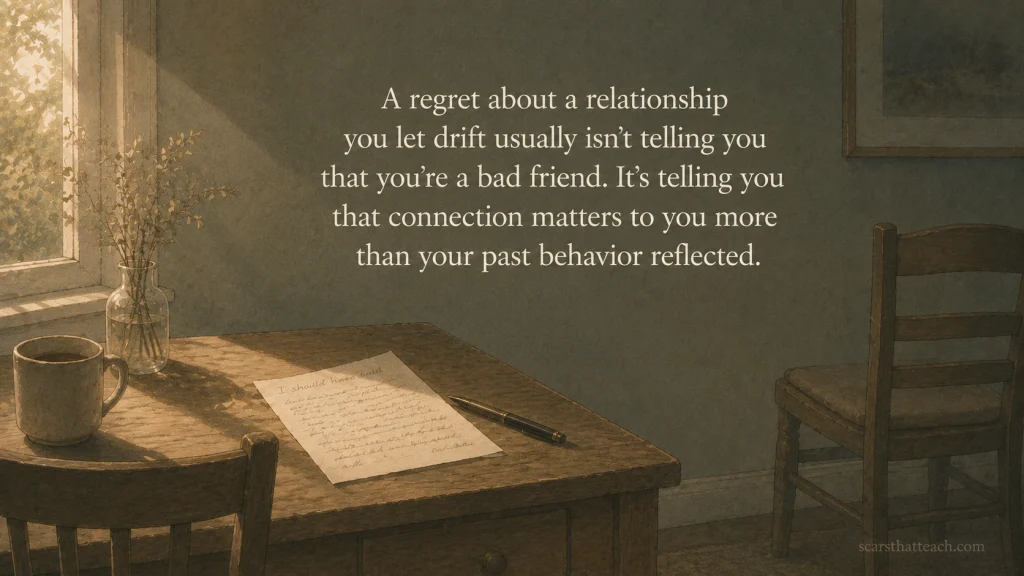
That reframing changes what regret is actually for. Instead of treating it as a flaw to manage or a feeling to suppress, you can ask what it’s pointing at. A regret about a relationship you let drift usually isn’t telling you that you’re a bad friend. It’s telling you that connection matters to you more than your past behavior reflected, which is useful information for what you do with the relationships still in front of you. A regret about a risk you didn’t take isn’t proof you’re cowardly. It’s telling you something about what kind of life you actually wanted, distinct from the one circumstances handed you.
This is also where Bronnie Ware’s well known observations as a hospice caregiver line up closely with what I watched directly. Her account of the most common regrets she heard near the end of life, wishing they’d had the courage to live a life true to themselves, wishing they hadn’t worked so much, wishing they’d stayed in touch with friends, all point the same direction Pink’s research does. The regrets that last are rarely about specific failures. They’re about a quiet mismatch between the life someone valued and the life they actually lived.
How to Tell What a Specific Regret Is Pointing At
If regret carries information rather than just discomfort, the practical question becomes how to actually read it. A few patterns tend to show up clearly enough to be useful once you go looking for them:
- Regrets about inaction, the thing you didn’t say or didn’t attempt, tend to point at a value that mattered more than circumstances let on at the time.
- Regrets about action, a decision you made that backfired, tend to point at a lesson about judgment or timing rather than a value, and they usually fade faster on their own.
- A regret that keeps returning years later is usually pointing at something still relevant to your life now, not just unfinished business from the past.
- A regret that only shows up around a specific person or anniversary is often more about that relationship specifically than about life in general.
- The intensity of a regret tracks how close you got to the thing you wanted, not how big the thing was, which is why a small unsaid sentence can outweigh a large failed project.
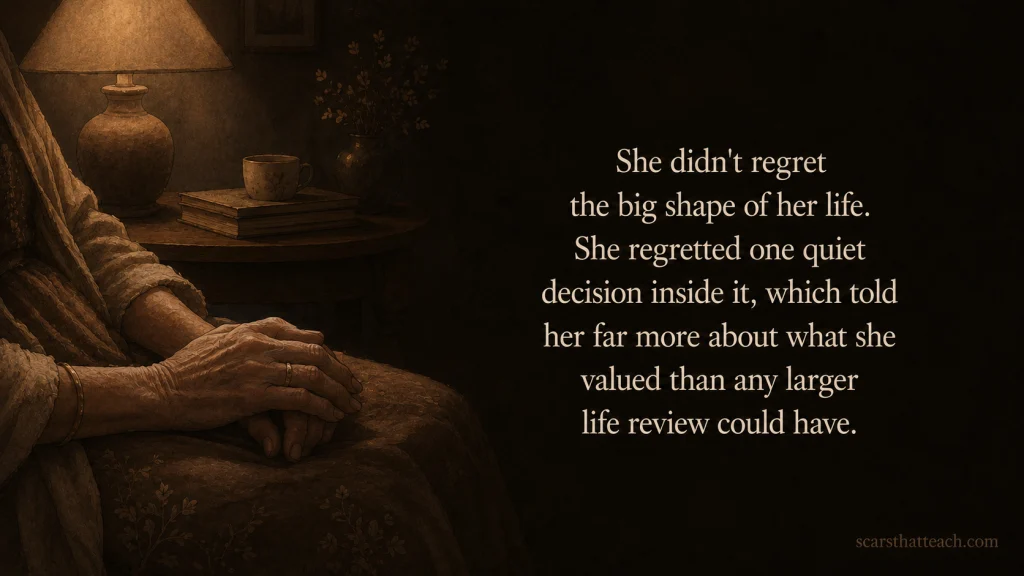
I sat with a woman once, a composite drawn from several conversations rather than any single person, who told me her clearest regret wasn’t the career she didn’t pursue. It was a specific afternoon, decades earlier, when she’d had the chance to tell someone something true and let the moment pass instead. She didn’t regret the big shape of her life. She regretted one quiet decision inside it, which told her far more about what she valued than any larger life review could have.
Final Thoughts: This Isn’t About Feeling Worse
I want to be clear about what this isn’t saying. Looking closely at a regret is not the same as wallowing in it, and reading it for information is not the same as deciding you ruined something irreversibly. Most regrets, even the ones that ache for decades, are pointing at something you can still act on in some form, even if the original opportunity is genuinely gone. The information survives even when the specific chance doesn’t.
If you want to sit with how other people have put failure and regret into words, there’s a collected set of quotes about failure that hold up under real scrutiny, the kind that read differently once you’ve actually lived through something like what they describe.
FAQs
💭 What does psychology actually say about regret?
Research consistently finds that people regret the things they didn’t do far more, over time, than the things they did. It also suggests regret carries real information about what a person values, rather than being a sign of simple failure or weak character.
🚪 Why do people regret inaction more than mistakes?
A decision that didn’t work out at least gives you something concrete to make sense of and move past. A door that was never opened stays open in the imagination indefinitely, which tends to make it ache longer rather than less.
🧭 Is regret actually useful, or just painful?
It can be both. The discomfort is real, but the regret is also pointing at something specific you valued, which is information worth using even when the original chance is gone.
⏳ Is it too late to do anything about a regret?
Often, the specific opportunity is genuinely gone, but the information the regret is pointing at usually isn’t. What you valued back then is frequently still something you can act on now, in a different form.
🕯️ What are the most common regrets people have near the end of life?
Patterns reported by hospice caregivers and researchers tend to center on not living true to oneself, working too much, not staying in touch with people who mattered, and not letting oneself feel or express things fully. They’re rarely about specific failures and more often about a mismatch between what someone valued and how they actually spent their time.