
The feeling of having learned something too late is one of the most persistent things I encountered across two decades in hospice work. It almost never turns out to be what it appears to be on the surface. The mechanism behind it is not a failure to encounter the right wisdom early enough. It is something more structural, something about how significant understanding actually arrives, and recognizing that changes what the late arrival of a lesson means about you.

What People Actually Mean When They Say They Learned Too Late
There is something I noticed early in my years of hospice work and never stopped noticing. When people described a lesson they had learned too late, they almost always described it with a specificity that gave them away. The detail was too precise. The framing was too clear. The words came too easily. What that specificity told me was not that they had just figured it out. It told me they had understood it, at some level, for a very long time. They had simply not yet understood it as something that applied to their own life.
That distinction matters more than it might seem at first. Knowing something and knowing it as applicable to yourself are not the same event. They can be separated by years. A man I sat with once had spent the better part of three decades telling himself he would slow down once the business found its footing. He said, almost word for word, that he had always known stability was a moving target. He could articulate the trap clearly. He had articulated it to other people. He just had never quite applied it to his own situation, not until there was nothing left to slow down for.
This is the specific puzzle behind why we always seem to learn some lessons too late. The question worth asking is not why the lesson failed to arrive. In most cases, it had arrived. The question is why it could not land with the weight it needed to actually change anything.
The Problem Was Rarely Missing the Information
Most people who looked back on something they had gotten wrong were not missing the relevant information at the time. They had it. What they were missing was the felt sense that this particular cost, not the abstract version of it but the specific version playing out in their actual life, was the one that needed their attention now. Research on anticipatory regret, the kind of regret that forms around choices still being made, points to a consistent pattern: people tend to underestimate, in the moment, how much they will regret the things they leave undone. Not what they chose. What they chose against, without quite naming it that way.
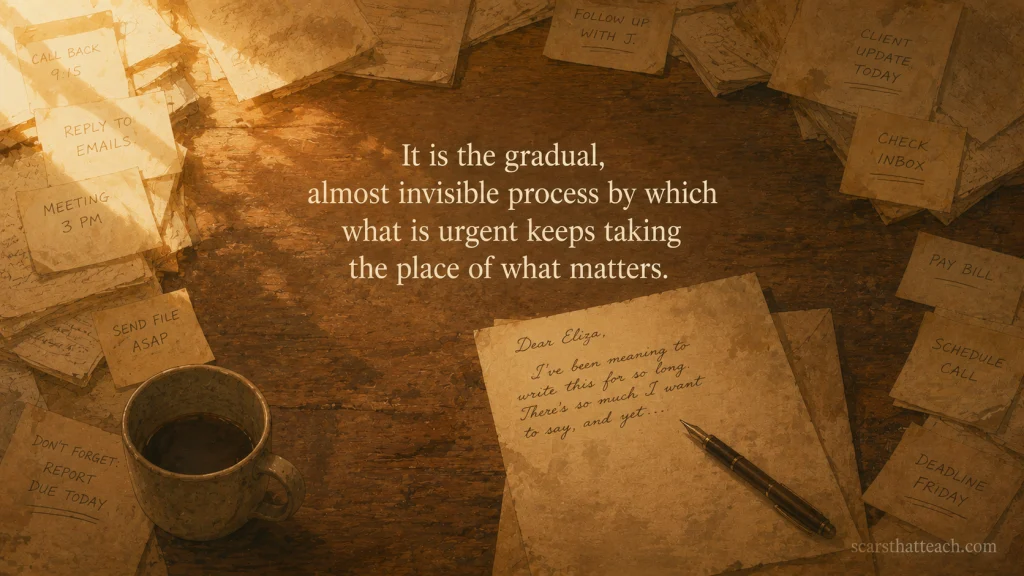
This is what priority displacement looks like from the inside. It is not the dramatic choice to ignore something important. It is the gradual, almost invisible process by which what is urgent keeps taking the place of what matters. The two categories do not look different in the moment. Urgent things feel important. Important things, because they do not usually arrive with deadlines attached, can keep waiting. And they wait, and wait, until the window closes and the waiting is suddenly visible as a choice that was being made all along.
A woman I sat with described noticing, years before anything reached a crisis point, that her relationship with her daughter was changing in ways that worried her. She did not need someone to tell her this. She could describe the pattern with more precision than most therapists could have managed. What she had not done was treat it as the thing that needed her attention before anything else. There was always something else that was more pressing right now. That is how the pattern looks from close up. Not a failure of perception. A failure of sequencing.
Why Understanding Cannot Arrive Without Something to Attach To
The common assumption about late lessons is that the solution is earlier exposure. If the right thing had been said at the right time, the lesson would have landed. What research on regret and understanding suggests is that this underestimates something structural about how significant understanding actually works. The issue is not access to wisdom. It is the gap between abstract knowledge and felt knowledge, between knowing something and knowing it in a way that carries weight inside actual decisions.
Lessons about what matters most cannot be fully absorbed in the abstract. They tend to require something concrete to attach them to. A loss. A near-miss. A moment where the cost of a long-standing pattern becomes undeniable and cannot be reframed. This is not a design flaw in the person. It is a feature of how understanding that matters arrives. Abstract knowledge, no matter how clearly stated or how often encountered, does not carry the same weight as knowledge anchored to a real consequence that has already happened.
Consider what a serious health scare does to someone who has been told, accurately and repeatedly, to change something about how they are living. The information was the same before the scare as after it. The advice was not new. What changed was that the information now had something specific to attach itself to. The understanding did not upgrade. The anchor for it did. And lessons learned in hindsight almost always feel this way, not like new information but like the same information finally carrying the weight it was always supposed to carry.
Research on counterfactual thinking, the mental habit of replaying what might have gone differently, helps explain why the concrete anchor matters as much as it does. After a significant loss or a moment of near-miss, the mind naturally runs the alternatives. What if I had called more often. What if I had acted on what I already knew. This replay is not merely painful. It is the mechanism by which abstract understanding gets converted into felt understanding. The “what if” is not rumination for its own sake. It is how the lesson finally becomes real. And the cost of that process, the fact that it requires the concrete thing to have already happened, is part of why we always seem to learn some lessons too late.
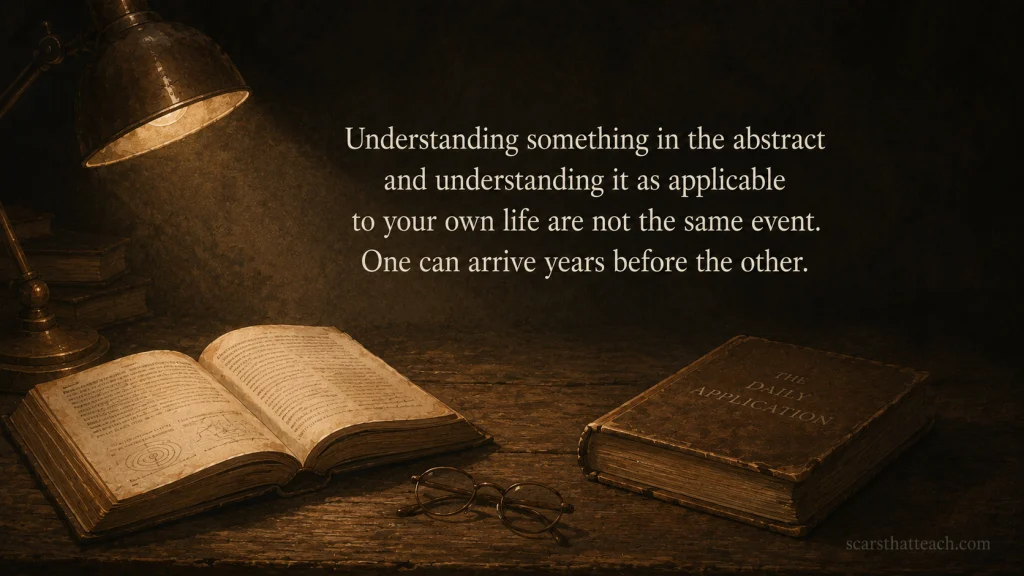
“Understanding something in the abstract and understanding it as applicable to your own life are not the same event. One can arrive years before the other.”
That gap is not a personal failing. It is the ordinary shape of how significant understanding arrives in a human life. The people who never experience that gap are not wiser. They are either very lucky in their timing, or they have not yet reached the moment that would reveal it.
Why Do We Learn Too Late: A Pattern, Not a Verdict
What I want to say plainly, because I watched it be said too gently too many times: the fact that a lesson arrived late does not mean you were careless. It does not mean you were less attentive than someone who does not carry this particular regret. The people who described their late lessons most clearly, with the most precision and the most grief, were not the people who had been least paying attention. They were often the people who had been paying the closest attention, just to the wrong sequence of things, in the way that almost everyone does.
Almost every person I sat with who named a lesson they wished they had learned sooner could describe the exact shape of what had displaced it. They could tell you what they had been prioritizing instead, and why, and how it had seemed reasonable at the time. That level of clarity is not what you would expect from someone who had been willfully blind. It is what you would expect from someone who had been human, in all the ordinary ways that being human means operating inside incomplete information with incomplete clarity about what is actually at stake.
It helps to be specific about what the late arrival of a lesson is and is not, because the two get confused in how people tend to hold this privately.
- It is not evidence that you were less attentive than people who do not carry this particular regret. Regret often lands hardest on the people who were paying the closest attention.
- It is not a sign that the right wisdom was available early and you failed to act on it. Abstract knowledge and felt knowledge are not the same thing, and the felt version needed something concrete that had not yet happened.
- It is a description of a sequence: the concrete anchor for significant understanding arrived when it arrived, and not before, because that is how concrete anchors work.
- It is, in many cases, a sign that you are now seeing clearly enough to recognize something real. That clarity is worth something, even arriving late.
This matters because the way people tend to hold late lessons privately is as evidence of something specific about themselves. As proof that they were the kind of person who gets this wrong. What I observed across many years is that the timing of insight is not a reliable indicator of character. The lesson arrived when it could arrive, which was after the concrete thing that would make it undeniable had already happened. That is not an indictment of who you were. It is a description of how understanding works. The fuller picture of what people carry into this territory, and how the patterns repeat across different lives and circumstances, is at the most common regrets people carry, which looks at the patterns rather than the mechanism.
Final Thoughts: The Clarity Is Real, Regardless of When It Arrived
There is something worth sitting with once the mechanism is clearer. The understanding you now have, the one that came after rather than before, is genuine understanding. Its late arrival does not make it wrong. What it cost to arrive does not diminish what it is. And there is something particular about understanding that has come through a concrete experience, through loss or near-loss or the specific weight of consequence, that is different from the abstract version of the same idea. It is harder to dismiss. It tends to hold.
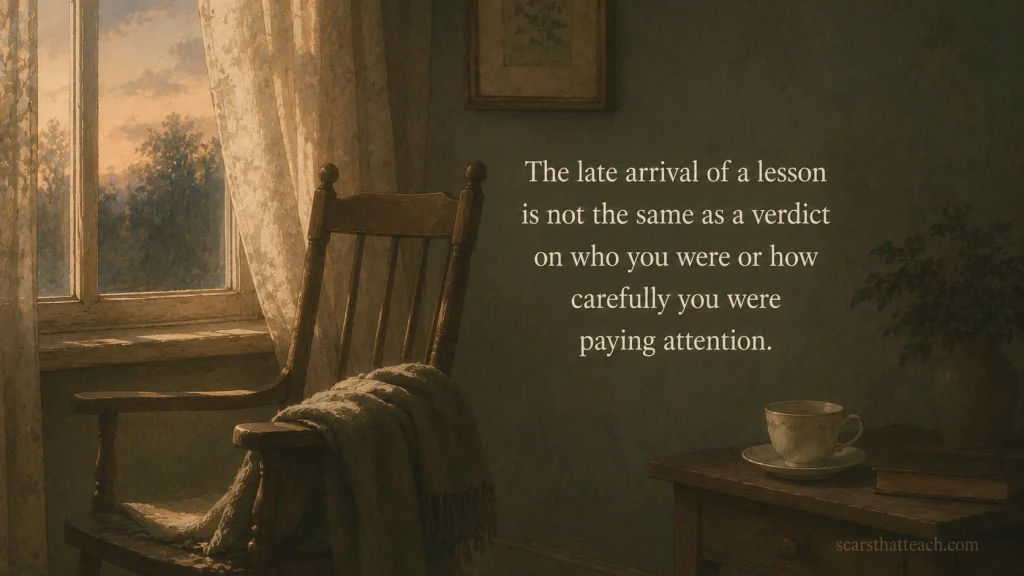
I am not going to suggest that this resolves the cost of learning something too late. For some people, in some situations, the cost is real and the window is closed and nothing about a clearer understanding of the mechanism changes that. I watched enough people sit with exactly that to know that offering a reframe is not always the right response. What I can say is that the late arrival of a lesson is not the same as a verdict on who you were or how carefully you were paying attention. It is a description of the sequence. The sequence is almost always the same. That is not consolation. But it is accurate.
For anyone working through what to do with understanding that has arrived after the fact, how regret can be turned toward something rather than just carried, more is available at how to use regret productively, which addresses the forward-facing question this piece deliberately does not try to answer. And for the broader territory of what people find themselves understanding too late across different kinds of situations, the surrounding questions are at lessons learned too late, where this cluster sits. For the words that tend to hold up under the specific weight of failure and what it teaches, some of the most useful ones I know are collected at words on failure and what it actually teaches.
FAQs
💭 Why do we always seem to learn life lessons too late?
Because significant understanding tends to require something concrete to attach itself to, and that concrete thing, a loss, a near-miss, a moment of undeniable consequence, usually arrives after the window for a different choice has closed. It is not that the wisdom was unavailable. It is that abstract knowledge and felt knowledge are different, and the felt version tends to need an anchor that did not yet exist.
🔍 Is it my fault if I learned something important too late?
Almost certainly not in the way the question implies. The people who carry the most specific and articulate regret are often the ones who were paying close attention to their lives, just to the wrong sequence of things. Insight that requires a concrete experience to land cannot arrive before that experience has happened. That is a structural feature of how understanding works, not a verdict on your character.
🧠 What is the difference between knowing something and really understanding it?
Knowing something in the abstract means you can state it clearly and recognize it when you see it in other people’s lives. Understanding it as applicable to your own life means it carries weight inside your actual decisions. Those two things can be separated by years. Most late lessons arrive not because the knowledge was missing but because the felt version of it needed a concrete anchor that had not yet appeared.
⏳ Why do lessons learned in hindsight feel so clear but were invisible before?
Because hindsight has the concrete anchor that foresight lacked. Once a consequence has happened, the lesson that would have prevented it stops being abstract and becomes specific. The clarity is real. What changed is not your intelligence or attentiveness. What changed is that the experience has now given the understanding something to hold onto.
❓ Can you ever learn an important lesson before it costs you something?
Sometimes, if someone else’s experience provides the concrete anchor instead of your own. Watching a close loss happen to someone you love can do what only your own loss could otherwise do. But this is not something you can engineer. And even then, it is more common than not for the lesson to feel different once you are inside your own version of it. The abstract and the lived are rarely the same weight.