The things people regret most are almost never the things they did badly. They are the things they never did at all. Research on regret has documented a consistent pattern: in the short term, a recent mistake tends to sting more than a missed opportunity. But over longer stretches of time, the pattern reverses, and the things left undone tend to outlast and outweigh the things done wrong. This piece explains why that reversal happens and why inaction regrets are so much harder to put down than action regrets.
Not What They Did. What They Did Not Do.
I noticed something early in my years as a hospice chaplain that I kept noticing for two decades after. The people who were crying over what they had done were almost always crying about a specific event. A decision. A conversation that went wrong. Something they could point to in time and name. The people who were crying over what they had not done were crying about something different in size and shape. Not a moment. A whole season of their life. The work they never started. The person they never said the true thing to. The version of themselves they kept putting off until later, until later became now and now was almost over.
I did not understand the difference in those early years the way I came to understand it later. It took long enough watching the pattern repeat to see what was actually separating the two. An action, even a badly wrong one, is a closed thing. It happened. There is a shape to it, a before and after, and the mind can eventually work with something that has a shape. A missed path is different. It never closed. It stays open in the imagination, always available, always just out of reach, and the mind cannot work its way out of something that never ended.
That asymmetry is not just an observation from hospice rooms. It has been documented in the research on regret for decades, and it explains something most people sense but have never had language for.
The Research on Why Inaction Hurts Longer
Thomas Gilovich and Victoria Husted Medvec published a study in 1994, in the Journal of Personality and Social Psychology, that identified what they called the temporal pattern of regret. Through surveys and interviews, they found that regret follows a time course rather than a fixed hierarchy. In the short term, recent actions tend to generate more regret than recent inactions. When something goes wrong because of a choice you made, the counterfactual thinking, all the ways it could have gone differently if you had chosen otherwise, is vivid and immediate. But over time, that pattern reverses. Long-term regrets cluster around failures to act, not failures in acting. Inactions are regretted more in the long run.
This finding has had mixed replication results over the years, and researchers have noted that the effects are real but not always large. The pattern holds in a consistent enough direction, across multiple studies and designs, to be taken seriously. It is not a fixed law. But it is not a coincidence either. It also helps explain why lessons learned too late so often gather around roads not taken rather than mistakes that actually happened.
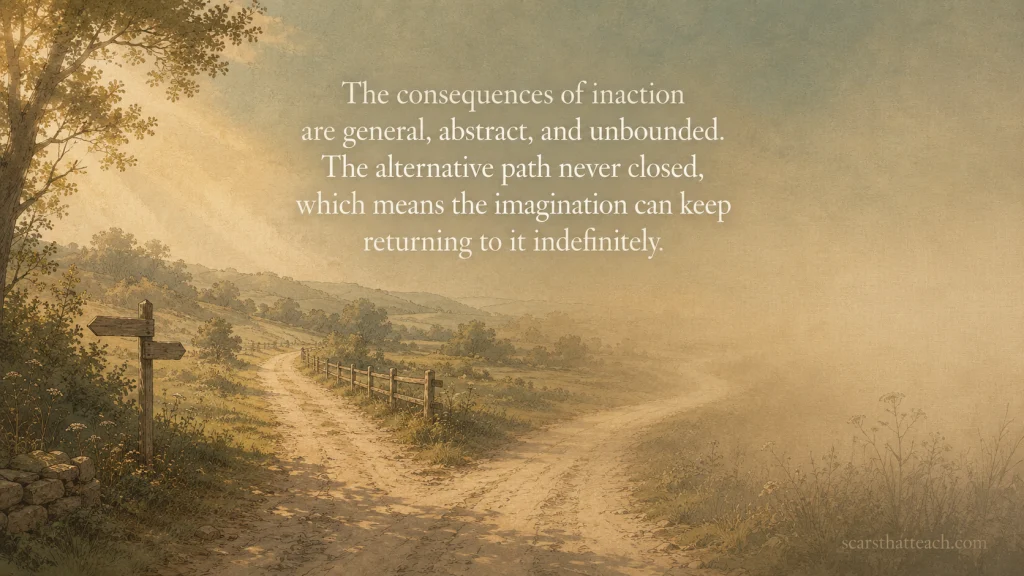
The more useful question is why it happens. Gilovich and Medvec, and researchers who followed, pointed to the mechanism of counterfactual thinking. When you do something and regret it, the counterfactual, the path not taken, is a specific alternative. You can compare what happened to what might have happened instead, and at some point that comparison exhausts itself. The mind can process a closed thing and eventually begin to move past it. When you do not do something and regret it, the counterfactual is not specific. It is open. The consequences of action are specific, concrete, and limited. The consequences of inaction are general, abstract, and unbounded. You can imagine what might have happened in infinite variations, because none of those variations ever got tested against reality. The alternative path never closed, which means the imagination can keep returning to it indefinitely.
Daniel Pink, drawing on his World Regret Survey of more than 15,000 people across more than 100 countries, found that inaction regrets are roughly twice as prevalent as action regrets in people who are older. Among people in their twenties, action and inaction regrets appear in roughly equal measure. As people age into their thirties, forties, and beyond, the inaction regrets accumulate and the action regrets diminish in relative weight. What sticks, over a lifetime, is not what was done badly. It is what was never attempted.
Why the Missed Path Stays Open
Several people tried to explain to me, when they talked about the things they had not done, what made that particular pain different. The specific quality was not just that the thing was undone. It was that they could still see themselves doing it. The conversation they never had with a sibling could still be imagined as having been possible. The work they never started could still be imagined as having succeeded. The relationship they never pursued could still be imagined as having been the right one. None of those outcomes had been tested against reality, so none of them could be ruled out. Each of those paths remained present in the imagination even when it was decades in the past, even when the circumstances that would have made them possible no longer existed.
That is the particular cruelty of inaction regret. It does not feel historical. It feels ongoing. The missed path stays live in the mind because the imagination has no evidence to close it, and so it keeps circling back to a door that is simultaneously always open and always out of reach.
What Action Regrets Can Do That Inaction Regrets Cannot
Action regrets are not painless. In the immediate aftermath of a choice that went badly, they can feel overwhelming. But they have a quality that inaction regrets generally lack: they are workable. Something happened. There is something to learn from it, something to reckon with, possibly something to repair. The mistake can be examined because it has a specific shape. In some cases, an apology is possible. In others, the damage can be partially undone. Even when none of that is available, the mind can eventually build a coherent account of what happened and what it means.
Inaction regrets resist this kind of processing. There is nothing concrete to examine. There is no outcome to learn from, because the action was never taken and the outcome never arrived. What there is instead is a persistent counterfactual, a version of events that exists only in imagination and can never be confirmed or dismissed. That is why they tend to stay. The ordinary processes by which regret becomes less sharp over time, learning from the experience, making sense of what happened, finding some closure, have nothing to grip.
I watched this play out often enough in those rooms to understand why the two kinds of pain land differently. An action regret, however sharp, gives the person something to hold. An inaction regret leaves them holding nothing but the question of what might have been.
The Thing Most People Get Wrong About This
The most common mistake people make when confronted with this pattern is to use it as a productivity argument: act more, regret less. That framing misses most of what matters. The people I sat with who carried the deepest inaction regrets were not people who had been lazy or inattentive. Many of them had been very busy, very responsible, very careful. What they had not done was distinguish between motion and the specific motion that mattered to them.
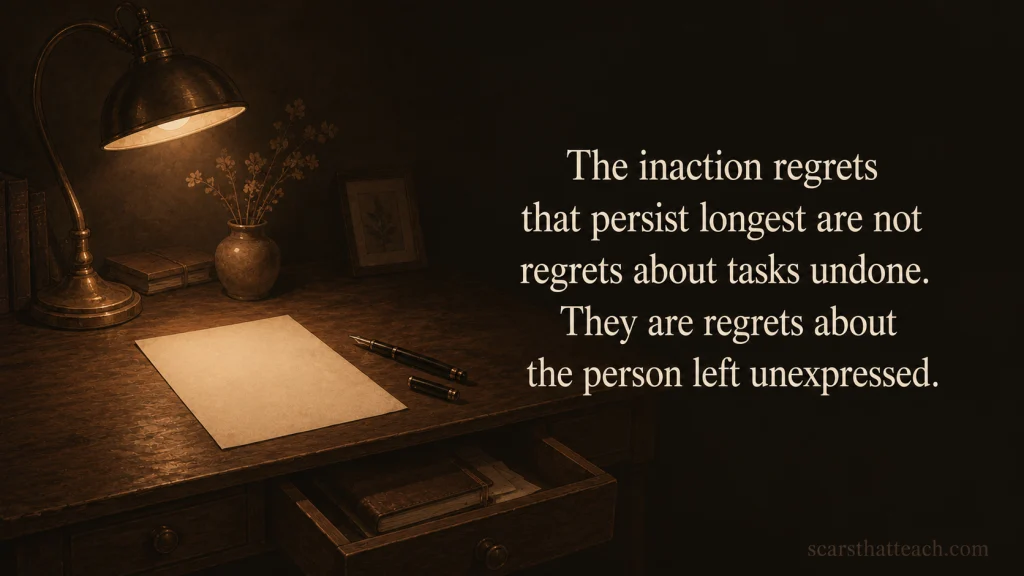
The inaction regrets that persist longest are not regrets about tasks undone. They are regrets about the person left unexpressed, the path not taken because it felt too uncertain or too late or too much, the connection that went quiet because nobody wanted to be the one to break the silence. These are not failures of productivity. They are failures of a different kind, and they do not respond to generic urgency. Telling someone to act boldly because inaction causes regret is as useful as telling a grieving person to cheer up. The instruction is not wrong. It just does not reach the thing it is trying to address.
What tends to be more useful is the specificity. Not acting more broadly, but identifying the one or two specific things that carry weight for you right now, the things that come to mind when you are honest about what you are not doing, and asking what it would actually take to move toward them. That is also why quotes about failure and what hard moments can teach are most useful when they sharpen attention instead of simply demanding boldness. That question is harder and slower than a general call to action. It is also more likely to matter.
What Twenty Years Taught Me About the Weight of the Undone
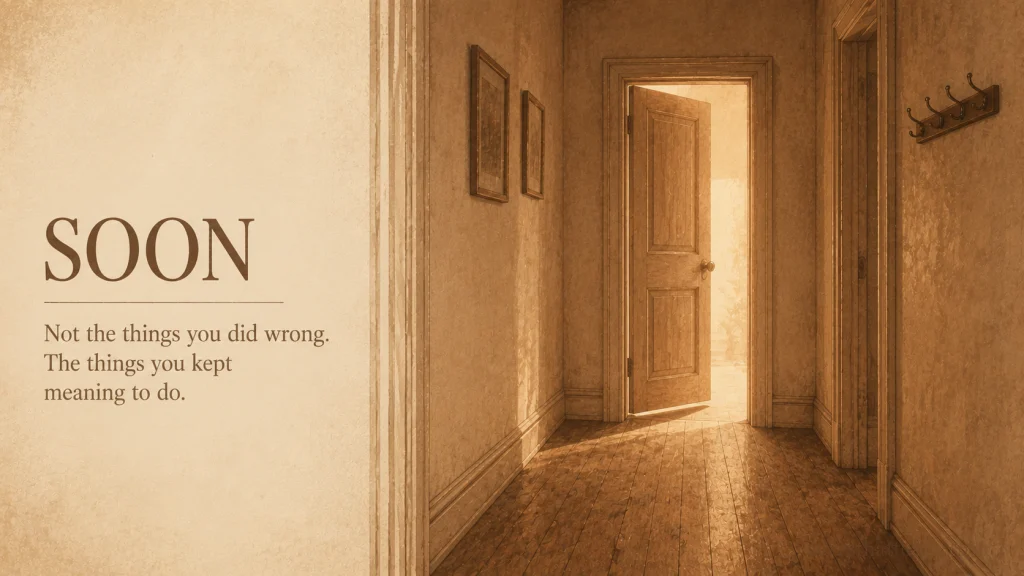
There is a pattern I want to name plainly, because I think it gets softened too often when people write about regret. The inaction regrets I witnessed over two decades were rarely about things people had been afraid to do. They were about things people had been almost ready to do, repeatedly, for years. The book they had been meaning to write was not a vague dream. They had a chapter in their head. The conversation they had never had was not something they had been avoiding because they did not care. They had rehearsed it a hundred times. What had stopped them, in almost every case, was not inability but timing. Not yet. Not the right moment. Soon.
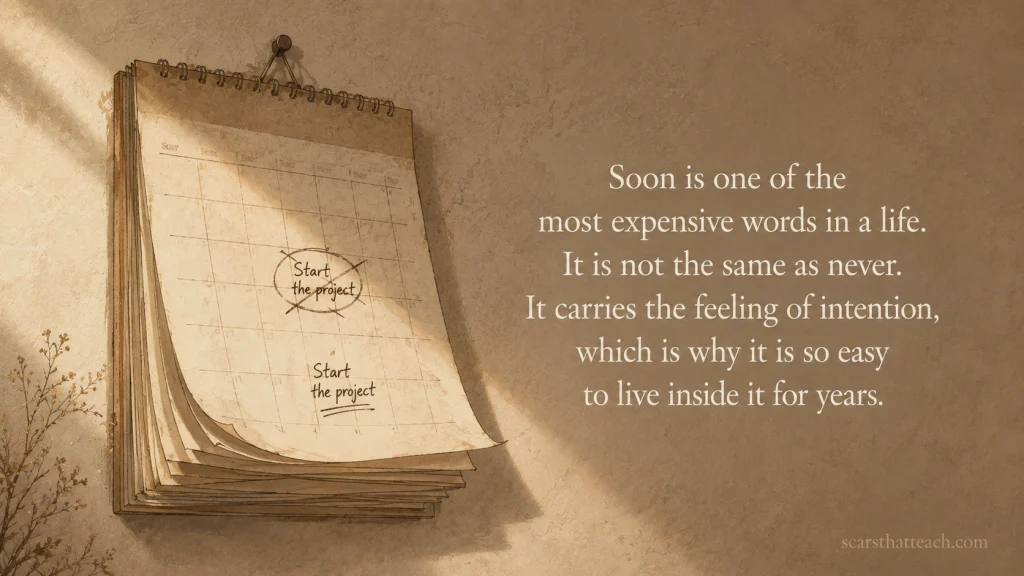
Soon is one of the most expensive words in a life. It is not the same as never. It carries the feeling of intention, which is why it is so easy to live inside it for years without recognizing what it is costing. The people who had said soon for long enough to run out of time were not people who had not cared. They had cared very much. They had just also believed, as most of us do, that the opportunity would still be there when the moment was finally right.
I am not saying this to induce fear. I have watched enough people carry enough weight to know that urgency imposed from outside rarely produces the movement it promises. What it tends to produce is anxiety, and anxiety is not a useful engine for the kind of action that addresses a real inaction regret. What I am saying is that the research on this and the experience from those rooms point in the same direction: the things that haunt people longest are the things that were genuinely available to them and that they kept believing would still be available later. That knowledge is not a reason to panic. It is a reason to be honest with yourself about what is on your list right now, and what you are actually telling yourself about the timing.
The word soon tends to arrive in recognizable forms. In those rooms, I heard versions of all of them:
- Once things settle down. The assumption that a calmer season is coming, and that the thing will be easier to do in it. The calmer season often does not come. And when it does, a new version of the same reason has usually arrived to take the old one’s place.
- When the time is right. A phrase that sounds like wisdom but often functions as a delay with no defined end point. The time being right is almost always a feeling, not a condition, and the feeling can be perpetually deferred.
- When I know how it will go. The need for certainty before beginning something that by its nature cannot offer certainty in advance. The outcome of an unmade conversation, an unwritten thing, an unreached-out-to person, cannot be known without attempting it. What this form of soon actually protects against is not failure, but the loss of a version of events that only survives in the imagination because it has never been tested.
- It has been too long already. The belief that time elapsed has sealed the opportunity. It is worth separating the genuine cases, where circumstances have actually changed, from the ones where it is the weight of time itself, not the facts of the situation, that is doing the work of closing the door.
For anyone thinking about how to work with regret rather than simply accumulate it, the useful question is not how to erase the feeling but what the feeling is pointing toward. Regret becomes more workable when it is read as information about what still matters, rather than as a verdict on what has already been lost.
Final Thoughts: What to Do with This
What sometimes shifts, when people understand this pattern clearly, is not the regret itself but the way they hold it. The sense of weakness or sentimentality that can accompany carrying something undone for years, the feeling that you should simply be over it by now, tends to ease when you understand what is actually happening. You are not being weak. You are doing what minds do with things that never produced an outcome. That is not a character flaw. It is a feature of how counterfactual thinking works, and it does not discriminate.
What this also suggests, about the future rather than the past, is something worth being careful with. The information is not a call to act on everything, or to make decisions in a rush, or to treat caution as the enemy. It is a call to be honest about the difference between thoughtful delay and the slow drift that arrives wearing the name of soon. Most people know the difference when they look at it plainly. The difficulty is in looking at it plainly. That is what the research confirms, and what I watched people do, or not do, for twenty years.
For anyone carrying a specific inaction regret right now, the most honest thing I can say is this: if the path is still open, even partially, the question of what it would actually take to move toward it is worth asking more carefully than most people do. Not because acting will guarantee a good outcome, but because the alternative, another season of soon, has a cost that tends to make itself clear too late.
FAQs
😔 Why do the things I never did haunt me more than my mistakes?
When you make a mistake, the outcome is real and finite, and the mind can eventually build a coherent account of what happened. When you never do something, the alternative outcome stays entirely in imagination, where it can be elaborated endlessly without ever being tested against reality. There is no closing evidence, so the mind keeps circling back. That is what makes inaction regrets harder to put down than most mistakes.
🔄 Is it normal that I regret things I didn’t do more than things I did?
Yes, and it becomes more common with age. Research has consistently found that as people get older, inaction regrets grow while action regrets diminish in relative weight. The things that tend to stick longest are the ones that were never attempted, not the ones that went badly.
🧠 What is the difference between action regret and inaction regret?
An action regret is about something that happened, which gives the mind something specific to process. An inaction regret is about something that never happened, which means the counterfactual, what might have been, exists only in imagination and never gets ruled out. That is why inaction regrets tend to last longer and feel harder to put down.
⏳ Why does regret about not doing something feel like it gets worse over time?
Because the imagination keeps the missed path alive. Without any real-world outcome to compare against, the alternative keeps seeming like it could have worked. The mind has nothing to close it with, and so it returns to the same unresolved question again and again. Over years, that pattern tends to deepen rather than fade.
💬 Does this mean I should always act rather than wait?
Not exactly. The regrets that persist longest are not about a general failure to act. They are about specific things that carried genuine weight for a person, things they kept meaning to do but kept deferring. The more useful question is not whether to act more broadly, but whether there is something specific on your list right now that you have been telling yourself you will get to soon.
🕰️ Is it too late to do something about an old inaction regret?
Sometimes the window has genuinely closed. But it closes later than most people assume, and people often discover that what they believed was gone was more available than they thought. The more honest question is whether the opportunity is actually over or whether it still exists and feels too late to attempt. The answer to that question is almost always more specific than it first appears, and worth finding out.