
Loneliness is not one thing. The word covers a range of experiences that feel similar on the surface but come from different places and respond to different things. A person who is lonely because they moved to a new city and know almost no one is carrying something structurally different from someone who has plenty of people around them and still cannot shake the feeling. Naming the specific kind of loneliness you are carrying is not a clinical exercise. It is the most direct way to stop reaching for answers that were never going to fit your situation.

The Patient Who Had Everyone, and the One Who Had No One
I spent two decades as a hospice chaplain, and one of the things I noticed early and never stopped noticing was that loneliness had almost no relationship to how many people showed up. Some of the most visited patients I sat with, people whose rooms were busy, whose families rotated through in shifts, still described themselves as lonely. Some of the least visited did not. The person with nobody coming described their solitude as something they had made peace with. The person surrounded by family described something hollow at the center of it all that the visits never quite reached.
What that taught me, over time, was that loneliness is not about the count of people in a room. It is about a specific kind of absence, and that absence takes different shapes depending on what a person actually needs and does not have. Two people can use the word “lonely” and be pointing at entirely different experiences. The one who moved across the country six months ago and has not made a single real connection is missing something different from the one who has been married twenty years and still feels unseen. The feeling may be similar. The gap is not.
The Distinction That Actually Helps
In 1973, the sociologist Robert Weiss drew a distinction in his book Loneliness: The Experience of Emotional and Social Isolation that has held up because it reflects something real. He identified two fundamentally different kinds of loneliness. The first is emotional isolation, which comes from the absence of a truly intimate tie: someone close enough to be a genuine source of connection. The second is social isolation, which comes from lacking a network of peers, the wider fabric of people you belong with in some ordinary, ongoing way.
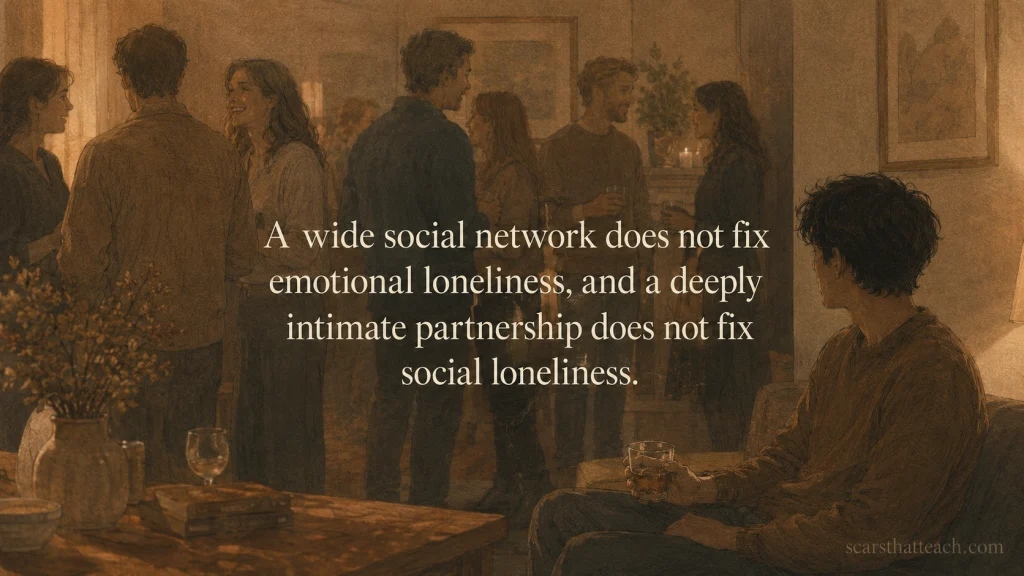
What Weiss was pointing at is that these two gaps are not interchangeable. A wide social network does not fix emotional loneliness, and a deeply intimate partnership does not fix social loneliness. Someone who has a close marriage but no real friends outside of it can feel socially adrift in a way that the marriage cannot reach. Someone who has a full social life but no one who actually knows them at any depth can feel emotionally invisible in a crowd. The presence of one kind of connection does not substitute for the other, and knowing which one is missing tends to clarify, fairly quickly, what would actually help.
The difference shows up most clearly in specific situations. If you have people to spend time with but no one you would call at 2 a.m., that is emotional loneliness: the social network exists, the intimate tie does not. If you have one person who genuinely knows you but feel socially unmoored outside of that relationship, that is social loneliness: the intimate connection exists, the wider fabric does not. And if you feel lonely even though both kinds of connection appear to be present, that is a different question, one that usually belongs somewhere closer to the existential end of things. Most loneliness content skips these distinctions entirely. It offers either a list of types with no way to locate yourself in it, or a generic checklist that treats all loneliness as the same problem with the same solutions. If you are lonely because your closest friendship has slowly dissolved over the past three years, you need different things than if you relocated six months ago and have not found your footing socially. Treating those two situations the same way helps neither of them.
Solitude Is Not the Same Thing
One distinction worth making before anything else: loneliness and solitude are not the same experience, even though they both involve being alone or feeling alone. Solitude is chosen, or at minimum accepted without distress. It is the experience of being with yourself in a way that does not feel like deprivation. Loneliness is the experience of an absence you did not choose and cannot fill on your own. The difference is not about how much time you spend alone. It is about whether the aloneness feels like something is missing.
I have sat with people who were entirely isolated by circumstance, no family close, few visitors, weeks between meaningful conversations, who had arrived at something that was not loneliness. They had found, over years, a kind of internal company that sustained them. And I have sat with people surrounded by noise and family obligation who were profoundly lonely in the way that only happens when you cannot locate anyone who actually sees you. What separated them was not the external circumstances. It was what each of them was actually missing, and whether that thing was absent or present.
This distinction matters because the instinct when someone is lonely is often to add people. More social activity. More invitations. More busyness. But if the loneliness is emotional in nature, adding social contact does not resolve it. And if a person has genuinely made peace with solitude, framing that as a problem to be fixed is itself a misreading of their situation.
A few signals tend to clarify which side of the line a person is on. Time alone that feels restorative points toward solitude. Time alone that feels like waiting for something missing to return points toward loneliness. A preference for less social contact than others expect of you is not the same thing as loneliness either: loneliness is the unwanted absence of connection, not the chosen reduction of it. And if being around people relieves the feeling, the gap is probably social. If being around people leaves the feeling mostly untouched, the gap is probably something else entirely.
Where Situation Shapes the Loneliness
Beyond the social-versus-emotional distinction, loneliness also takes different shapes depending on the specific life circumstance driving it. The same underlying gap, the absence of close connection, can look and feel very different depending on whether it arrived through a move, a relationship that stopped meeting your needs, a life stage that hollowed out your social world, or something that has never quite been nameable but has always been there.
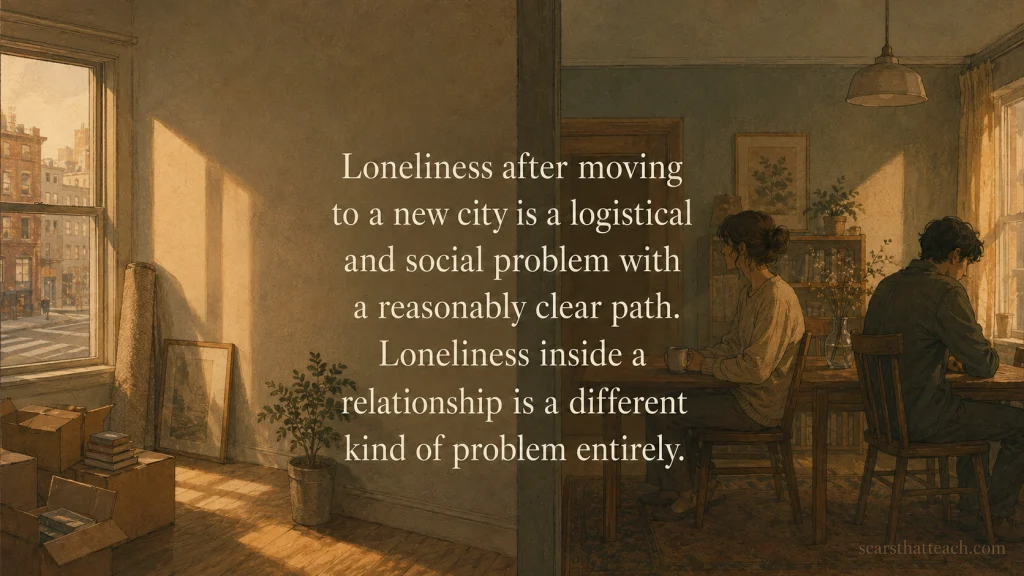
These situational shapes matter because they determine what questions are actually relevant. Loneliness after moving to a new city is a logistical and social problem with a reasonably clear path, even if the path is slow and uncomfortable. Loneliness inside a relationship is a different kind of problem entirely, one that involves a connection that exists but is not working in the way it needs to. Loneliness that does not attach to any specific absence, the kind that follows a person from circumstance to circumstance regardless of how much changes, has its own particular weight and its own particular questions.
The six situations below are the ones I return to most often when I think about the specific shapes loneliness takes in adult life. They are not an exhaustive list, but if you are carrying something right now, one of them is probably close to it. Most of what people describe falls into one of three broad shapes: loneliness from a missing network, where the social fabric simply does not exist yet because of a move, a life stage that thinned it out, or a period of withdrawal that went longer than intended; loneliness inside existing connections, where the people are present but the relationships are not reaching the place where loneliness lives; or loneliness that does not attach to any specific gap, a persistent sense of being fundamentally alone that follows a person across situations regardless of how much connection is technically available.
Find the Situation That Fits
Each of the situations below points to a distinct shape of loneliness. They share the same underlying feeling but come from different places and call for different kinds of thinking. Start with the one that sounds closest to what you are actually carrying.
| The situation | What it covers |
|---|---|
| Lonely after moving to a new city | When the social fabric you built over years simply does not exist yet in the place you now live, and the gap is larger than you expected. |
| Lonely while single | When the absence of a partner carries a particular weight, and it is not always clear how much of that weight belongs to the relationship itself versus everything it represents. |
| Lonely in a relationship | When the connection is present but is not reaching the place where loneliness lives, which is the specific difficulty of being lonely with someone rather than simply without anyone. |
| Lonely even with friends | When there are people around, and the friendships are real by most measures, but something about the depth or the direction of them still leaves a gap. |
| Existential loneliness | When the loneliness does not attach to a specific missing person or relationship but to something more fundamental: the sense that certain parts of your experience cannot fully be reached by anyone else. |
| Empty nest loneliness | When a life structured around the presence of children reorganizes around their absence, and the loneliness that surfaces is not just about them but about who you were in relation to them. |
Not every situation fits neatly into one row. Someone can be carrying more than one of these at the same time, and usually the most persistent loneliness has more than one thing feeding it.

Final Thoughts: What Naming It Actually Does
Naming the specific kind of loneliness you are carrying does not resolve it. I want to be clear about that. What it does is something more modest and more useful: it points the thinking in the right direction. Someone who has identified that their loneliness is primarily emotional, that they have people around them but no one who really knows them, is in a different conversation than someone whose loneliness is primarily social. The second person is missing a network that simply does not exist yet and needs to be built. Those are different problems. They call for different kinds of patience and different kinds of effort.
What I noticed across two decades of sitting with people who had run out of time to be imprecise about things was that the ones who had named their loneliness clearly, even if they had not resolved it, carried it differently. Not lighter, exactly. But with more accuracy. They were not reaching for solutions that were never going to fit. They were not blaming themselves for failing to respond to advice aimed at a different problem. They knew what was actually missing, and that knowledge, even without a fix, was something.
The broader questions about difficult relationships and the people we carry with us throughout our lives are ones I explore across a wider range of situations in a look at what the most enduring observations about toxic people and relationships actually say. Loneliness often lives in that territory, even when no single person is to blame for it.
FAQs
💬 What is the difference between loneliness and being alone?
Being alone is a circumstance. Loneliness is the experience of a specific absence you did not choose and cannot fill by yourself. People can be physically alone without feeling lonely, and they can be surrounded by others and still feel profoundly lonely. The difference is not about headcount. It is about whether something essential feels missing.
🤔 Why do I feel lonely even when I am around people?
Because loneliness is not about the presence of people. It is about the presence of a specific kind of connection, whether emotional intimacy, genuine being-known, or belonging to a social fabric that feels real. If what you need is not what the people around you are providing, their presence does not reach the place where loneliness lives.
😔 What are the main types of loneliness?
The most useful distinction is between emotional loneliness, which comes from the absence of a truly intimate tie, and social loneliness, which comes from lacking a network of people you belong with in an ongoing way. These are different gaps and do not substitute for each other. Beyond that, loneliness also takes situational shapes depending on what specific life circumstance is driving it.
🔍 Is it normal to feel lonely even in a relationship?
Yes, and it is one of the more disorienting versions of loneliness because the obvious explanation, that you simply need someone, does not apply. Loneliness inside a relationship usually means the connection is present but is not reaching a particular depth or meeting a particular need. It is not evidence that the relationship has failed, though it is worth understanding what specifically is missing.
🌿 How do you deal with loneliness when you cannot easily change your circumstances?
Start by naming what is actually missing as precisely as you can. Generic advice for loneliness rarely helps because it treats all loneliness as the same problem. Knowing whether you are missing one close connection, a wider social network, a sense of belonging, or something more fundamental points you toward what would actually move the needle, even if slowly and imperfectly.