
Heartbreak from being cheated on does not behave like ordinary heartbreak, and there is a reason for that. Clinicians who study infidelity describe symptoms that look closer to trauma than grief: intrusive replaying, hypervigilance, a nervous system that will not settle. But the part almost nobody names clearly is what betrayal does to your trust in your own memory, not just your trust in the person who hurt you. This piece walks through why that distinction matters, what the trauma response actually looks like, and where people get stuck trying to heal from the wrong wound.

Why This Kind of Heartbreak Feels Different
I sat with a woman once whose husband had been unfaithful for the better part of two years before she found out. She was not there because of him. He had already left the marriage by then, in every way that mattered. She was there because she told me the hardest part was not losing her husband. It was losing her own memory of the last ten years, because she no longer knew which parts of it had been real.
That sentence has stayed with me longer than almost anything else I heard in two decades of this work. Heartbreak from being cheated on is not just sadness about an ending. It is a specific kind of injury, and it behaves differently in the body and the mind than an ordinary breakup does. If you are trying to understand why you feel unsteady in ways that do not match what people around you seem to expect, you are not imagining it, and you are not overreacting.
Why Betrayal Trauma Behaves Like Trauma, Not Grief
Ordinary heartbreak, the kind that comes from falling out of love or growing apart, usually follows a recognizable arc. There is sadness, there is adjustment, and over time the sharp edges soften. Betrayal trauma does not follow that arc, and clinicians who work with infidelity have spent real time documenting why. Dr. Dennis Ortman, writing on what he calls post-infidelity stress disorder, describes a cluster of symptoms that closely mirror post-traumatic stress: intrusive images of the affair, a nervous system stuck on high alert, sudden waves of panic triggered by something as small as a smell or a text notification.
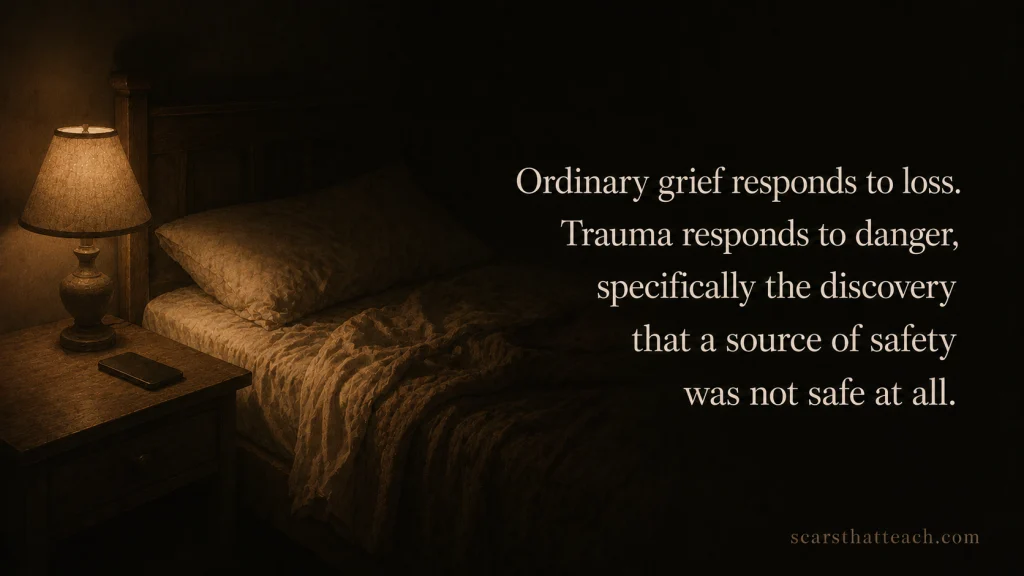
The reason it behaves this way comes down to how the mind processes betrayal from someone it trusted completely. Ordinary grief responds to loss. Trauma responds to danger, specifically the discovery that a source of safety was not safe at all. Researchers studying betrayal trauma, including work associated with Jennifer Freyd, describe this as a wound to the attachment system itself, not just to the relationship. The person you built a life around turns out to have been someone you did not fully know, and your body reacts the way it would to any threat it did not see coming.
That is why someone healing from this kind of heartbreak can feel like they are handling something closer to shock than sorrow. Sleep gets disrupted. Concentration disappears. Small reminders trigger a physical response that feels disproportionate to the moment, because it is not actually about the moment. It is about the discovery underneath it.

The Wound Most People Never Name
Almost everything written about trust issues after being cheated on focuses on rebuilding trust in other people. That matters, and it deserves its own attention. But it is not the whole wound, and in my experience, it is often not even the deepest part of it. The quieter injury is what betrayal does to your trust in your own perception. Before you found out, you were living inside a version of your life that felt settled. You had already decided what certain moments meant. A trip that felt close. A conversation that felt honest. A quiet Tuesday that felt like nothing was wrong.
Finding out means going back through years of settled memory and relitigating all of it. Was that trip actually close, or was I not paying attention? Was that Tuesday actually fine, or was I the only one who thought so? That process is exhausting in a way that is hard to explain to someone who has not lived through it. It is not the relationship alone that gets grieved here. It is the certainty that came with it, and certainty is not something you can simply decide to feel again once it has been shaken this thoroughly.
This is the part that tends to outlast the anger at the person who cheated. The anger has a target. The self-doubt does not. It follows you into new situations, new relationships, even ordinary moments that have nothing to do with what happened, because it is no longer only about him or her. It is about whether your own read on a situation can be trusted at all.
A few signs tend to point specifically to this deeper layer, separate from the more familiar trust issues people expect to have with a new partner:
- Replaying old, unrelated memories and searching them for signs you think you should have caught.
- Doubting your own read on a completely different situation that has nothing to do with the relationship.
- Feeling unsettled by your own certainty, even about small things, in a way that is new since the betrayal.
- Needing external confirmation for things you used to simply know for yourself.
Naming this layer does not fix it by itself. But it does explain why healing after infidelity can feel incomplete even after the anger has faded and the ex is long gone. Rebuilding trust in other people was never the whole task. The harder part, quietly, is rebuilding trust in your own eyes.
Where People Get Stuck Trying to Heal
The most common mistake I see is treating this as a trust problem to be solved entirely through the next relationship. People believe that once they find someone honest, the unsettled feeling will resolve on its own. Sometimes it eases. It rarely disappears, because the wound was never only about the specific person who lied. It was about discovering that your own perception could be that far off from reality, and a new partner’s honesty does not answer that question. Only time, along with evidence you gather through your own experience, slowly answers it.
The second mistake is rushing the timeline because other people seem uncomfortable with how long it is taking. Betrayal trauma does not move on a schedule that matches an ordinary breakup, and expecting it to only adds shame to something that was already hard enough. If the symptoms are severe, persistent, or starting to interfere with daily functioning, that is worth bringing to a therapist who works specifically with trauma or infidelity. This kind of injury is not something you are required to work through alone, and there is no version of strength that requires you to.
The third mistake is treating self-doubt as proof that something is still wrong with your judgment. It is easy to look at how badly you misread the relationship and conclude that your instincts cannot be trusted going forward. But misreading one person who was actively working to deceive you is not the same as having unreliable judgment in general. Deception is designed to defeat even careful attention. Holding that distinction, between being lied to skillfully and being fundamentally bad at reading people, is part of what lets the self-doubt loosen its grip over time.

Final Thoughts: The Trust You Are Rebuilding Is Also Your Own
I think about that woman often, the one who said losing her memory hurt more than losing her husband. She was not being dramatic. She was describing something precise: betrayal does not just end a relationship, it reaches backward and unsettles everything you thought you already understood. Healing from that is not the same project as healing from an ordinary breakup, and it should not be measured against one. What she was rebuilding, slowly and without a clear timeline, went further than her ability to trust someone else again. It reached all the way down to her ability to trust her own eyes.
Not every ending that hurts this deeply involves betrayal specifically. Some of what applies here overlaps with heartbreak from being dumped, though the injury to trust in your own perception is particular to discovering you were deceived. And for anyone still working through whether to stay or go, the strain of breaking up with someone you still love carries its own weight that this piece does not attempt to cover. If what you read here felt familiar, there is more written on lessons from other kinds of heartbreak worth sitting with as well, alongside reflections on toxic people that speak to the same kind of betrayal.
FAQs
💔 Why does being cheated on hurt more than a normal breakup?
Ordinary heartbreak responds to loss. Betrayal triggers a trauma response because it reveals that a source of safety was not safe, which is why the symptoms often feel closer to shock than sadness.
🧠 Is what I’m feeling actually trauma?
Clinicians who study infidelity describe symptoms like intrusive replaying and hypervigilance that closely resemble trauma responses. That said, only a licensed professional can properly assess what you are experiencing, so bring persistent or severe symptoms to someone trained in trauma.
🔍 Why do I keep questioning memories that have nothing to do with the affair?
Betrayal often shakes trust in your own perception, not just trust in the person who lied. That can spill into unrelated memories and situations because the real question underneath is whether your own read on things can be trusted.
⏳ How long does this kind of healing usually take?
There is no fixed timeline, and betrayal trauma often takes longer than an ordinary breakup to settle. Rushing it to match what others expect tends to add shame without actually speeding up the process.
🤝 Will trusting a new partner fix this?
It can help, but it rarely resolves the deeper layer on its own, since that layer is about your trust in your own perception, not only theirs. That part tends to heal through time and evidence you gather for yourself.
😳 Why do I feel embarrassed about being cheated on, even though I did nothing wrong?
Embarrassment often comes from feeling like you should have seen it sooner, not from anything you actually did. That feeling is common, but it confuses being deceived skillfully with being at fault, and those are not the same thing.
📅 Can betrayal trauma show up even if the affair ended years ago?
Yes. Betrayal trauma does not follow a strict clock, and something as ordinary as a smell, a song, or an unrelated conversation can bring the response back years later, especially if the deeper self-doubt was never fully addressed.
❓ Why do I still doubt myself after leaving the relationship entirely?
Leaving ends the relationship, but it does not automatically resolve the question betrayal raised about your own perception. That question tends to linger until it is named and worked through on its own, separately from the decision to stay or go.