Being lonely while single is rarely solved by the advice it usually gets, which tends to circle around self-acceptance and not settling out of fear. The more precise thing missing is often smaller than a relationship and easy to overlook: a daily witness for the ordinary moments too minor to bring to a friend but exactly the kind of thing you would text a partner without thinking twice. This piece looks at that specific gap and what it actually takes to address it.

The People Who Said No One Really Knew Them Were Rarely the Ones Without Friends
One of the more surprising patterns I noticed, sitting with people across many different circumstances, was who tended to say that no one really knew them. It was rarely the people with no friends at all. More often it was people surrounded by a full life, family nearby, a steady job, a calendar with plenty in it, who still described a particular kind of unwitnessed feeling that none of that activity touched.
If you are lonely while single, even with friends and family who genuinely care about you, that pattern probably sounds familiar. The loneliness is not really about a lack of people in your life. It is about a specific kind of presence none of those people are positioned to provide, and naming that precisely tends to matter more than any general advice about getting out more.

The Specific Thing Missing: A Witness for the Ordinary
The psychologist Irvin Yalom described a kind of aloneness that exists even within full social lives, the simple fact that no one else fully shares your particular vantage point on your own experience. What I noticed sitting with people across very different circumstances was a much more concrete version of that idea showing up specifically in single loneliness. It is the absence of someone whose role, by default, is to hear about your day in granular detail, the small complaint about a coworker, the strange thing you saw on the walk home, the minor decision you are turned around about, none of it big enough to justify a phone call to a friend, but exactly the kind of thing a partner hears without you having to decide whether it is worth mentioning.
That is a different thing than wanting a relationship in the romantic sense, and different again from simply needing more friends. You can have several people you would call in a real crisis and still feel this particular absence every evening, because crisis-level friendship and daily-witness intimacy are not the same currency. It is also a different problem entirely from feeling alone inside an existing relationship, which has its own shape and its own causes worth looking at separately. Most single loneliness advice treats the feeling as something to manage internally, through acceptance or self-compassion, without ever naming this more precise missing piece.
Why This Distinction Actually Matters
Naming the gap this specifically changes what you do about it. Treating it as a general wish for a relationship puts enormous pressure on dating and tends to make the search itself feel more desperate than it needs to. Treating it as a need for more friends can leave you filling your schedule with plans that never quite touch the actual ache, because volume was never the issue.
Once the gap is named as the absence of a daily witness specifically, other options become visible that the broader framing hides. A small number of people in your life, sometimes just one, can be deliberately invited into that daily-witness role without it being romantic at all. A sibling you start texting the small stuff to. A friend you agree, explicitly, to check in with about ordinary days rather than only major events. None of it replaces wanting a partner eventually, but it can meaningfully soften the specific shape of this loneliness in the meantime.
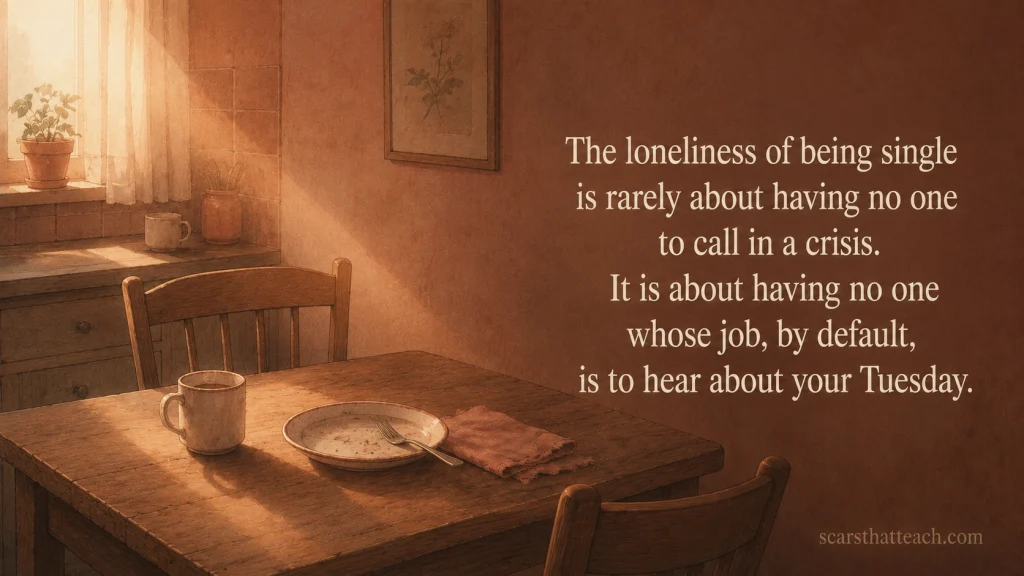
The loneliness of being single is rarely about having no one to call in a crisis. It is about having no one whose job, by default, is to hear about your Tuesday.
What People Commonly Get Wrong When They Try to Address This
The most common mistake is assuming the feeling will resolve itself once a relationship arrives, which puts the entire fix on a timeline you cannot control. People who frame it this way often put their daily life on hold in small ways, postponing decisions, staying less invested in friendships, treating the current chapter as something to get through rather than live inside, all while waiting for a partner to arrive and absorb the loneliness automatically.
The second mistake is assuming that more socializing alone will close the gap. Filling a calendar with group activities can ease general loneliness without touching this more specific kind, because group settings rarely create the particular, low-stakes, ongoing exchange a daily witness provides. The fix is less about volume of contact and more about its shape, which is also why it is worth being selective about who fills that role, since not every relationship you have is built to hold it well, the way certain relationships quietly cost more than they give regardless of how much time they take up.
- You have people to call in a real emergency but no one you text about your ordinary day.
- You catch yourself drafting a message about something small, then deleting it because it feels too minor to send.
- You feel this loneliness most in quiet, ordinary moments rather than during obvious crises.
- You have assumed a future relationship is the only real fix and put other options on hold while you wait for it.
- You have several friends but no one occupying the specific daily-check-in role.

Final Thoughts: A Precise Problem Deserves a Precise Answer
The feeling of being lonely while single is real, and it deserves more than being told to accept it or work on yourself until it fades. Most of the time it is pointing at something specific: the absence of a daily witness, not the absence of people in general. Naming that precisely is often the difference between a vague ache you wait out and something you can actually do something about in the meantime. A wider look at the different shapes loneliness can take covers related situations that may sound similar but come from different roots.
FAQs
📱 Why do I feel lonely even though I have friends and family?
You may be missing a specific kind of presence, a daily witness for ordinary moments, that friends and family are not positioned to provide even when the relationships themselves are genuinely close.
💬 Is this just about wanting someone to talk to?
Not quite. It is more specific than general conversation, the absence of someone whose default role is hearing your ordinary day, the small stuff too minor to bring to a friend but easy to mention to a partner.
🚫 Will this loneliness go away once I am in a relationship?
Often, yes, but waiting for that as the only solution puts your wellbeing on a timeline you cannot control. Naming and addressing the specific gap now does not have to depend on finding a partner first.
👥 Is this the same as just needing more friends?
Not quite. More socializing eases general loneliness, but the specific ache of single loneliness usually needs a particular kind of ongoing, low-stakes exchange that group activities rarely provide on their own.
🌱 What can I actually do about this in the meantime?
Consider inviting one person already in your life, a sibling, a close friend, into the specific role of hearing your ordinary days, explicitly and deliberately, rather than waiting for a future relationship to fill that role.