Existential loneliness is not the ache of an empty calendar or a quiet weekend alone. It is the experience of feeling fundamentally alone in a way that has little to do with how many people actually care about you. I have sat with people who had a house full of visitors and still asked me, in one form or another, whether any of it had meant something to anyone but them. That question was never really about who was in the room. This is about naming that specific kind of alone, why the usual advice for loneliness does not touch it, and what actually narrows the distance, even though it never fully closes.

When Being Understood Isn’t Enough
Existential loneliness shows up in people who, on paper, have nothing to complain about. They have a partner who listens, friends who show up, family who calls. And still there is a particular kind of alone that none of that touches, the sense that no matter how much you explain yourself, some part of what it feels like to be you simply does not transfer to another person. I have watched this surface most clearly near the end of people’s lives, because dying strips away the noise that usually covers it, but it was never really about dying. It was about whether any of it, the work, the love, the years, had actually landed somewhere real.
That gap between being cared for and being known is what this is about. It is not a flaw in your relationships, and it is not something a better conversation or a more emotionally available partner fixes outright. It sits closer to a fact of being a separate consciousness inside a separate life than to a problem with your social circle. Naming it accurately is most of the relief, because a lot of people spend years trying to solve it with the wrong tools, mistaking it for a friendship problem or a marriage problem, before wondering why the fix never quite lands.
A Kind of Alone That Has a Name
People usually think of loneliness as one thing with different intensities, worse on a Friday night, better after a good phone call. But there are a few distinct kinds, and the one most people never hear named is this one: the loneliness of being different in a way that goes deeper than circumstance, the sense that your interior world runs on its own frequency that other people can approximate but never fully receive. This is separate from the ordinary version where you have friends on paper but nobody you would call at two in the morning. That version is about closeness. This one is about the basic separateness between any two minds, and it can be present even inside the closest relationship you have.
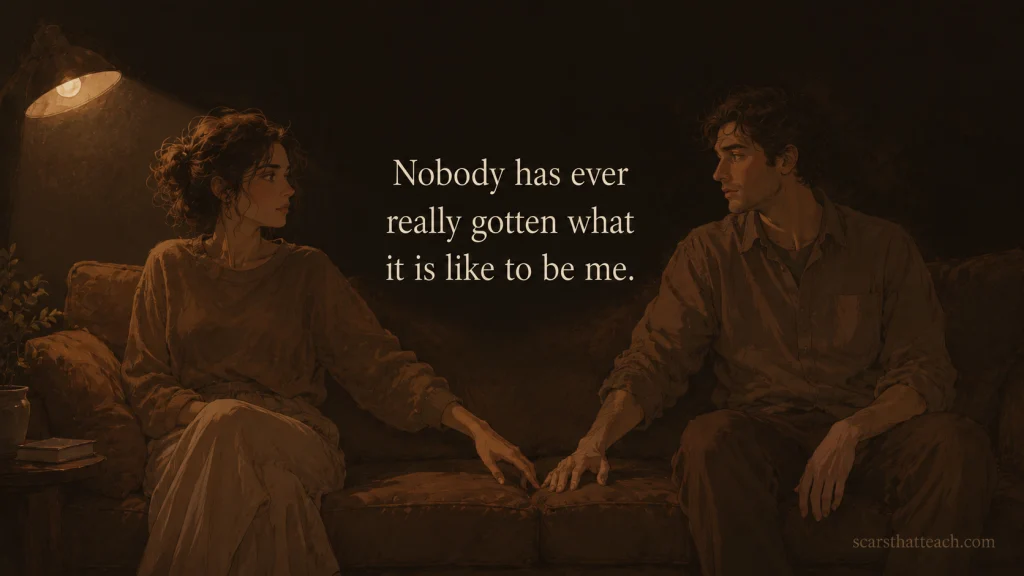
I have sat across from spouses married thirty, forty years, people who by every visible measure had built a real partnership, and still heard one of them say something close to nobody has ever really gotten what it is like to be me. It was not a complaint about the marriage. It was closer to a quiet fact they had carried the whole time, something they had mostly made peace with and only said out loud once someone was finally listening without an agenda. That is the shape this usually takes. It does not announce itself as a crisis. It sits underneath a full life, mostly unspoken, because there is rarely a natural place to say it out loud.
What People Get Wrong When They Try to Fix It
The instinct, once someone recognizes existential loneliness in themselves, is to treat it like a solvable problem. They look for a better therapist, a more emotionally intelligent partner, a friend group that finally gets it. Sometimes that search produces real improvements in their life. It rarely touches the specific ache they were trying to solve, because that ache was never really about the quality of the people around them. Most of what gets written about this names it accurately and then stops, treating it as something to simply accept rather than something with any real response beyond acknowledgment. That leaves people with a name for the feeling and nowhere to go from it, which can feel worse than not having language for it at all.
The other common mistake is assuming this means something is broken in the relationship itself. A person feels the gap with their partner and starts auditing the marriage for problems, when the marriage might be sound and the gap might simply be the space that exists between any two people’s inner lives. I have watched people leave good relationships chasing a closeness that was never going to be fully available from another person, no matter who that person was. The problem was not who they had chosen. It was the expectation that another human being could close a distance that is, to some extent, built into being a separate person at all.
A few signs tend to show up together when this is what someone is actually carrying:
- Feeling unseen in a relationship that is otherwise stable and caring, with no specific incident to point to.
- A sense that explaining your inner experience to someone else always loses something in the translation, no matter how well they listen.
- Feeling most alone in a crowded room or a close conversation, not in actual solitude.
- A quiet suspicion that no amount of company would fully close the gap, paired with guilt for feeling that way when the people around you are genuinely good to you.
None of that means the relationship is the problem. It usually means the feeling has been misdiagnosed as one.
The Difference a Witness Makes
Here is where most of what is written about this stops short. It names the feeling, tells you it is a normal part of being conscious and separate from other people, and leaves it there, as if acknowledgment were the end of the conversation. I think that undersells what is actually available. The goal was never to close the gap completely. Nobody gets full access to another person’s inner world, and treating that as a failure sets an impossible bar. The realistic goal is narrower and more useful: finding someone who witnesses your ordinary days closely enough that the gap stops feeling so wide, even though it never disappears. That is what existential loneliness responds to, even if nothing fully erases it.
A witness is different from someone who understands you completely. It is someone who knows the small, unglamorous texture of your life, the argument you had on Tuesday, the thing you have been avoiding, the joke only the two of you would find funny, closely enough that you stop having to explain yourself from scratch every time you want to say something real. I have seen this matter most for people who had spent years managing patterns in relationships that quietly wear someone down, people who assumed the loneliness they felt afterward was just leftover damage. Some of it was. But part of it was this same gap, made sharper by having spent so long unseen in a specific, painful way.
Final: A Gap Worth Narrowing, Not Solving
Before you try to act on any of this, it is worth checking that you are naming the right thing. If what you are picturing when you read this is more about having people around but nobody who feels close, that is a related but different experience, closer to feeling lonely even with friends nearby than to what is described here. Existential loneliness sits one layer deeper. It is less about the number or quality of people in your life and more about the basic fact of being a separate consciousness that no one else fully enters, even the people who love you well. Neither version is smaller than the other. They just call for different responses.
What I would say to someone sitting with this, plainly, is that you are not broken and your relationships are not necessarily failing you. The distance you feel is closer to a condition of being a person than a symptom of a bad relationship. Finding one or two people who witness the actual texture of your days, who know the specifics without needing them re-explained, will not erase that distance. It will make it smaller, and for most people that turns out to be enough. If disconnection in other forms is also part of what you are carrying, it is worth getting honest about the different ways disconnection shows up in daily life before you try to fix the wrong one.
FAQs
🧭 What is existential loneliness, and how is it different from regular loneliness?
Regular loneliness is usually about not having enough people around, or not having anyone close enough to call. Existential loneliness can happen even with plenty of close relationships. It is the sense that a part of your inner experience never fully transfers to another person, no matter how well they know you.
💭 Can you feel this way even in a happy marriage or a close friendship?
Yes, and it is more common than people admit out loud. I have heard it from people in genuinely good marriages, not troubled ones. It is not a sign the relationship is failing. It is closer to a fact about being two separate people, no matter how close you are.
🕯️ Is this the same thing as spiritual loneliness?
They overlap for some people, but they are not the same thing. Spiritual loneliness usually points toward a specific religious or faith based longing. Existential loneliness is broader than that. It is about feeling fundamentally separate from other minds, whether or not faith is part of your life at all.
🌫️ Does it ever go away completely?
Honestly, probably not completely. Some distance between one person’s inner world and another’s is just built into being separate people. What changes is how wide that gap feels, and the right relationships can narrow it a great deal.
🤝 What actually helps with this kind of loneliness?
Not a bigger social circle. What tends to help is one or two people who know the ordinary texture of your days closely enough that you stop having to explain yourself from the beginning every time. That is what narrows the gap, even when it cannot close it.
🪞 Is feeling fundamentally different from everyone else a sign something is wrong with me?
No. It is a common human experience, not a defect. I would be cautious of anyone who tells you it means you are broken or that you need to be fixed. Most people carry some version of this. Very few say it out loud.