Comparison with others is one of the most reliable ways to lose satisfaction you already had. The mechanism is specific: when you compare upward, you raise the invisible standard against which your own circumstances are measured, and what was previously enough quietly becomes insufficient. This is not a character flaw or a failure of gratitude. It is how the mind works when it uses someone else’s life as a reference point. Understanding why this happens does not make comparison disappear, but it does make it harder to mistake the feeling for reality.
How Comparison Moves the Line
I noticed this pattern more times than I can count across two decades of sitting with people at the end of life. Someone would describe a period of their life when they had felt, genuinely, that they had enough. A decent job. A home they liked. A relationship that worked. And then they would describe the afternoon that changed it. A neighbor’s new house. A sibling’s promotion. A college reunion where someone else had done something that, until that moment, had not seemed like something worth wanting. And after that afternoon, the same life that had been quietly satisfying started to feel like something they had settled for.
What I kept noticing was that the circumstances had not changed. The job was still the same job. The house was the same house. What had changed was the line they were measuring against. That is the mechanism, and it is persistent precisely because it operates below the level of what most people think to question. It does not reduce what you have. It raises the standard against which what you have is judged, so that the same circumstances now fall short of a bar that did not exist last Tuesday.
The Reference Point Problem
Satisfaction is not an absolute. It is not a fixed quantity that you either have or do not have based on objective circumstances. It is a judgment, and like most judgments, it depends on what you are comparing against. A salary that felt generous when you took the job starts to feel inadequate the month you learn what a colleague earns. A vacation that sounded wonderful in January becomes disappointingly ordinary in April, after someone in your circle posts theirs from somewhere more remarkable. The experience itself has not changed. The reference point has.
Leon Festinger identified in 1954 that people have a fundamental drive to evaluate their own circumstances, abilities, and standing by comparing themselves to others, particularly when no objective measure is available (“A Theory of Social Comparison Processes,” Human Relations, Vol. 7, No. 2, 1954). What the decades of research since then have added is a clearer picture of what upward comparison specifically does to that evaluation. When you compare yourself to someone who appears to have more, do more, or be more, you are not simply gaining information. You are importing a new reference point into the way you see your own situation. And that reference point does not leave when the comparison ends.
The thing most people miss is that this is not about envy in the dramatic sense. You do not have to feel bitter or resentful for the mechanism to run. It can happen quietly, almost automatically. You see someone’s life and notice, without any particular heat behind it, that it looks like a version of yours that went differently. And from that moment, your own version is being evaluated against a standard it was never being held to before. Much of what gets said about happiness, the quotes people return to, the framings that have lasted, points at this same problem from different angles: that how we feel about our circumstances depends less on the circumstances than on what we are measuring them against. I have collected some of that thinking in a broader look at what the most enduring observations about happiness actually say.
What the Comparison Costs
The cost is not dramatic. That is part of why it is so hard to name. No single comparison destroys satisfaction the way a crisis does. What it does instead is quieter: it makes adequacy feel like failure. The house you were proud of starts to seem like the house you could afford. The work you found meaningful starts to seem like the work you ended up doing. The relationship that felt like something good starts to feel like something that simply did not go wrong. The circumstances are unchanged. But the frame has shifted, and through the new frame, everything looks a little more like settling.
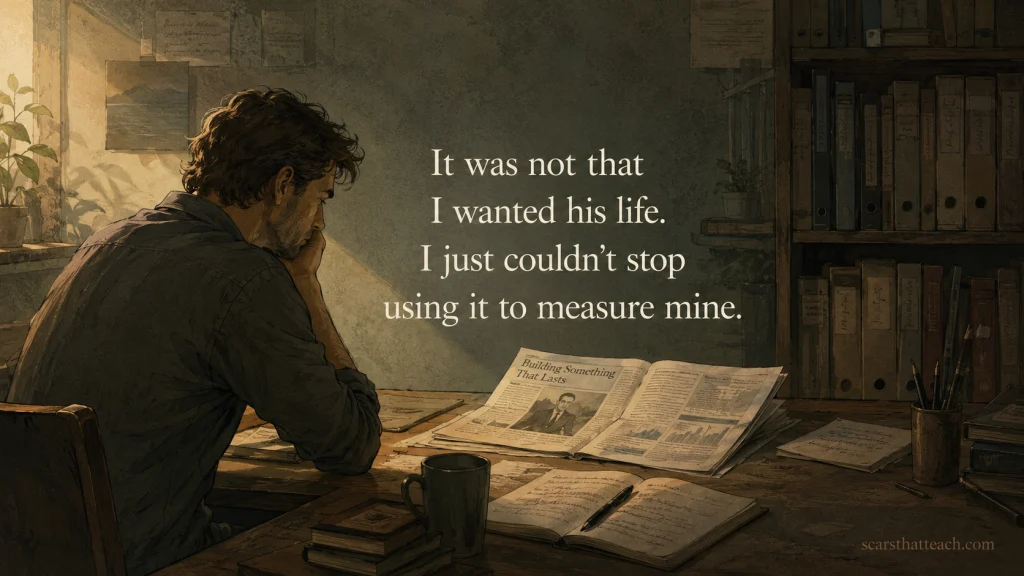
I sat with a man once who had spent the better part of thirty years measuring his career against a college friend’s. The friend had gone on to do the kind of work that shows up in profiles and announcements. My patient had built something smaller, quieter, and by most honest measures, something he was good at and that mattered to the people around him. But every few years, the friend’s name would surface somewhere, and for weeks afterward, the work that had been sustaining felt like a consolation. He said something I have thought about since: “It was not that I wanted his life. I just couldn’t stop using it to measure mine.”
That is the damage comparison does when it runs on autopilot. It is not about ambition or desire. It is about a reference point that has lodged itself into how you see what you have. And a reference point, once set, is very hard to simply decide to ignore.
The feeling of having enough is not a fixed state. It is always relative to whatever you are currently using as a standard. Change the standard, and you change what counts as enough, without changing anything else about the circumstances themselves.
When Comparison Is Not the Problem
It is worth being precise about what this is and is not. Not all comparison is destructive. Downward comparison, looking at circumstances worse than your own, has well-documented effects on gratitude and perspective, even if those effects are temporary and complicated. Comparison with your own past self, where you were a year ago versus where you are now, is a fundamentally different exercise, one that uses a reference point you actually control and that is rooted in your own trajectory rather than someone else’s.
The specific problem is upward social comparison, the kind where you are measuring your life against someone else’s, someone who appears to be ahead by whatever metric the comparison imports. And within that, the mechanism that does the most damage is not the comparison itself. It is the reference point that comparison installs and leaves behind.
Comparing your current self to your past self uses a reference point you own and can trace. It tells you something about movement, not rank. Comparing yourself to someone whose situation is genuinely instructive, because they have figured out something specific you want to learn, is a different exercise as well. The goal there is information, not evaluation. What you are taking from the comparison is a method or a lesson, not a new position on a hierarchy you now have to climb.
The reference-point problem runs hardest when you are comparing your overall circumstances to someone who appears to simply have more, with no specific reason for the comparison beyond the fact that you encountered their life. And even within that, there is a distinction worth holding: noticing a contrast is not the same as letting the contrast set a new standard you now have to clear. The first is observation. The second is the mechanism that quietly rewrites what counts as enough.
The question worth asking, when you catch a comparison happening, is not whether the comparison is fair. It is what reference point the comparison is installing, and whether you want to evaluate your life against that standard going forward. Most of the time, when people ask that question honestly, the answer is no. But by then the standard is already in place.
Why the Generic Advice Does Not Work
The usual response to comparison is some version of “be grateful for what you have” or “run your own race.” These are not wrong, exactly. But they misidentify the problem. They treat comparison as though it produces a feeling. The solution, in their logic, is to replace that feeling with a better one. What comparison actually produces is a shift in the reference point against which satisfaction is calculated. Gratitude does not relocate the reference point. It just tries to generate a competing feeling in the same moment the reference point is doing its work.
That is why gratitude practices can feel thin when comparison is running hard. You are trying to feel thankful for the house while also, somewhere just below the surface, evaluating the house against a different one. The gratitude is real. The reference point is also real. And the reference point tends to win, because it is embedded in the structure of the evaluation rather than layered on top of it.
What actually helps, when it helps, is something closer to noticing the specific reference point that a comparison has installed, and then asking whether that reference point reflects anything you actually value or whether it was imported accidentally from someone else’s life. A college friend’s career trajectory is not irrelevant, but it is also not a standard you would have chosen if you had been designing your own measure of a good life. Most of the reference points that upward comparison installs were never chosen. They arrived with the comparison and stayed.
This connects to broader questions about what actually sustains satisfaction over time, questions I’ve written about more fully in the context of never feeling satisfied, including why the feeling of enough is so difficult to hold regardless of how circumstances improve.
What to Do With This
I want to be honest about the limits here. Understanding the reference-point mechanism does not make comparison stop. The drive to evaluate your own standing against others is old and not easily overridden by knowing about it. What understanding the mechanism can do is give you a small amount of space between the comparison and the conclusion you draw from it.
The people I watched navigate this most clearly were not people who had stopped noticing others’ circumstances. They were people who had gotten very specific about which standards they actually endorsed. When a comparison happened, the question they were effectively asking was: is this a standard I would choose? Does this reference point belong in how I measure my own life, or did it just arrive because I happened to see something? That is a different question from “am I grateful enough?” and it tends to produce a different kind of clarity.
When I try to put that into something more concrete, a few questions tend to do the most work:
- Did I choose this standard, or did it arrive with the comparison?
- Is this person’s situation something I actually want, or just something that reads as more than mine?
- If I had never seen this, would I still consider my circumstances insufficient?
- What would I use to measure a good life if no one else’s were visible?
None of these questions dissolve the comparison. But they do make it harder to let a reference point you never chose quietly govern how you feel about a life you built.
This is also, it is worth saying, not something most people figure out early. The pattern I saw most consistently in people near the end of life was that they had spent decades comparing against standards they had never consciously chosen, and that the standards had shaped how they felt about choices that were actually fine, sometimes very good, evaluated on their own terms. The years spent feeling like they were behind were years spent behind a comparison that never should have been the measurement. That is one of the clearest illustrations I know of how satisfaction is not about circumstances. It is about what you are using to measure them.
If you are trying to understand why achieving things has not produced the satisfaction you expected, the reference-point shift that comparison creates is part of that picture. I’ve written about the specific version of that, where reaching a goal and feeling less than expected is its own distinct experience, at why achieving goals doesn’t make you as happy as you expected. But comparison is not the only thing that keeps satisfaction out of reach. For some people it runs in the background regardless of who they have been measuring against, and that is a different pattern with its own set of reasons. I’ve looked at that more directly in the piece on why you are never satisfied.
Final Thoughts: The Standard You Did Not Choose
The thing about comparison is that it rarely announces itself as a standard-setter. It presents as a moment of noticing. Someone else has something. Their life looks a certain way. You register it and move on. What you often do not notice is that the registration has recalibrated something. The same life you were evaluating positively an hour ago is now being evaluated against a different measure. That measure arrived with the comparison and did not leave with it.
Satisfaction is relative. That is not a failure of character or will. It is the structure of how the mind evaluates circumstances. Knowing that does not free you from comparison, but it does change what you can do with it. The question is not whether a comparison is fair. The question is whether the reference point it introduces is one you would actually choose as the standard for your own life. Most of the time, when you ask it clearly, it is not. And sometimes, simply naming that is enough to return the standard to something that actually belongs to you.
FAQs
🔍 Why does comparing yourself to others make you feel worse even when your life is objectively good?
Because satisfaction is not measured against an objective standard. It is measured against whatever reference point is currently in use. When you compare upward, the reference point shifts, and your circumstances are now being evaluated against someone else’s, which makes what was previously enough feel like less, regardless of how good it actually is.
😔 Why does gratitude not fix the way comparison makes me feel?
Gratitude tries to generate a feeling that competes with the reference point comparison installs. But the reference point is embedded in the evaluation itself, not just the feeling. Gratitude sits on top; the reference point runs underneath. That is why practicing gratitude while a comparison is actively running can feel like it is not reaching the problem.
🤔 Is all social comparison harmful?
No. Comparing yourself to your own past, or learning from someone who has figured out something specific you want to understand, is a different exercise from measuring your overall circumstances against someone else’s. The problem is upward comparison that installs a reference point you never chose, not comparison as a category.
📱 Why does social media make comparison so much harder to manage?
It compresses the timeline. In a normal day, you might encounter one or two natural comparison points. A feed gives you dozens in a few minutes, each one a possible reference point being quietly installed. The mechanism is the same. The volume is the problem.
💭 How do you stop comparing yourself to others?
You probably cannot stop it entirely, and trying to may not be the most useful goal. What tends to work better is getting specific about which reference points you actually endorse. When a comparison happens, the useful question is not “why am I comparing?” but “is this a standard I would choose for measuring my own life?” Most of the time, the honest answer is no.