The drive to compare ourselves to others is not a flaw in the way we think. It is a feature. Social psychologist Leon Festinger proposed in 1954 that people evaluate their abilities and opinions by comparing them to others, particularly when no objective standard is available, and that this is a normal process of self-calibration, not a sign of something wrong. What most practical advice on this subject gets wrong is treating comparison like a habit to break rather than a structural part of how people come to understand themselves in a social world. The more useful question is not how to stop comparing but which kind of comparison is happening and what it is actually measuring.

The Confession
Over the years I spent in hospice rooms, I heard a version of the same admission more times than I can count. Someone would describe something that had been bothering them, and somewhere in the middle of it they would say, almost as a side note: “I know, I’ve been comparing myself to others again.” Said the way you would confess to something you were supposed to have stopped doing by now. The tone was always the same. Faintly ashamed. As though this were a weakness that a more evolved person would have outgrown.
It never seemed like weakness to me. What it seemed like was someone using the wrong instrument for the wrong measurement. Not a broken person, but someone reaching for a tool and applying it to a question it was not designed to answer. That is a different problem, and it has a different solution. Before you can figure out what the right instrument is, it helps to understand why the drive to compare is there in the first place, and why it does not simply turn off when you tell it to.

What the Psychology of Comparing Yourself to Others Actually Says
In 1954, social psychologist Leon Festinger proposed what became known as social comparison theory. His argument was straightforward: people have a natural drive to evaluate their own abilities and opinions, and when objective standards are not available, they do this by comparing themselves to others. This was not, in Festinger’s framing, a pathology or a sign of insecurity. It was a description of how people actually navigate a world where most of the things that matter, how hard you should work, how much is enough, what counts as a successful life, cannot be measured with a ruler.
Some studies since have estimated that as many as 10 percent of our thoughts involve comparisons of some kind. Whether or not that specific figure holds across all contexts, the broader point is clear enough: this is not an occasional habit. It is woven into the ordinary texture of daily thinking. The person who believes they have stopped comparing entirely has almost certainly just stopped noticing when they are doing it.
Festinger also observed that people tend to compare themselves to others who are similar to them rather than to people at the extremes. This makes sense if you understand what comparison is trying to do. It is trying to locate you on a scale. A beginning runner does not learn much about their own pace by thinking about a professional marathoner. They learn by running with people who are a little faster than they are. The mind, left to its own devices, often figures this out. It is not always accurate, but it is not random either.
Upward, Downward, and the Three Reasons the Drive Persists
Research on social comparison has identified two directions the process tends to move. Upward comparison is when you compare yourself to someone you perceive as doing better. Downward comparison is when you compare yourself to someone worse off. Both directions exist for a reason, and neither is simply good or bad on its own.
Downward comparison tends to make people feel better in the short term. It was described in research by Thomas Wills in 1981 as a way people protect their own sense of worth when it is under pressure. Someone who is struggling in one area of their life may look toward people who have it harder and feel a temporary reassurance. This is not noble behavior, but it is extremely common, and it serves a function: it keeps people from collapsing under the weight of their own difficulties. Whether it does anything useful after that is a separate question.
Upward comparison is more complicated. It can motivate genuine improvement. It can also produce dissatisfaction, envy, or a persistent sense of falling short, depending on what the comparison is being used for. That difference in outcome is where the more important distinction lies. Research has identified three main reasons people engage in social comparison, and they lead to very different places:
- Self-evaluation: trying to determine where you actually stand in terms of ability, opinion, or achievement, using others as a reference point when objective measures are not available.
- Self-improvement: observing someone who has already developed something you are trying to develop, and using that observation to calibrate your own effort and direction.
- Self-enhancement: comparing yourself to someone worse off in order to feel better about your current situation, or comparing favorably on a dimension that matters to you.
The same comparison, on the surface, can be doing any of these three things. A person watching a colleague receive recognition at work might be evaluating where their own work stands, figuring out what to do differently, or reassuring themselves that they are at least better off than the colleague who got passed over entirely. Often all three are happening at once, which is part of why this is so hard to simply switch off.
Why “Just Stop Comparing” Misses What Is Actually Happening
Most of the practical advice I have seen on this subject treats social comparison psychology as a bad habit, the kind of thing you can interrupt by catching yourself in the act and redirecting your attention. The problem with that framing is that it mistakes a structural feature of human cognition for a behavior pattern you can choose to skip.
Habits can be broken because they are learned. You can learn to reach for your phone every morning, and you can unlearn it. Comparison is not quite like that. It is closer to the mechanism by which people locate themselves in a social world. The reason Festinger called it a drive and not a habit is that it operates at a more basic level: it activates when objective standards are unavailable, which is most of the time, for most of the things people care about most. How do you know if you are a good parent without observing other parents? How do you know if your grief is taking too long without some sense of how long others have taken? How do you know if your ambition is reasonable or excessive without looking at what people around you are attempting?
There is no internal ruler for these questions. Other people are the ruler. That is not a choice you can simply unmake by being more mindful about it.
What I noticed across the years I did this work, in composite rather than in any single conversation, was that the people who were hardest on themselves for comparing were not comparing more than anyone else. They were comparing in a specific way that felt bad, and then treating the comparison itself as the problem. The goal is not to stop comparing. It is worth understanding what comparing yourself to others does over time when the same comparison keeps running on the same track, because that is where the damage tends to accumulate.
The Instrument and the Measurement
This is where the question becomes more useful. Not whether you are comparing, but what the comparison is trying to measure, and whether it can actually measure that.
A person who is new to a skill and compares themselves to someone slightly ahead of them is using comparison for what it does well: locating the edge of their current competence and finding direction. That is comparison as calibration. It produces information. It tells you something you can act on.
A person who has been doing a job well for twenty years and compares their ordinary life to a neighbor who started a company and sold it at forty-five is using comparison as a scale for measuring their entire worth as a human being. That is comparison applied to a question it cannot answer. No comparison can tell you whether your life is enough, whether you made the right choices, or whether you are a good person. It was not built for those questions. Applying it to them does not produce information. It produces a feeling, and the feeling is almost always inadequate.
The people I sat with who carried the least regret about this particular habit were not the ones who had stopped comparing. They were the ones who had, at some point, recognized what comparison could and could not tell them. The ones who used it for self-evaluation and self-improvement, who stopped applying it as a verdict on their worth. That shift is quieter and more durable than any advice about stopping. It is also harder to make, because it requires looking honestly at what you are actually using the comparison for, which most people find uncomfortable.
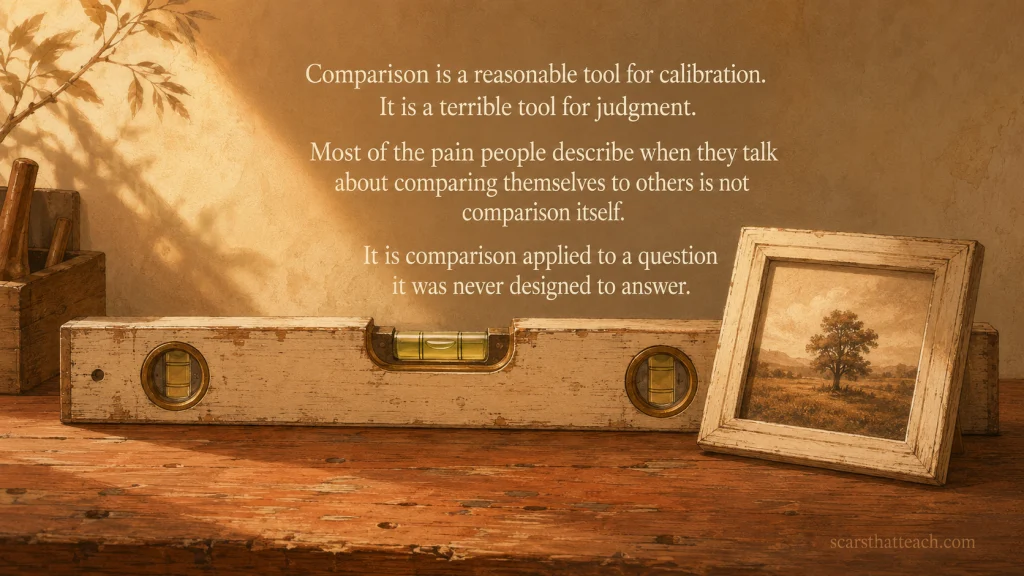
“Comparison is a reasonable tool for calibration. It is a terrible tool for judgment.”
There are words that cut through this more cleanly than any explanation. Some of the clearest words about self-worth and what comparison cannot measure come from people who worked this out the hard way. They are worth sitting with.
What People Almost Always Get Wrong About This
The most common mistake I have seen, and the one that causes the most persistent difficulty, is the belief that the goal is to feel good about yourself relative to others. This is the frame that comparison tends to pull people into, and it is also the frame that makes the comparison most painful. If the goal is to feel good about yourself relative to others, then comparison can never fully succeed, because there is always someone doing better at something. The frame itself guarantees dissatisfaction.
The people who get stuck most deeply are not those who compare too often. They are those who have never examined what they are trying to find. They compare in order to determine their worth, receive a result that is ambiguous or unflattering, and conclude that they need to compare more carefully or more broadly, with different people, in different domains, until they find a version of the comparison that settles the question. The question does not get settled. It never does when comparison is being used for something it cannot do.
Understanding why you compare at all is the more honest starting point. Whether the drive is pointing toward calibration, toward improvement, or toward reassurance tells you something about what you actually need at the moment. None of those are wrong needs. They just require different responses. Comparison, used carefully and aimed at the right target, is a reasonable instrument. The work is recognizing which measurement you are actually trying to take, and whether comparison is the right tool for it. When it is not, and sometimes it clearly is not, knowing that is itself useful. It tells you what to look for instead. The question of when comparison shifts into something that genuinely damages you over time is a different conversation and worth having separately if that is what you are noticing.

Final Thoughts: The Drive That Does Not Turn Off
The title of this piece says the drive never fully turns off. That is not meant as discouragement. It is meant as relief. If comparison is structural rather than a personal failing, then the goal of eliminating it entirely is the wrong goal. You are not supposed to stop comparing. You are supposed to understand what you are comparing, and why, and whether the thing you are measuring has any relationship to the question you are actually trying to answer.
What I found, across many years of sitting with people who were working through exactly this, is that the most useful shift is not a change in behavior. It is a change in what the behavior is for. A person who compares in order to evaluate and improve is using the same mechanism in a completely different way than a person who compares in order to determine whether they are enough. The first is manageable. The second will not resolve, because comparison cannot answer that question, no matter how many times or against how many people you apply it.
You will compare yourself to others. That will probably never stop. What can change is what you do with the comparison once it arrives: whether you treat it as a verdict or as a data point, and whether you have the presence of mind to notice which question you were actually trying to answer.
FAQs
🔍 Why do we compare ourselves to others even when we know it makes us feel bad?
Because the drive to compare is not primarily about feeling good. It is about locating yourself relative to others when no objective standard is available. That function does not switch off just because the result is uncomfortable. What changes when comparison becomes more manageable is not the frequency. It is understanding what you were trying to find out and whether comparison was ever going to tell you that.
🧠 What is social comparison theory, and who came up with it?
Social comparison theory was developed by psychologist Leon Festinger in 1954. The core idea is that people evaluate their abilities and opinions by comparing themselves to others, especially when objective standards are not available. This is not a description of a flaw. It is a description of how people naturally orient themselves in a social world where most of the meaningful questions do not have objective answers.
📊 Is comparing yourself to others ever actually useful?
Yes, in specific situations. Comparing yourself to someone slightly ahead of you in a skill you are developing gives you a realistic benchmark and direction. Comparing your behavior to someone who handles a difficult situation well can show you something concrete to try. The difference between useful comparison and painful comparison is usually what question the comparison is being asked to answer. Calibration and improvement are questions it can handle. Worth and enoughness are not.
💭 What is the difference between upward and downward comparison?
Upward comparison is comparing yourself to someone doing better in some way. Downward comparison is comparing yourself to someone worse off. Both happen naturally. Downward comparison tends to produce short-term reassurance. Upward comparison can motivate improvement but can also fuel dissatisfaction, depending on what the comparison is being used for. Neither direction is inherently wrong. What matters is the purpose.
🛑 Can you ever actually stop comparing yourself to others?
Probably not entirely, and trying to is likely the wrong goal. The drive to compare is structural, not habitual. People who describe having stopped usually mean they have stopped noticing it or stopped using it as a verdict on their worth. That is a meaningful shift. It is just not the same as elimination, and pretending it is sets an unrealistic standard that itself becomes another way to feel inadequate.
⚖️ When does social comparison become genuinely harmful?
When it is consistently being used to answer a question it cannot answer, specifically the question of whether you are enough. Comparison that runs on that track tends to escalate rather than resolve, because there is always a more unfavorable comparison available. If what you notice is not occasional dissatisfaction but a persistent pattern of feeling worse after comparing, that is worth looking at more closely as a separate question.