Most adults know, in a general way, that their past has shaped them. What is harder to see is how specifically that shaping happened with money, not through conscious choices or character flaws, but through messages absorbed so early they never registered as messages at all. This piece covers how those early signals form, why they function differently from beliefs developed later in life, and what becomes possible once you can see the mechanism clearly.
The Question That Reveals More Than a Budget Ever Could
The most useful question I ever heard asked in a conversation about money was not about income, spending, or savings. It was: What did the adults around you say when money was tight? The answer, almost every time, explained everything else.
I spent over twenty years as a hospice chaplain, sitting with people at the end of their lives and the families surrounding them. Money was not the primary subject of those conversations, but it surfaced constantly, woven through regrets about choices made, relationships strained over finances, patterns that had repeated across a lifetime without anyone naming what was driving them. What I noticed, more times than I can count, is that the people who had the clearest understanding of their own financial behavior were the ones who had learned to trace it back. Not to their income level, not to specific decisions, but to what they had absorbed before they were old enough to question anything at all.
The childhood money beliefs that follow us into adulthood are not quirks or personal failings. They are the logical result of a process that happens to every person raised in a household with adults who had feelings about money. Which is to say, every person.
Where Money Mindset Comes From: What the Household Taught Without Meaning To
Children absorb information about money long before they understand what money is. The tone of voice a parent uses when a bill arrives. Whether the adults in the house argue about finances privately or loudly. The phrases that become household refrains: we can’t afford that, money doesn’t grow on trees, rich people are just lucky, never talk about what you earn. These are not just things that were said. They are a framework, assembled piece by piece before a child has the cognitive tools to evaluate whether the framework is accurate.
If the adults around you treated money as a source of constant danger, that is likely the emotional register money still carries for you. If the household message was that wanting more than you had was shameful, you may find yourself uncomfortable with financial ambition in ways you have never been able to fully account for. If money was talked about as something that always ran out, that scarcity pattern can persist even in circumstances that objectively do not warrant it. Research from financial psychology confirms what was evident in those hospice conversations: your money mindset is shaped by upbringing, cultural influences, past experiences, and personal beliefs, and if the adults around you found money stressful, the same worry tends to transfer.
Silence is a message too. Some households never talked about money at all, which teaches its own lesson: that money is either too stressful or too shameful to discuss openly. Adults raised in those households often describe a kind of free-floating anxiety around financial topics, a discomfort they cannot trace to any specific event because it was ambient, always present, never named.
The specific messages vary. The mechanism does not. Here are some of the most common family money beliefs that show up in adult behavior:
- Scarcity as a default: “There’s never enough” — absorbed from a household that was genuinely stretched, or from adults who felt perpetually anxious regardless of the actual circumstances.
- Money as moral risk: “Having too much makes you greedy” or “wealthy people can’t be trusted” — often rooted in religious or cultural frameworks the household carried.
- Money as too private to discuss: Financial topics treated as shameful to the point of secrecy, leaving children with no framework for navigating money conversations as adults.
- Money as love or safety: Households where money was the primary expression of care, gifts instead of presence, teaching that financial giving is what security looks like.
- Abundance as unsafe: “Enjoy it while it lasts” or spending immediately when money arrived, because experience taught the adults that it would not stay — and that message transferred.
None of these represent character flaws in the person who carries them now. They represent what a child was given to work with. That distinction matters more than it might initially seem.
Why Childhood Money Beliefs Are Harder to Revise Than Beliefs Formed Later
This is the part that most writing on financial patterns tends to leave out, and it is the part that actually explains why knowing something intellectually does not automatically change behavior.
Beliefs formed in adulthood arrive with a certain amount of scaffolding. You encounter an idea, weigh it against what you already know, and either accept it or push back. The critical evaluative faculty is present. Childhood is different. The messages absorbed in early life arrive before that faculty exists. They are not processed as opinions to be evaluated. They register as the way things are, baseline facts about how the world works, and that means they function as assumptions rather than beliefs. An assumption does not announce itself as something to question. It just filters everything else.
The person who earns a comfortable income and still feels a persistent, low-level anxiety about financial security is often not responding to their actual circumstances. They are responding to an earlier template. The template was never examined because it was never visible as a template. Research on this confirms what I watched play out in those hospital rooms: money scripts absorbed in childhood tend to operate below awareness, which is precisely why repeating a new, more optimistic belief on top of them tends not to work. The old one is still running.
I sat with enough families in those final weeks to see this pattern transfer across generations. A woman in her sixties, watching her father die, described spending decades managing her own household the way she had watched her mother manage theirs: every purchase justified, every expense logged, every small pleasure quietly preceded by guilt. Her mother had lived through genuine scarcity. She had not. The template transferred anyway, intact, because it had never been identified as a template in the first place. It had just been called the right way to be careful with money.
The gap between knowing something and being able to act differently on it is almost always a gap in legibility. The belief has to become visible before it can be examined. And a belief absorbed before critical thinking was possible has had decades to become invisible, woven into how decisions feel rather than how they are consciously made.
What Making the Pattern Legible Actually Does
I want to be careful here about what I am and am not saying. Tracing a financial behavior back to a childhood message does not erase the behavior. Understanding where something came from is not the same as being free of it. What it does is give you a more accurate account of what you are dealing with, and that changes the nature of the work considerably.
Someone who grew up in a household where money was a constant source of stress and now finds themselves anxious every time a larger purchase is needed is not being irrational. They are being historically accurate, responding to a pattern that was real in a context where it no longer applies in the same way. Naming that, even just privately, shifts the question from what is wrong with me to what was I taught, and does it still hold. That is not a small shift.
The common mistake is reaching for replacement. People encounter this kind of framework and immediately try to overwrite the old belief with a new one, using affirmations or deliberate positive thinking as a substitute. The result is usually a surface-level overlay on something much older and more deeply embedded. The assumption underneath does not disappear because a newer, more optimistic statement has been placed on top of it. It tends to reassert itself under pressure, when things feel uncertain, when the old emotional triggers surface.
What tends to work better, in my observation, is not replacement but examination. Asking, with genuine curiosity rather than judgment: where did I first learn this? What were the circumstances? Was the person who taught it to me responding to their reality, or to something older they had inherited themselves? That kind of inquiry does not require a therapist’s office, though for some people the patterns are layered enough that professional support genuinely helps. It requires enough honesty to look at something you have been treating as a fact and ask whether it is actually just a story that was handed down.
There is something clarifying about putting a name to what you have been carrying without language for it, and the right quote or observation sometimes does that work faster than analysis alone. What it cannot do is fix the thing. But it can make the thing something you can see and hold at a distance, rather than something operating on you without your awareness.
Final Thoughts: The Pattern Is Not the Verdict
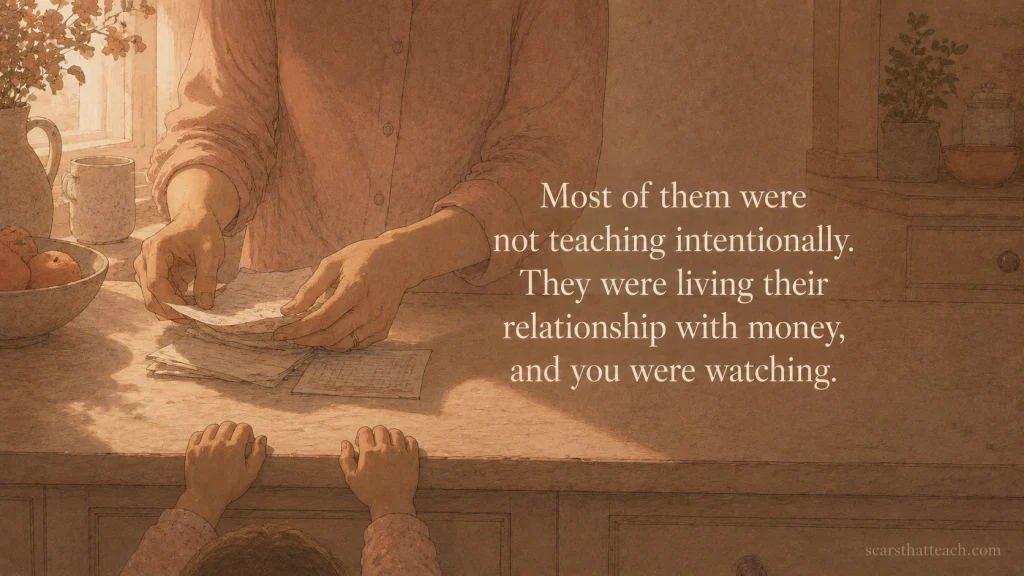
The adults who shaped your early understanding of money were themselves shaped by the adults who came before them. Most of them were not teaching intentionally. They were living their relationship with money, and you were watching. That is not an excuse for anything that followed, and it is not an indictment of anyone. It is just what actually happened.
What you do with that understanding is yours to decide. Some people find that naming the origin loosens its grip considerably. Others find the pattern stubborn enough to warrant working through with a financial therapist or counselor, someone who specializes in exactly this intersection of money and emotional history. Neither path requires you to have had a different childhood or to be a different kind of person. Both start with the same thing: seeing clearly what was absorbed, and asking honestly whether it still fits.
If you want to go deeper on how financial attitudes and beliefs develop and compound over time, the other pieces on understanding your money mindset cover the terrain from different angles, including what it looks like to begin changing your relationship with money once you have identified where it came from.
FAQs
🧠 How does childhood affect your relationship with money?
The adults in your household modeled a relationship with money — through what they said, how they behaved, and what they avoided talking about — before you had the capacity to evaluate any of it critically. Those absorbed patterns become the default emotional framework for financial decisions made in adulthood, often without awareness that they came from somewhere specific.
😰 Why do I feel anxious about money even when I am doing fine financially?
Financial anxiety is not always a response to your current situation. If scarcity or money stress was a constant in the household where you grew up, the emotional pattern can persist long after the circumstances that created it have changed. You may be responding to an older template, not the one in front of you right now.
🔄 Can you actually change money beliefs that came from childhood?
Yes, but not usually by replacing them with new statements. The more durable path is examination: understanding where the belief came from, what it was responding to at the time, and whether it accurately applies now. For deeply entrenched patterns, a financial therapist can be genuinely useful. Change is possible, but it is slower and more honest than an affirmation.
👨👩👧 What are common money beliefs children absorb from their families?
The most recurring ones involve scarcity (“there’s never enough”), moral suspicion of wealth (“rich people are greedy”), shame around financial topics, and money treated as a proxy for love or security. They tend to operate as assumptions rather than opinions, which is what makes them harder to notice and examine in the first place.
🪞 How do I know if my money habits are coming from childhood rather than my current situation?
One signal: the emotional response feels disproportionate to what is actually happening. If a routine financial decision produces anxiety, guilt, or avoidance that does not match the objective stakes, it is worth asking whether the feeling is responding to the present or to something older. Tracing it back, asking where you first experienced this feeling around money, often reveals the source.