One of the heaviest sentences I ever heard in a hospice room was not I made a mistake. It was I think I spent my life becoming someone I never meant to become, said quietly, with the exhaustion of a person who had taken years to admit it out loud. Feeling like you wasted your life is not the same as regretting one decision. It is a global, identity-level ache, and it deserves an honest answer rather than a quick reassurance that it is never too late. Part of what you lost is not coming back. But the fact that you can name what feels wasted is telling you something important about what still matters to you, and that information is worth using.

The Sentence That Took Years to Say Out Loud
He was in his sixties, sitting across from a man he was visiting in hospice care, and I happened to be nearby when he said it. Not I made a mistake. Something heavier. I think I spent my life becoming someone I never meant to become. He did not say it with anger. He said it flat and quiet, the way people talk when a thought has been sitting in them so long it has stopped feeling like a thought and started feeling like a fact. It had clearly taken him years to admit that sentence to himself, let alone say it to another person.
I have heard versions of that sentence more times than I can count over the years, and it never sounds like a specific regret. It sounds like an entire stretch of life, sometimes decades of it, being looked back on and found to have gone somewhere the person never actually meant to go. That is a different kind of pain than wishing you had made one different choice. It is the sense that a whole chapter, or several, added up to a life that does not match who you thought you were supposed to become.
What Research on Regret Actually Finds
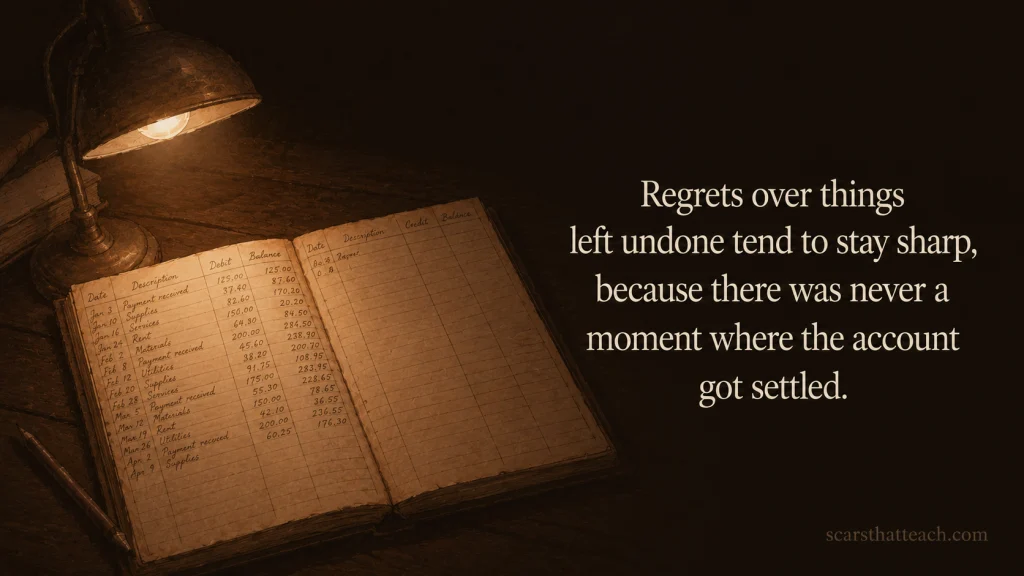
Extensive research into what people regret most, including large surveys collecting tens of thousands of personal regrets from people around the world, finds a consistent pattern. The regrets that persist longest and cut deepest are rarely about specific errors. They cluster around inaction: chances not taken, risks not run, the version of a person’s life that could have unfolded if they had made a different choice at some fork in the road. As people age, this pattern gets stronger rather than weaker. Regrets over things done tend to fade with time, in part because actions can often be explained, apologized for, or corrected. Regrets over things left undone tend to stay sharp, because there was never a moment where the account got settled.
This matters for understanding why the wasted-life feeling hits the way it does. It is rarely built from a single bad decision. It is usually built from years of small deferrals, a version of yourself that kept getting postponed in favor of what felt safer or easier at the time, until the gap between who you meant to become and who you actually became grew wide enough to notice all at once. That gap is what people are naming when they say they wasted their life. Not one mistake. An accumulated drift.
Two Things That Are Both True at Once
Most of what gets written about this feeling responds with reassurance. It is never too late. You can still change. Start today. I understand the instinct behind that response, and sometimes it is even accurate. But offered as a blanket answer, it tends to feel hollow to the person actually carrying this weight, because part of what they are grieving is real and cannot be undone by a change of attitude. Years genuinely pass. Some doors genuinely close. Telling someone in their sixties that it is never too late to have the career, the family, or the decades of a different life they wanted can sound less like comfort and more like a refusal to take their loss seriously.
The more honest response holds two things at once, without collapsing either into the other. Some time really is gone, and pretending otherwise does not help anyone.
At the same time, the fact that a person can identify exactly what feels wasted is not a verdict on the rest of their life. It works more like a map. The specific shape of what someone regrets, what they wish had gone differently, what version of themselves they feel they lost track of, traces out a fairly precise picture of what they actually value. Most people do not have that picture handed to them clearly very often. Regret, as painful as it is, hands it over in sharp detail.
The man who told me he had spent his life becoming someone he never meant to become was not, underneath that sentence, actually asking whether it was too late. He already knew some of it was too late, and he was not looking for me to argue him out of that. What he needed was somewhere to put the grief of it, and eventually, some way to hear what that grief was actually telling him about who he still wanted to be with whatever time was left. Those are two different needs, and confusing them with each other rarely helps.
The feeling that you wasted your life is not a verdict. It is grief pointing directly at what you still care about, even after everything.
Reading the Feeling for What It Actually Says
If you sit with this feeling honestly instead of rushing to either despair or forced optimism, it usually has something specific to say. Someone who feels they wasted years in a career that never fit them is often, underneath that, still carrying a clear picture of the work that would have fit. Someone who feels they wasted their youth being too cautious is often still carrying a real appetite for the boldness they never let themselves have. Someone who feels they wasted years staying in a marriage that had already gone quiet, or years spent caregiving for a parent while their own life waited outside the door, is usually carrying just as clear a sense of what they needed and did not get to have. The feeling usually points somewhere specific. It has a direction, and that direction points at exactly what you still wish you had more of.
A few honest questions tend to surface that direction faster than sitting in the general ache does:
- What specifically comes to mind first when you say your life feels wasted, a career, a relationship, or a version of yourself that never had the chance to emerge?
- What would the years have looked like if they had gone the way you actually wanted?
- Is there a value hiding underneath the regret, connection, boldness, honesty, that you still have a chance to act on now?
- What would it look like to honor that value in a smaller way today, even without getting the original years back?
This does not erase the loss of the years themselves. It reframes what those years are for now. A person cannot get back a decade spent in the wrong career, but they can take seriously what that decade showed them about what actually matters, and let that shape whatever time remains rather than letting the years already spent become the whole verdict. What was lost stays lost. What it uncovered does not have to be lost along with it.
I want to be careful here, because this is not the same as saying every regret can be repaired or every lost chapter can be rewritten. Some things genuinely cannot be recovered, a parent who died before an apology was made, a decade of health that will not come back, a window for having children that has closed. Naming what a regret reveals about your values is not a promise that you can act on all of it. Sometimes what it reveals can only be honored in a different form, through different choices, for different people, in whatever time is left. That is a smaller consolation than getting the years back, and it is still a real one.
When This Feeling Becomes Something Heavier
There is a difference between reflective regret, painful but bearable, and a hopelessness that has stopped feeling survivable. If the sense that your life has been wasted has tipped into something that feels less like grief and more like there is no reason to keep going, that is no longer a question this kind of reflection can answer, and it deserves real support, not an article. A doctor, a therapist, or a crisis line is the right next step in that case, and reaching out is not a failure of the reflection above. It is simply what the moment calls for instead.
For most people, though, what they are carrying is closer to what that man in the hospice room described. Heavy, honest, and worth sitting with, but not a closed door. The years behind you are what they are. What you do with what they have shown you about yourself is still, for now, an open question.
Final Thoughts: The Years Were Not Nothing
I never told that man his years were not wasted, because I do not think that would have been honest, and he would have known it. What I told him instead was that the person who could name, with that much precision, exactly who he never meant to become was not actually lost. That precision was proof that some part of him had never stopped tracking who he actually wanted to be, even through all the years he spent somewhere else. The waste is real. So is the part of you that still knows the difference. That same thread, the part of a person that keeps track of who they meant to be even through failure, runs through much of what I have gathered in this collection of reflections on failure and what it teaches. For more on carrying regret and what it can teach, there is a broader collection of writing on lessons learned too late worth working through alongside this. It also helps to understand why inaction tends to cause more lasting regret than action, since that pattern shapes much of what this global sense of waste is usually built from.
FAQs
💭 Why do I feel like I wasted my whole life?
This feeling usually builds from years of small deferrals rather than one mistake, a widening gap between who you meant to become and who you actually became. It is often less about a single decision and more about an accumulated drift over time.
⏳ Is it true that it’s never too late to change?
Not entirely, and pretending otherwise can feel dismissive. Some time and some opportunities really are gone permanently. What remains true is that the years already spent can still inform how you use whatever time is left.
🔍 What does it mean if I can clearly name what I regret?
Being able to name a regret precisely often reveals what you actually value, even after years away from it. That clarity is information about your priorities, not a final judgment on the rest of your life.
⚠️ When does this feeling need more than reflection?
If the sense of a wasted life turns into hopelessness about the future rather than grief about the past, that calls for real support from a doctor, therapist, or crisis line, not self-reflection alone.