How to start over when you have nothing is a different question than how to start over after a setback. When someone says they have nothing left, they are rarely talking about a literal inventory of possessions. They are describing something quieter and heavier: the sense that they no longer have any internal evidence that they are capable of building something from what remains. This piece walks through why that specific kind of emptiness disorients people so completely, why turning it into a resource checklist misses the point, and what the first honest move actually looks like when there is no proof yet that rebuilding is even possible.

What People Actually Mean When They Say They Have Nothing
I have sat with people who used almost the same sentence, in different rooms, years apart. I have nothing left. At first I assumed they meant it literally: no savings, no job, no place to live. Sometimes that was part of it. But more often, once I asked what nothing actually meant to them, the answer was not about possessions at all. It was about the terrifying absence of proof that anything could still be built from what remained.
That distinction matters more than it sounds like it should. A person who has lost their savings but still believes they know how to earn money again is in a different position than a person who has enough money for now but no longer believes they are capable of building anything that lasts. This piece is written for that second condition, the specific despair of beginning again without a single shred of internal evidence that you can navigate what comes next.
Why This Feels More Disorienting Than an Ordinary Setback
Most versions of starting over still leave something intact. A person who loses a job usually still has a sense of who they are at work. A person who ends a relationship usually still has friends, routines, an identity outside the relationship that survived it. What makes starting over with nothing distinct is that several of those anchors go missing at once: no money, no network, no clear sense of identity, no momentum carrying the next step forward.
Researchers and clinicians who study major life disruption describe this as a specific kind of psychological disorientation, separate from ordinary stress. When enough anchors disappear at the same time, the mind loses its usual reference points for judging whether things are survivable. The circumstances alone are not what makes it so hard. What makes it hard is that the person no longer has an internal system for measuring what hard even means anymore, because the systems they used to rely on for that measurement have gone quiet along with everything else.
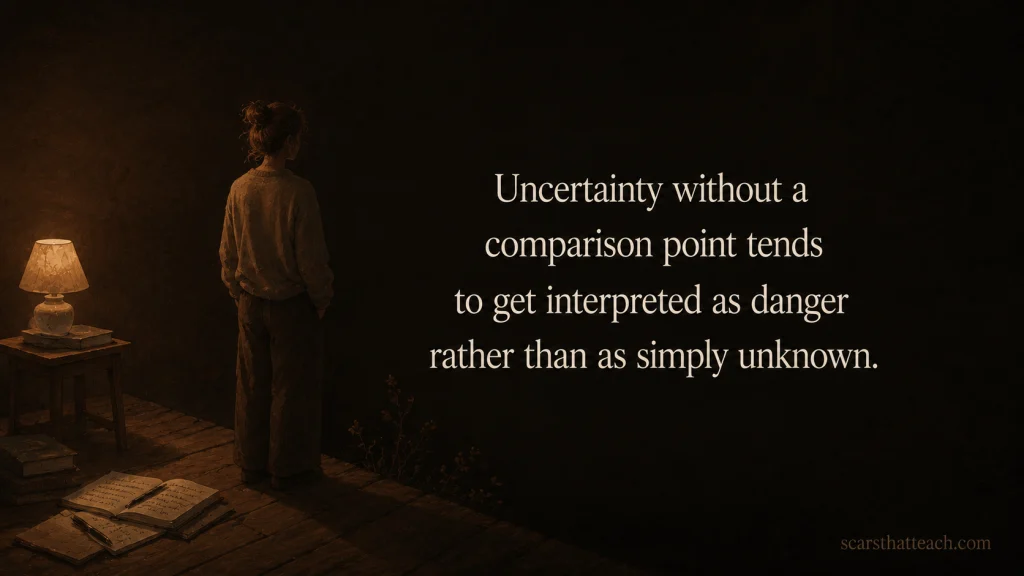
There is a mechanical reason this pushes past ordinary stress. Confidence about the next step usually comes from recalling recent evidence of competence, some memory of handling something similar and getting through it. When someone has lost that recall, whether because too much has changed too fast or because the losses have piled on top of each other, the mind has nothing recent to compare the next step against. Uncertainty without a comparison point tends to get interpreted as danger rather than as simply unknown. That is the difference between facing a hard problem and facing a hard problem while also distrusting your own ability to size it up correctly.
This is different from what gets covered when someone is figuring out where to begin after life falls apart in a more general sense. That version usually still has some scaffolding left standing. What this piece is naming is the version where the scaffolding itself feels gone, not just the structure it used to hold up.
Why the Usual Advice Misses the Real Problem
Most advice aimed at people starting over with nothing turns quickly into a resource checklist. Update your resume. Reach out to old contacts. Set a budget. None of that is wrong exactly, but it assumes the person already has the internal belief that action leads somewhere, and that belief is precisely what feels missing when someone says they have nothing left. A checklist handed to someone who does not yet trust their own capacity to rebuild tends to feel like being asked to run before anyone has confirmed the legs still work.
The other common approach is an appeal to resilience. You have survived hard things before, you can survive this too. That can be true, and it is not unkind to say. But it rarely lands the way it is meant to, because it asks the person to draw on remembered competence they currently feel disconnected from. Telling someone to trust their own resilience does not work when the entire experience of having nothing is the feeling that the confidence behind that resilience has gone missing.
The Smallest Viable Claim, Not the Whole Rebuild
The more honest starting point is smaller than either of those approaches, and it asks for less. When someone genuinely feels they have nothing, the first task is not to design the whole future. It is to find one small action that makes some claim on what still matters to them, not as proof that recovery has begun, but simply as a sign that some capacity to choose still exists inside the situation.
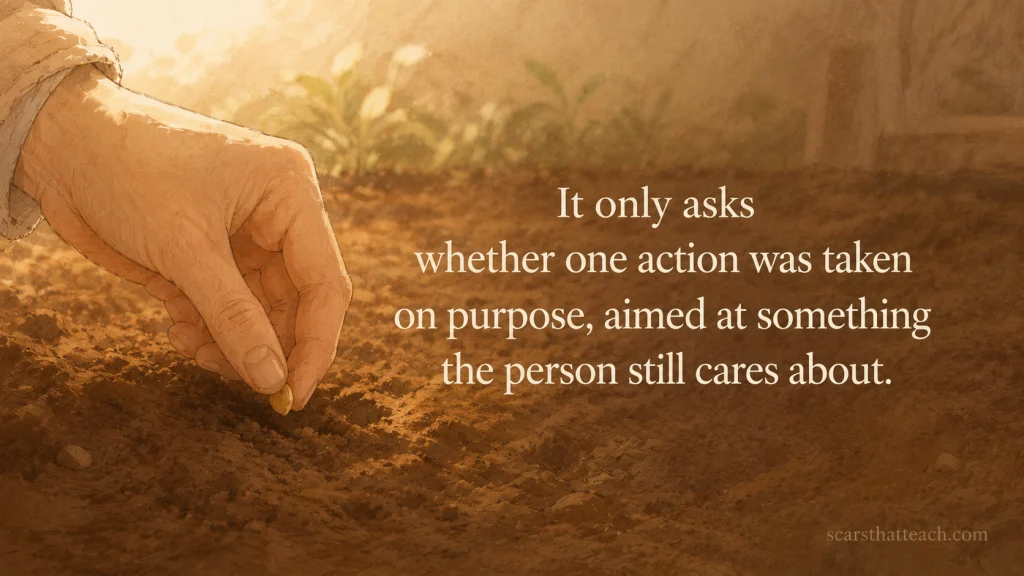
That distinction, proof of recovery versus a small demonstrated capacity to act, is the part most guidance skips past. Proof of recovery is a heavy standard. It asks for a result: a new job, a stable place to live, a sense that things are working again. A demonstrated capacity to act asks for almost nothing by comparison. It only asks whether one action was taken on purpose, aimed at something the person still cares about, regardless of whether it changes the overall picture yet.
What that action looks like depends entirely on what still matters to the person, which is why generic advice struggles here. For one person it might be calling someone they have avoided out of shame. For another it might be cooking one real meal instead of skipping it again. For another it might be writing down, honestly, the one thing they still want, even if they have no plan yet for reaching it. None of these fix the larger situation. What they do is interrupt the belief that nothing can be acted on at all, which is usually the belief doing the most damage at this stage, more than the actual lack of resources.
A few signs tend to show that this smallest claim is actually happening, rather than being skipped in favor of waiting for motivation to arrive first:
- The action is small enough to complete today, not a plan that depends on conditions improving first.
- It connects to something the person still genuinely values, not something borrowed from someone else’s advice.
- It does not require feeling ready or hopeful beforehand, only being willing to do it once.
- It is judged by whether it happened, not by whether it changed anything measurable yet.
Where People Get Stuck Trying to Rebuild From Nothing
The most common mistake I see is waiting for some internal signal, a return of hope or confidence, before allowing themselves to act. That signal is not required, and for many people it does not arrive first. It tends to arrive after a few small actions have been taken, not before, because the act of choosing something on purpose is often what produces the feeling of hope, rather than the other way around.
The second mistake is measuring the first action against the size of the problem. Someone starting over with no support and no clear identity will often dismiss a small step as pointless because it does not come close to solving the whole situation. But the smallest viable claim was never meant to solve the whole situation. It was only meant to interrupt the belief that nothing at all could be done, which is a smaller and more solvable problem than it first appears.
Final Thoughts: You Do Not Need Proof to Begin
The people I sat with who eventually rebuilt something real almost never described a moment where proof arrived first. They described one small action, taken without evidence that it would lead anywhere, that quietly reminded them agency was still theirs. Starting over when you have nothing does not require the whole future to be visible. It requires one claim on what still matters, made honestly, without waiting for permission from a feeling that has not shown up yet. If what you are carrying right now feels heavier than you can hold alone, that is worth bringing to someone who can support you through it, not just something to work through in isolation.
Not everyone starting over is starting from this specific bottomed out place. If your situation still has some scaffolding left standing, it may be more useful to look at how to start over after life falls apart in a broader sense. And once the smallest claim on agency has been made a few times, questions about direction tend to surface next, which is what finding purpose while starting over addresses. For other reflections on beginning again, there is more written on starting over as a broader subject, alongside thoughts on failure that speak to the same terrain.
FAQs
🕳️ What does it actually mean to start over with nothing?
It usually means more than losing money or possessions. Most people describing this are talking about losing the internal proof that they are capable of building anything from what remains, which is a different and heavier kind of loss.
🧭 Why does this feel so much more disorienting than a normal setback?
Because several anchors tend to disappear at the same time: money, network, identity, and momentum. When that many reference points go missing together, the mind loses its usual way of judging what is survivable.
✅ Why doesn’t a checklist or a resilience pep talk help when things feel this bad?
Both approaches assume you already believe action leads somewhere. When you feel you have nothing left, that belief is exactly what feels missing, so advice built on top of it tends to fall flat no matter how well intended it is.
🌱 What should the first step actually be?
One small action tied to something you still genuinely care about, done as evidence that agency still exists, not as proof that recovery has started. It does not need to change anything measurable yet to count.
⏱️ Do I need to feel hopeful before I start acting?
No. Hope tends to follow a few small actions rather than arrive first. Waiting for the feeling before allowing yourself to act is one of the most common ways people stay stuck longer than they need to.