
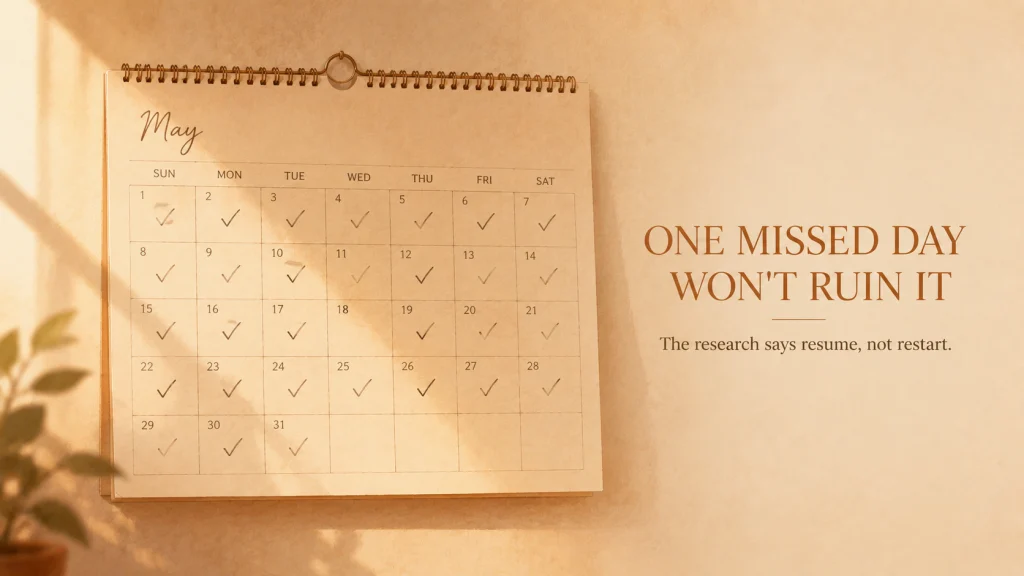
Missing a day will not ruin your habit, and the research on habit formation backs that up directly. Most advice treats a missed day as a setback that has to be earned back through extra effort or a fresh start. The actual study on this question found something calmer: skipping a single opportunity to perform a new behavior did not meaningfully affect how the habit formed over time. This piece walks through what that research actually says, why streak culture teaches the opposite, and what to do with a missed day instead of treating it as the end of the effort.
The Day People Point to When They Quit
Over the years I have talked with a number of people who had given up on something they once cared about, whether it was exercise, prayer, calling a parent, or simply getting out of bed at a decent hour. When I asked what happened, an unusual number of them pointed to one specific day. Not a bad month. Not a slow decline. One missed day, as if the whole effort had been a streak that needed protecting rather than a process that needed time.
That belief is common, and it is also not supported by the research on how habits actually form. What the science actually found is more forgiving than most people expect, and it changes what a single gap should mean going forward.
What the Research Actually Found
The most frequently cited study on this question comes out of University College London, led by Phillippa Lally and her team in 2010. Researchers tracked participants forming new habits over several months and measured how consistently the behavior was repeated. One of the findings gets far less attention than it deserves: when participants missed a single opportunity to perform the new behavior, that missed occasion did not meaningfully disrupt the overall habit formation process.
In plain terms, one skipped day did not reset anything, and it did not derail the process the way most people assume it does. The habit was still forming in the background across the weeks and months that followed, largely unaffected by that single gap. This runs directly against how most people talk about habits day to day, where a missed day gets treated as proof the whole attempt has failed.
Habit apps built around streak counters, productivity blogs promising a fresh 21-day or 66-day countdown, and the general language of “starting clean” all point the same direction: treat any gap as a failure that has to be earned back. That framing comes from somewhere real. Nobody wants to lose the progress they have made. But it is not what the actual research on the subject points to, and treating a single missed day like a crisis tends to cause more damage than the missed day itself ever did.
Resuming Is Not the Same as Starting Over
This finding matters because it reframes the entire question a person asks themselves after a missed day. The usual question is did I miss a day, as though the answer determines whether the whole effort still counts. The research suggests a better question: am I still repeating this behavior in this context over time. One missed occasion barely moves the needle on that second question, even though it feels like it moves everything on the first.
That distinction changes what a missed day actually requires from you. Starting over implies the previous effort is gone, that whatever ground was gained has to be earned back from the beginning. Resuming implies something much smaller: the behavior is still yours, it just did not happen yesterday, and it can happen again today without any penalty attached. Streak culture, with its calendars full of unbroken chains and app notifications counting consecutive days, teaches the first framing constantly. The research supports the second one.
A related but narrower pattern shows up when people talk about the shame and failure cycle that can build up around discipline in general, or the sharper collapse some people describe after breaking a long streak, where one gap suddenly feels like it undoes an entire identity. Those are real experiences and worth their own attention elsewhere. What the Lally research is pointing at here is smaller and steadier: the actual mechanics of habit formation simply tolerate a missed day better than most people assume.
A few things tend to be true for people who get back to the behavior well after a gap, rather than treating it as a reason to abandon the habit entirely:
- They return to the behavior the next available opportunity, without waiting for a symbolic restart date like a Monday or the first of the month.
- They do not try to make up for lost time with an exaggerated effort that is hard to sustain again tomorrow.
- They judge progress by the pattern across weeks and months, not by whether any single day was perfect.
- They separate the gap from their sense of identity, rather than letting it redefine who they believe they are.

Why a Single Day Feels Bigger Than It Actually Is
Streak culture did not appear out of nowhere. Counting consecutive days gives the mind something concrete to hold onto, a visible number that goes up when things are going well and drops back to zero the moment they do not. That visibility is exactly what makes it so persuasive, and exactly what makes it a poor match for how habits actually form. A streak counter treats every day as equally decisive. The research on habit formation does not, because that is simply not how the underlying process works.
Habit formation is, at its core, a statistical process rather than a ceremonial one. Each repetition of a behavior strengthens the association between a situation and a response, a cue and an action, a little more each time. That association builds up gradually across dozens of repetitions, and it does not depend on any one repetition happening flawlessly. A single missed day removes one data point from a pattern built out of many. It does not erase the pattern, because the pattern was never stored in that one day to begin with.
This is different from how a ceremony works, where missing the one required occasion means the ceremony simply did not happen. Habits are closer to a language you are learning by using it often than a ritual you either perform correctly or fail. A missed conversation in a language you are learning does not erase the vocabulary already built up in your memory. The brain seems to respond to that same logic with behavior: it is tracking whether a cue and a response keep showing up together often enough, not whether the pairing showed up on every single occasion without exception.
Understanding that mechanism is part of what makes the missed-day finding so useful. It is not just permission to feel less guilty. It is a more accurate description of what your own habit formation is actually doing underneath the feeling of having failed. The process was built to absorb gaps, because gaps are a normal part of life, and any system that could not tolerate them would have made habit formation nearly impossible for anyone.
Where the Perfectionism Trap Comes In
The most common mistake I see is treating consistency and perfection as the same requirement. They are not. Consistency is about the pattern holding up across time, with room for the occasional gap. Perfection demands that every single day count, with no room for anything less, and that standard is not what the research says habit formation actually needs. Chasing perfection instead of consistency is often what turns a single gap into a full stop, because the moment perfection breaks, there is no fallback plan for anything short of it.
The second mistake is treating the gap as something that requires punishment before it can be forgiven, an unspoken rule that guilt has to be paid first before the habit is allowed to continue. Guilt does not make the next repetition more likely. If anything, it adds a layer of dread to a behavior that was supposed to feel manageable in the first place. The statistical process described above does not check whether guilt was felt. It only checks whether the behavior showed up again, which means the guilt was never actually required.
Final Thoughts: The Habit Was Never a Streak
I think about how many people I have known who quit something meaningful over a single missed day, convinced the whole effort was ruined because the chain had broken. The research says the chain was never the thing doing the work. What mattered was the pattern repeating across enough days, in enough weeks, to become part of how a person actually lives. Missing a day will not ruin your habit. It only ends the habit if the missed day gets treated as a reason to stop showing up for the next one.
Sometimes the issue is not the missed day itself but everything that gets tangled up around it. For a broader look at how consistency and habits actually work day to day, there is more written on consistency and habits. And for reflections on discipline more generally, including how it holds up over the long haul, there is more in thoughts on discipline worth sitting with as well.
FAQs
📅 Does missing one day really not break a habit?
According to the Lally 2010 study out of University College London, missing a single opportunity to perform a new behavior did not meaningfully affect the overall habit formation process. One missed day is not the same as quitting.
🔁 Do I need to start over after skipping a day?
No. The research points to resuming rather than restarting. The behavior is still yours, it simply did not happen on one occasion, and picking it back up at the next opportunity is enough.
⛓️ Why does missing a day feel like such a big deal?
Streak culture, with unbroken calendars and consecutive-day counters, trains people to see any gap as a failure. That framing is cultural, not scientific, and it does not match what the habit formation research actually found.
🎯 Should I try to make up for a missed day?
Not really. Trying to compensate with an exaggerated effort the next day is harder to sustain and is not what the research suggests is needed. The simplest response is just resuming the normal behavior at the next opportunity.
🧩 What actually matters more than any single day?
Whether the behavior keeps repeating in the same context across weeks and months. That pattern over time is what habit formation research measures, not whether any one day happened to go perfectly.