
Consistency and habits are not a matter of wanting something badly enough. Almost everyone has committed to a change that mattered to them at some point, and what separated the people who actually sustained that change from those who quietly let it go rarely came down to desire. It came down to mechanics: how the behavior was cued, how long it realistically took to become automatic, and whether the environment around the person made the behavior easier or harder to repeat. This piece covers what actually happens when a habit forms, why the popular timelines people have heard are wrong, and where to go next depending on the specific question you are carrying.
Consistency and Habits: The Mechanics of Change That Actually Stick
I have sat across from almost every kind of person who decided to change something. The man who promised himself he would call his daughter every week. The woman who decided she would finally start walking in the mornings, after a diagnosis made the stairs feel like a warning. The recovering father trying to show up the same way twice in a row for the first time in his adult life. Nearly all of them wanted the change badly. Wanting was never the rare ingredient in that room. What was rare was understanding what actually has to happen, mechanically, for a new behavior to stop requiring willpower and start requiring almost nothing at all.
Most of what people are taught about building habits treats the problem as a matter of motivation. Want it more. Try harder. Do not give up. None of that explains why a person who wanted something enormously still could not sustain it, while someone with a far smaller stake in the outcome managed to make a behavior stick almost without noticing. The difference was never the wanting. It was the structure underneath it.
How a Habit Actually Forms
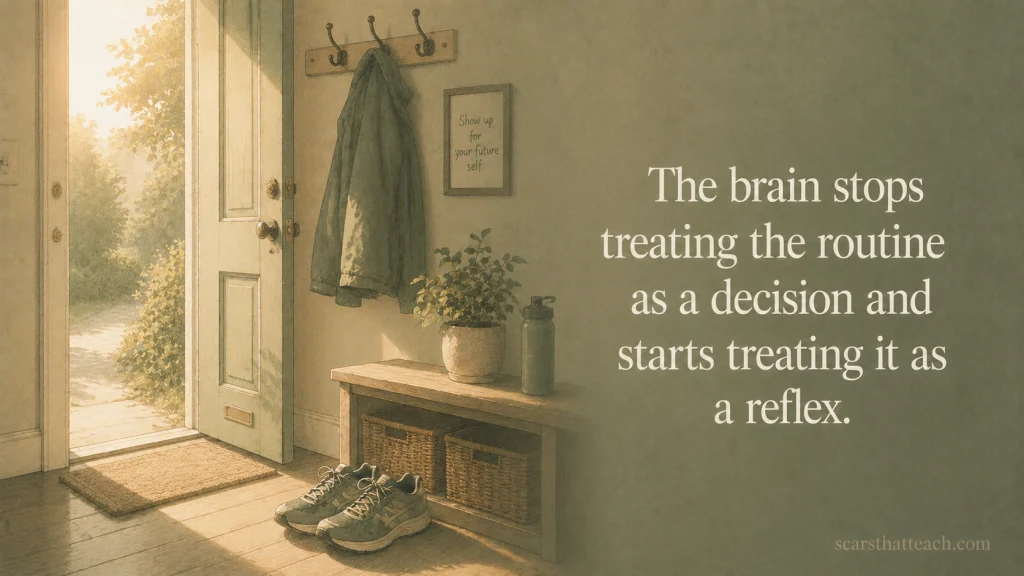
A habit, in the way researchers use the word, is a behavior triggered automatically by a cue and reinforced by a reward, repeated until the behavior requires no real deliberation at all. This is the cue-routine-reward loop described by journalist Charles Duhigg in his research on habit formation, and it holds up across the kinds of behaviors I watched people try to build or break over two decades. A cue arrives, something as small as a doorway, a time of day, a feeling. A routine follows, the behavior itself. A reward closes the loop, something that tells the brain this sequence was worth repeating. Over enough repetitions, the brain stops treating the routine as a decision and starts treating it as a reflex.
That point, where a behavior stops requiring deliberate choice, is what researchers call automaticity, and it is the actual marker of a habit having formed. Not commitment. Not motivation. Automaticity. This distinction matters more than it sounds like it should, because most people are waiting for a feeling, the feeling of having truly changed, when what they should be tracking is something closer to whether the behavior still requires a decision each time or whether it has started to happen on its own.
Why the Popular Timeline Is Wrong
Most people have heard that a habit takes twenty-one days to form. That number did not come from rigorous research on habit formation. It traces back, loosely, to observations about how long it took patients to psychologically adjust to changes in their appearance after surgery, and it has been repeated so often that it now sounds like settled science. It is not.
The actual research, a study led by Phillippa Lally and colleagues and published in the European Journal of Social Psychology in 2010, tracked participants building simple daily behaviors and found that automaticity took an average of 66 days to develop, with individual results ranging anywhere from 18 days to 254 days depending on the behavior and the person attempting it. That range is wide enough to matter. Someone forming the habit of drinking a glass of water after breakfast and someone forming the habit of a structured exercise routine are not on the same timeline, and treating both as a three-week project sets nearly everyone up to quit right around the point where the behavior was actually starting to take hold.
I watched this misunderstanding do real damage. People would commit to something, push through three weeks of discomfort, expect the discomfort to lift on schedule, and when it did not, conclude they had failed at something that should have worked by now. Most of them had not failed. They had simply been told the wrong number.
Habits Are an Environmental Design Problem, Not a Willpower Problem
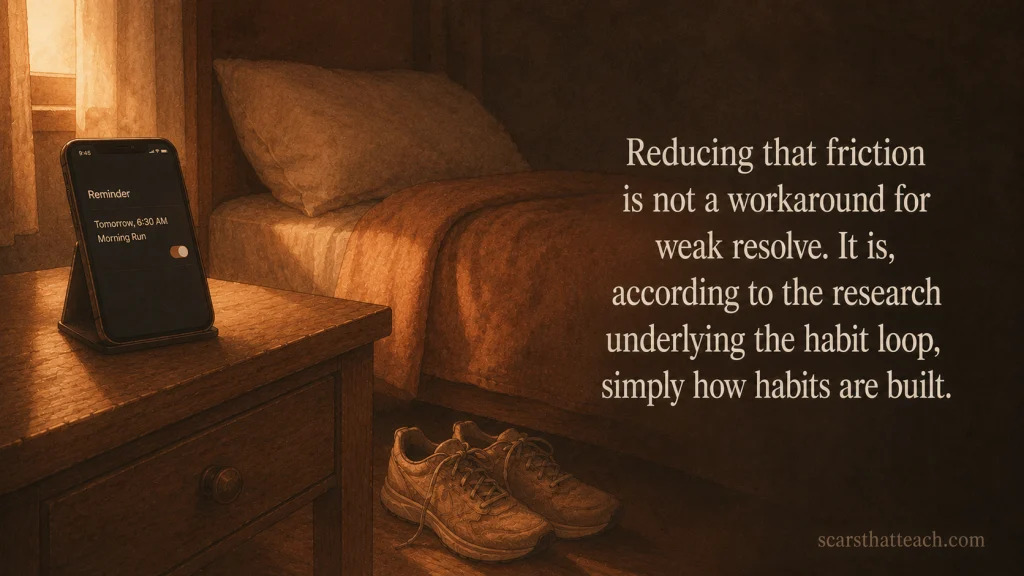
The single biggest shift I watched separate the people who sustained change from the people who did not was not how much willpower either group had. It was whether the environment around them made the new behavior easier or harder to repeat. The woman who started walking every morning succeeded, in large part, because she put her shoes by the door the night before, removing one decision from a moment of the day when her resolve was at its lowest. The man trying to call his daughter every week succeeded once he set a recurring reminder at a time he was reliably free, instead of relying on remembering, which had already failed him more times than he could count.
This is the part most popular advice on consistency leaves out entirely. It treats the person as the only variable in the equation, when the cue and the friction surrounding the behavior matter just as much, sometimes more. A cue that is inconsistent produces an inconsistent habit, no matter how much the person wants the outcome. A routine that requires too many small decisions before it can happen gives willpower more chances to fail. Reducing that friction is not a workaround for weak resolve. It is, according to the research underlying the habit loop, simply how habits are built.
- A reliable, specific cue, tied to something that already happens at the same time or place every day, rather than a vague intention to do something “more.”
- A routine small enough to perform even on a low-motivation day, since the behavior has to survive those days to reach automaticity at all.
- A reward that is felt close to the behavior itself, not a distant outcome that will not be visible for months.
None of this guarantees a habit will stick. It does mean the odds shift meaningfully once the environment is doing some of the work that willpower alone was never built to carry on its own.
Where Most People Actually Quit
I noticed a pattern across nearly every person I watched abandon a change they genuinely wanted. It rarely happened during the hardest week. It happened during an ordinary week, when life interrupted the routine once, and the person treated that single missed day as proof the whole effort had collapsed. The research backs up what I watched directly: missing a single opportunity to perform a behavior does not meaningfully damage the habit formation process. What damages it is the story a person tells themselves after the miss, the one where one missed day becomes evidence that the entire attempt was already failing.
This is the quiet, unglamorous truth underneath most of what gets called a lack of discipline. It is rarely the missed day itself. It is the conclusion drawn from it.

Final Thoughts: The Mechanics Matter More Than the Motivation
If you are in the middle of trying to build something that matters to you, the most useful thing I can offer is not encouragement. It is permission to stop measuring yourself against a three-week timeline that was never accurate in the first place, and to start paying closer attention to the cue, the friction, and the reward sitting underneath the behavior you are trying to repeat. You were never short on desire. Most people in that position never are. What was missing was a clear enough look at the scaffolding holding the desire up.
Each of the questions below covers a specific piece of this. Whichever one matches where you actually are right now is the one worth reading next, drawing on the discipline that honest reflection on what it actually takes to keep going tends to require more than motivation ever does.
Find the Question That Matches Where You Are
Some of these speak to why consistency feels so much harder than it should. Others get into the mechanics underneath a habit once it has already started forming, or what to do when an old habit will not let go, or a new one slips for a day. Read the lead-in for each and pick the one closest to your actual situation.
| Article | What It Covers |
|---|---|
| Why Is It So Hard to Be Consistent | The honest reasons consistency feels disproportionately difficult, beyond simple lack of willpower. |
| How Long Does It Take to Form a Habit | A closer look at the real research timeline and what it means for your specific behavior. |
| How the Habit Loop Works | A deeper walk through the cue-routine-reward cycle and how to identify your own loops. |
| What Are Keystone Habits | The small number of habits that tend to reshape several other areas of life at once. |
| Habit Stacking | How attaching a new behavior to an existing one lowers the friction of starting. |
| Identity-Based Habits | Why habits tied to who you see yourself as tend to outlast habits tied to a goal alone. |
| Why Are Bad Habits So Hard to Break | What makes an unwanted habit resistant to willpower, and what actually loosens its hold. |
| Missing a Day Won’t Ruin Your Habit | What the research actually says about a single missed day, and why the story afterward matters more. |
FAQs
🔁 What is the actual difference between a routine and a habit?
A routine still requires a decision each time you do it. A habit has crossed into automaticity, meaning it happens with little or no deliberate choice involved.
📅 How long does it really take to build a habit?
Research points to an average of 66 days, with a realistic range of 18 to 254 days depending on the behavior and the person. Three weeks is not a reliable benchmark.
🧠 Is building a habit mostly about willpower?
No. The environment around the behavior, the cue, the friction, and the reward, tends to matter more than raw willpower in determining whether a habit sticks.
⚠️ Does missing one day ruin a habit you’re building?
Not according to the research. A single missed day does not meaningfully disrupt habit formation. What tends to derail people is the story they tell themselves after the miss.
🔄 Why do some habits stick while others never do?
Habits that stick usually have a reliable cue, a low-friction routine, and a reward felt close to the behavior itself. Habits without those structural pieces tend to depend entirely on motivation, which fades.