Comparing yourself to others is not a character flaw. It is one of the oldest habits the human mind has, built into how people figure out where they stand when there is no clearer measuring stick. Most advice treats comparison as something to eliminate, but the more honest distinction is between the kind that quietly wears a person down and the kind that, used differently, can point them somewhere worth going. What follows traces where the habit comes from, what the common advice gets wrong about it, and how to tell which kind you are actually doing.

The Habit That Feels Personal But Isn’t
I spent over twenty years sitting with people in the last weeks and months of their lives, and what surprised me most was not regret over big mistakes. It was how many of them had spent decades comparing themselves to others, measuring a life against someone else’s, and never once getting to live fully inside their own story instead. The ones who seemed least at peace in those final weeks were rarely the ones whose lives had actually gone the worst. They were the ones who had spent the most years standing outside their own life, checking it against everyone else’s.
If you are comparing yourself to others right now, in some specific way you could probably name without much thought, you are not doing anything unusual or weak. You are running a piece of mental wiring every person carries, the same one that makes a child notice whose plate has more food and an adult notice whose career, marriage, or body looks further along. The question worth asking is not how to switch it off, because it rarely switches off cleanly, and most people who try just end up hiding the comparison instead of resolving it. The more useful question is which kind of comparison you are running, because that distinction changes everything about what to do with it next.
Why Do We Compare Ourselves to Others in the First Place
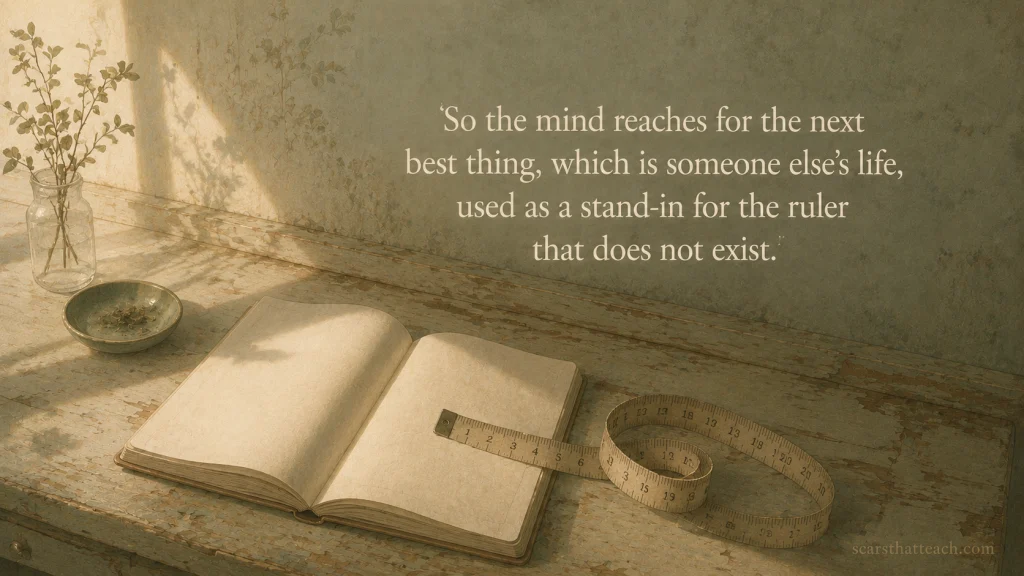
There is a name for this, if you want one. A psychologist named Leon Festinger described it back in 1954, and the core idea has held up well: people figure out where they stand, on ability and on opinion alike, by checking themselves against others, especially when there is no clearer measuring stick available. There is no objective ruler for whether your career is going well, whether your marriage is solid, or whether you are aging the way you are supposed to. So the mind reaches for the next best thing, which is someone else’s life, used as a stand-in for the ruler that does not exist.
What that means in practice is that comparison is not random. It shows up hardest in exactly the places where you have the least objective feedback. Nobody compares their height to a neighbor’s height, because a tape measure settles that question on its own. People compare income, parenting, relationships, and how put-together a life looks, because none of those things come with a number you can simply check. I watched this play out for years in families sitting at a bedside, where two siblings would describe the same childhood in completely different terms, each one quietly measuring how much they had been loved against how much the other one had.
The comparison itself usually runs in one of two directions. Upward comparison means measuring yourself against someone who seems to be doing better. Downward comparison means measuring yourself against someone who seems to be doing worse. Both happen constantly, often within the same hour, and neither one is inherently the healthy or unhealthy version. What determines whether a comparison helps or hurts has less to do with the direction and more to do with what you are using it for.
Why Comparison Isn’t the Villain Most Advice Makes It Out to Be
The advice you have probably already gotten amounts to four words: stop comparing yourself. It is not bad advice so much as incomplete advice, the kind that sounds clean in a sentence and falls apart the first time you try to live by it. Comparison can motivate. It can orient you toward what is actually possible instead of what you assumed was out of reach. It can calibrate your sense of where you stand so you are not operating on guesswork alone. None of that is the problem, and treating all comparison as equally harmful just adds a second layer of frustration on top of the first one.
The problem is a more specific pattern: comparison that is involuntary, aimed upward at someone whose life you only see in its most curated form, and used to evaluate yourself rather than to improve anything. That last part matters more than people realize. A comparison used for self-evaluation asks what this says about you, and almost always answers it badly. A comparison used for self-improvement asks what this tells you about a next step, and that question tends to be far more bearable, even when the comparison itself is unflattering.
A few signs tend to separate the kind of comparison that is quietly wearing you down from the kind that is actually pointing somewhere useful:
- It happens automatically, scrolling or glancing, not as something you chose to think about.
- The target is someone you do not know personally, presented in a version of their life with the hard parts edited out.
- It leaves you with a verdict about yourself rather than an idea about what to try next.
- It repeats the same comparison over and over without ever resolving into action.
- It is aimed at something you have no real path toward, rather than something a specific next step could move you closer to.
Social media did not invent this pattern, but it gave it a steroid. A person scrolling in bed at midnight is not comparing herself to her neighbor’s actual life. She is comparing herself to a single edited image of a stranger’s best afternoon, repeated hundreds of times a night, with no way to fact check any of it. I sat with people in their final months who told me, almost as an aside, that they wished they had spent less of their forties measuring their own ordinary days against other people’s highlight reels. Not one of them ever wished they had compared more.
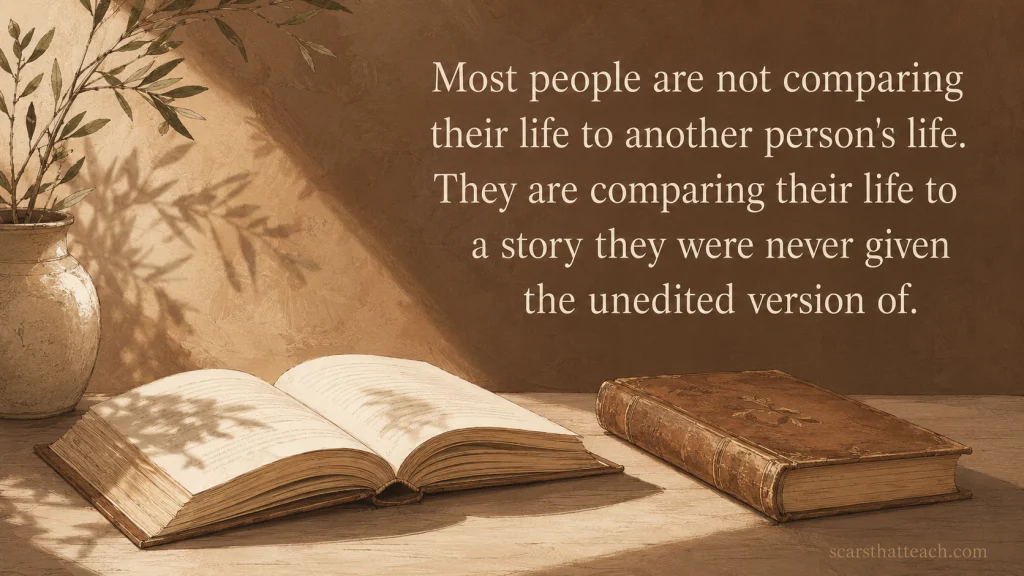
Most people are not comparing their life to another person’s life. They are comparing their life to a story they were never given the unedited version of.
That gap between the edited version and the real one is where most of the damage happens, and it is worth sitting with before moving on to the practical side of any of this.
Six Different Threads Hiding Inside One Habit
Comparing yourself to others is not one single experience, even though it can feel that way in the moment. There are at least six distinct threads worth pulling apart on their own, because the advice that helps one rarely helps another. Why the habit starts in the first place is its own question, separate from why it tends to leave people feeling worse than before they started. Why social media specifically intensifies it is different again from the practical question of what actually reduces it day to day. And underneath all of that sits a question almost nobody asks directly: when, if ever, does comparing yourself to someone else actually help, and what does it mean when jealousy over someone else’s success is trying to tell you something instead of just hurting.
Each of those deserves more room than a single section here can give it, and trying to untangle all six at once tends to just produce more comparison, this time about how well you are handling your comparison. What matters more right now is recognizing that you are probably carrying more than one of these threads at the same time, and that naming which one you are actually facing, specifically, is most of the difficult work already done. The rest, in most cases, gets easier once the thread is correctly identified instead of treated as one large, vague feeling.
What Actually Changes Once You See the Pattern
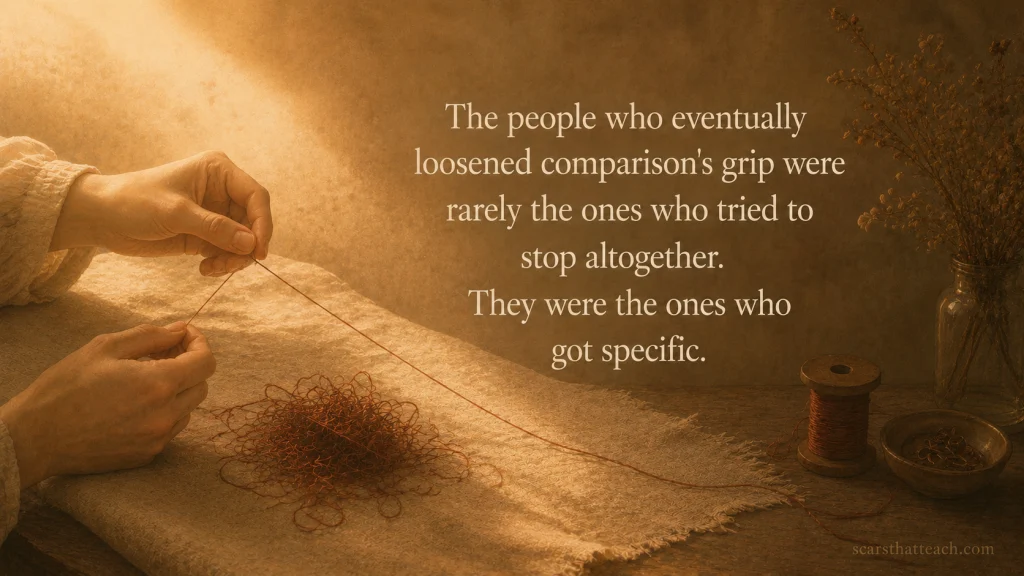
I never told anyone at a bedside that they should have lived differently. That was never my place, and it would not have been kind even if it were true. What I can say, having watched this pattern repeat across hundreds of rooms over two decades, is that the people who eventually loosened comparison’s grip were rarely the ones who tried to stop comparing yourself altogether. They were the ones who got specific: naming exactly who they were measuring themselves against, exactly what they were using the comparison to decide, and exactly whether it was pointing toward a next step or just delivering a verdict.
None of that requires becoming a different kind of person. It requires being honest with yourself about what a comparison is actually doing for you in a given moment, and letting that honesty decide whether to sit with the feeling, act on it, or let it pass without assigning it any verdict at all. If any of this points to a more basic question about how you see yourself underneath all the comparing, you will find more on what self-love actually requires, away from the noise of any specific comparison.
Where Each Thread Gets Its Own Closer Look
Each of the threads mentioned above gets its own closer look elsewhere on this site. None of them require reading the others first, so feel free to go straight to whichever one matches what you are actually carrying right now.
| Where to go next | What it covers |
|---|---|
| Why Do We Compare Ourselves to Others? | A closer look at where the habit starts and why it shows up even in people who otherwise feel settled in their own life. |
| Why Comparing Yourself to Others Makes You Miserable | The specific mechanism behind why this habit so often leaves people feeling worse instead of motivated. |
| Why Social Media Makes Comparison Worse | What changes about comparison once the person on the other end is a stranger’s curated version of a single afternoon. |
| How to Stop Comparing Yourself to Others | Practical ways to loosen the habit without pretending it will disappear completely. |
| When Comparing Yourself to Others Can Actually Help | The narrow set of conditions where this same habit points toward something useful instead of just a verdict. |
| Why Am I Jealous of Other People’s Success? | What jealousy over someone else’s success is usually trying to tell you, once it is separated from shame about feeling it. |
FAQs
🤔 Why do I keep comparing myself to others?
Because your mind is looking for a way to measure where you stand, and in most of the areas that matter most to you there is no objective ruler available. Other people become the stand-in measuring stick. It is automatic, not a personal failing.
📱 Does social media make comparing yourself to others worse?
Yes, because it puts you in front of curated highlights from strangers, on a loop, with no way to check what was left out. The comparison feels constant because the supply of edited moments never runs out.
😔 Why does comparing myself to others make me feel worse instead of motivated?
It usually depends on what the comparison is being used for. If it is answering “what does this say about me,” it tends to land as a verdict. If it is answering “what does this tell me about a next step,” it tends to land as motivation instead.
🧭 How do I stop comparing myself to others?
Trying to eliminate the habit completely rarely works. What helps more is getting specific about who you are comparing yourself to and why, in the moment it is happening, rather than treating it as one large feeling to switch off.
✅ Is comparing yourself to others ever actually helpful?
It can be, when it is voluntary, aimed at someone whose situation you can realistically learn from, and used to find a next step rather than to judge yourself. The direction of the comparison matters less than what you do with it.
😬 Why am I jealous when someone else succeeds?
Jealousy often points at something you actually want but have not named clearly yet. It is worth treating as information about your own direction rather than as a feeling to be ashamed of.