
The illusion of control is the well-documented tendency to believe we have more influence over outcomes than we actually do. It is not a personal failing. It is a pattern that shows up reliably across populations and across a lifetime of decisions that felt more within our hands than they were. The confusing part is not the tendency itself but the two oversimplified conclusions that tend to follow from noticing it: that you control everything, or that you control nothing. Neither is accurate. What a clearer view offers is more specific and more actionable than either of those.

The Gap Is Almost Always Larger Than Expected
One of the more consistent things I observed over twenty years in hospice work was the distance between what people believed they had controlled and what, in retrospect, they actually had. The illusion of control was not something I diagnosed. It was something I watched dissolve, often quietly, in people who finally had the space to be honest about their own histories. The gap between what they thought they had governed and what had actually been in their hands was almost always larger than they expected. And once they could see it clearly, the recognition came, more often than not, as a relief.
Psychology has a name for this tendency. The illusion of control refers to the consistent human inclination to overestimate the degree to which our actions determine outcomes. The effect was documented carefully in the 1970s, when researchers observed that people behaved as if skill were involved in situations that were actually governed by chance. They were more confident about lottery tickets they had selected themselves than ones randomly assigned to them. They pressed elevator buttons with more force when they believed the press would register. The belief in personal control, it turned out, did not require much actual control to sustain itself.
This is not a finding designed to produce despair. The tendency is partly adaptive. Believing that your actions matter supports effort, and effort does generally produce better outcomes than passivity. The problem is not the belief in agency itself. The problem is the gap between the belief and the reality, and what lives in that gap: misplaced blame, compounded frustration, and the quiet assumption that if an outcome is bad, someone, usually yourself, must have done something wrong. The question worth sitting with is why that gap is so reliably large, and why it leans in the same direction for almost everyone.

Why We Overestimate Control in the First Place
The tendency is not random. It is built into how the mind manages uncertainty. Perceived control reduces anxiety. It motivates persistence. It keeps people engaged with their circumstances when disengagement would be easier. In that sense, the illusion earns its place. A person who believes their effort influences outcomes is more likely to keep trying, and trying, even against uncertain odds, does shift probabilities. The difficulty comes when the belief hardens into something more absolute than the evidence supports.
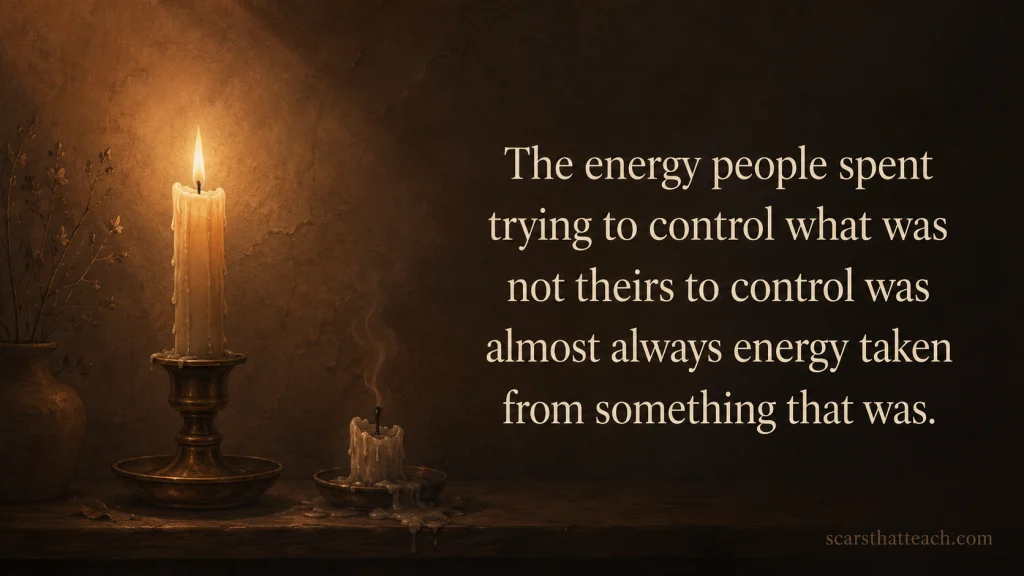
What I observed, across many conversations with people who had spent years overextended by circumstances they could not change, is that the exhaustion was rarely just situational. It was the exhaustion of someone who had been treating an uncontrollable outcome as if it were a solvable problem. A parent who had spent years trying to fix an adult child’s addiction. A spouse who had believed, for a decade, that the right combination of patience and effort would change someone who had no interest in changing. An adult child who carried private blame for a parent’s decision to estrange. In every case, the effort was real. What was missing was an accurate read on what that effort could actually produce. This pattern connects to some of the lessons that tend to surface only in retrospect, long after the chance to apply them differently has passed.
The psychology here is not complicated once you see it clearly. The question is not whether your actions have consequences. They do. The question is whether your assessment of which outcomes are actually within your influence is accurate. And for most people, in most situations, that assessment skews consistently toward overestimation.
What You Can Control, What You Can’t, and What Falls Between
Most of what exists on the subject of control lands in one of two places, and both of them miss. The first is the one that has dominated most self-help content for decades: the idea that you create your reality, that outcomes reflect your beliefs, and that failure is essentially a symptom of insufficient intention. This framing is not just inaccurate. It is actively harmful for the person who internalizes it, because it converts every bad outcome into evidence of personal inadequacy. When circumstances do not respond to effort, the only conclusion available is that the effort was insufficient, the belief was not strong enough, the mindset was flawed.
The second wrong answer runs the other direction: nothing matters, effort is pointless, outcomes are determined entirely by forces outside your reach. This position is more honest than the first in some respects, but it does not produce anything useful either. Most people cannot live inside that position for long, and the ones who try do not typically do well.
The more accurate position sits between those two, and it is more specific than either of them. Neither endpoint is accurate. There are things that fall within your actual control and things that do not, and the two categories are not equally weighted. Understanding the difference is not a philosophical exercise. It is a practical one.
- Within your control: your own actions, where you direct your attention, how you respond to what happens, and the effort you bring to any situation.
- Largely outside your control: how other people respond to you, whether your effort produces the outcome you intended, timing, external circumstances, and the behavior of anyone other than yourself.
- In between: outcomes that are influenced by your actions but not determined by them. Whether you get the position depends partly on your preparation and partly on who else applied. Whether a relationship holds depends partly on what you bring to it and partly on what the other person chooses to bring.
That third category is where most people spend the most energy. Because influence is real, it can feel like control. But influence and control are not the same thing. Feeling that something is in your hands and it actually being in your hands are not the same thing, and conflating them is where the trouble tends to begin.
“Most people spend the majority of their energy in the third column. Not because they have not thought about this. Because influence and control feel identical from the inside.”
What Recalibrating Actually Changes
The shift is not from effort to passivity. That is the most common misreading of this idea, and it is worth naming directly. Recognizing that we have less control than we think does not mean withdrawing effort. It means directing effort more honestly. A person who has spent two years trying to change a family member’s behavior by confronting, reasoning, pleading, and waiting is not failing because their effort is insufficient. They are more likely failing because the outcome they are pursuing is not within their power to produce. Redirecting that energy toward their own choices, their own responses, their own decision about whether to remain in the relationship, is not resignation. It is calibration.
There are frameworks in clinical psychology, including approaches built around acceptance and commitment, that draw a clear line between what a person can influence and what they cannot, and ask people to direct their energy accordingly. The distinction is not between caring and not caring. A person can care deeply about an outcome and still accept that they do not control it. Those two things are compatible. What changes is where the effort goes, and how the person relates to results when things do not land as planned.
A man I sat with once had spent close to twenty years angry at his brother over a falling-out they had never repaired. When I asked, gently, what he had actually controlled in that situation, he took a long time to answer. He had controlled whether to reach out. He had reached out. His brother had not responded. He had spent two decades measuring his own worth against his brother’s silence, when the silence was, at most, a reflection of his brother’s willingness to engage. That distinction, between what was his and what was not, had taken twenty years to become visible. Once it did, it did not take long to change something.
For people who are still in the middle of their lives rather than at the end of them, the question is more immediate: which part of this situation is actually mine to influence? Not theoretically mine. Not mine if everything goes right. Actually mine, regardless of how the other pieces resolve. That is a smaller category than most people assume, and working within it honestly tends to produce something. Working against the parts that are not yours rarely does.
If you find yourself trying to draw this line in your own circumstances, the piece on how to stop worrying about things you cannot control goes further into the practical side of that distinction.
For those whose need for control runs deep enough to feel more like a compulsion than a situational response, the piece on why the need for control runs so deep examines what tends to be underneath it.
Final Thoughts: The Relief in Getting the Accounting Right
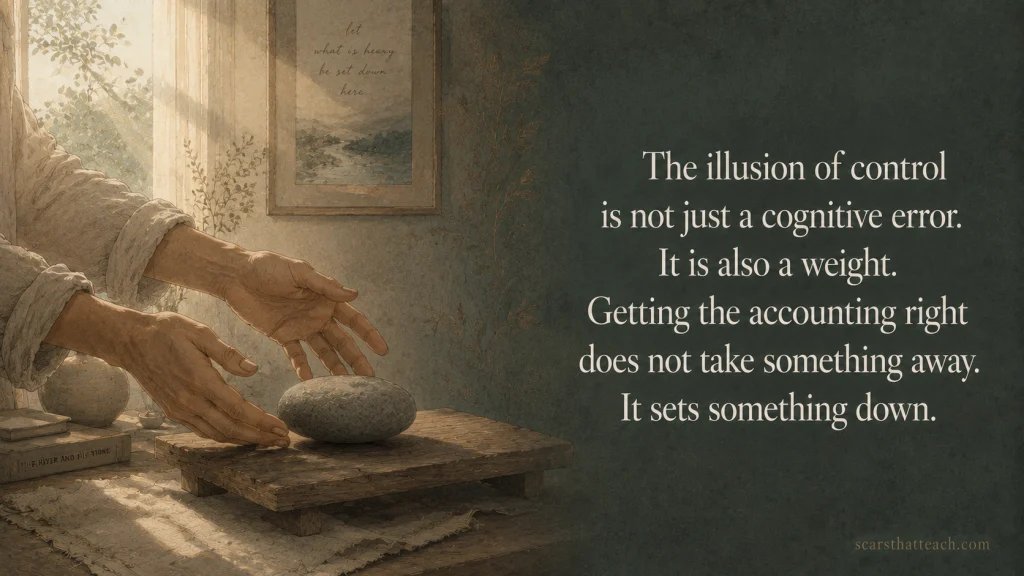
The word I kept coming back to earlier was relief. That is not the word most people expect when the subject is discovering they have less control than they thought. Disappointment, maybe. Deflation. But relief is the more accurate description of what I watched in people who genuinely arrived at this understanding, and I think the reason is straightforward enough. The illusion of control is not just a cognitive error. It is also a weight. Carrying it means accepting responsibility for outcomes that were never fully yours to produce, which means that every time those outcomes went wrong, so did you. Getting the accounting right does not take something away. It sets something down.
The broader question of what it actually takes to let go of control, including what that requires and what tends to get in the way, is one worth sitting with more fully. What I can say is that the timing of this recognition varies from person to person. It tends to be more useful when it is sought before the circumstances narrow the options, not because it is wasted when it comes late, but because there is more room to work with it early.
FAQs
💭 What is the illusion of control?
It is the well-documented tendency to believe your actions have more influence over outcomes than they actually do. The effect shows up across populations and circumstances, including situations that are governed largely by chance. Recognizing it is not the same as believing nothing matters. It is closer to getting the accounting right about what is and is not actually yours to determine.
🔄 Why do people overestimate how much control they have?
Partly because the tendency is adaptive. Believing your effort matters supports persistence, and persistence generally does improve outcomes. The problem is when that belief hardens into something more absolute, converting every bad outcome into evidence of personal failure rather than evidence that some things were never in your hands to begin with.
⚖️ What things are actually within my control?
Your own actions, your attention, your responses to what happens, and the effort you bring to a situation. What falls outside it: how other people behave, whether your effort produces the outcome you intended, timing, and most external circumstances. The category of things genuinely in your control is real. It is also smaller than most people assume, and that distinction matters.
😔 Does the illusion of control actually hurt people?
It can, yes. When someone treats an uncontrollable outcome as a solvable problem, they spend energy that cannot produce the result they are aiming for. That energy comes from somewhere. Over time, it tends to come from the things that are actually within their reach, which is where the real cost accumulates quietly.
🕊️ Does accepting less control mean I should stop trying?
No. The shift is not from effort to passivity. It is from effort directed at uncontrollable outcomes toward effort directed at what is actually yours to influence. You can care deeply about something you do not control. The question is whether your energy is going toward the part of the situation that can actually move, or the part that cannot.
🧩 How do I figure out what I can and cannot control in my own situation?
A useful starting question: which part of this outcome would resolve the same way regardless of what I do? If the answer covers most of it, the outcome is not really yours to control. The cleaner question is which part depends on your own choices and actions, as opposed to someone else’s choices and actions. Start there, and be honest about where that line actually falls.